
Walk into a massive warehouse without any labels on the shelves. Now, find a medium, blue, cotton t-shirt. Good luck.
That chaotic, time-consuming nightmare is exactly what running an e-commerce store feels like without a proper SKU system. A stock keeping unit, or SKU, is a unique code you create to track your inventory internally. It's the product's backstage pass, its internal nickname that tells you and your systems everything you need to know.
Think of it as your business's secret language. While your customer sees a product page for a "Medium Blue Cotton T-Shirt," your warehouse team, your point-of-sale system, and your analytics software all see something like "TS-COT-BLU-M".
That isn't just a random jumble of letters. It's a neatly organized piece of data that instantly tells a story about that specific product. Every dash and every letter has a purpose, translating a fuzzy, customer-facing description into a concrete, scannable identifier for your operations.
The best way I've found to explain the power of an SKU is to compare it to a library's call number. Every single book has a unique code printed on its spine, and that code is a map.
Just like a librarian can use that system to find any book in seconds, your team can use SKUs to pinpoint the exact product variant they need in your warehouse. That simple code becomes the central nervous system for your entire inventory operation.
A well-structured SKU is more than just an identifier; it’s the fundamental unit of intelligence for your entire inventory system. It turns a simple product list into a powerful tool for analysis, forecasting, and operational excellence.
This level of organization is what stops costly shipping errors in their tracks. It guarantees your inventory counts are razor-sharp. Ultimately, it creates a smoother, more reliable experience for your customers.
When an order for "TS-COT-BLU-M" comes through, there's zero ambiguity. Your team knows precisely which item to pick, pack, and ship. Guesswork is eliminated, and fulfillment gets faster. Every scan and every sale updates your records with precision, giving you a real-time view of stock levels and sales velocity for that specific variant. Getting this foundational piece right is what unlocks more advanced inventory strategies down the road.
Navigating the world of product identifiers can feel like swimming in alphabet soup. You’ve got SKUs, UPCs, ASINs, and a handful of others, but they are absolutely not interchangeable. To really get the most out of your inventory system, you first need to understand the unique role a stock keeping unit number plays in your business.
Think of it this way: your SKU is an internal nickname you create for a product. It’s a code built by you, for you. It’s designed specifically for your team, your warehouse, and your analytics, forming a private language for your operations.
A Universal Product Code (UPC), on the other hand, is like a product's official passport. It's a globally recognized, standardized 12-digit number assigned by a single organization, GS1. The barcode you see on almost every retail product is a UPC. It’s external and universal, meaning the exact same blue t-shirt from a specific brand will have the same UPC no matter who sells it.
This diagram shows the simple, internal journey a product takes using its stock keeping unit number.
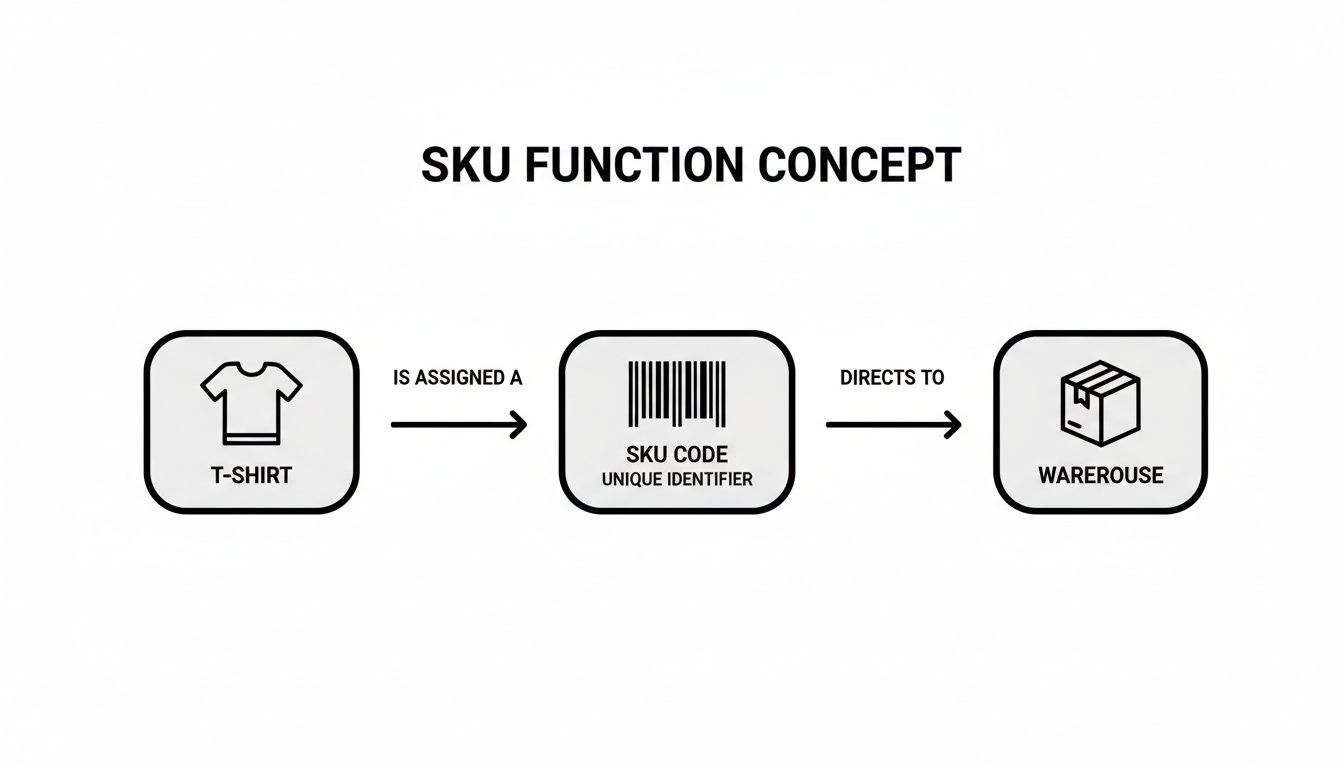
As you can see, the SKU acts as a direct map from the physical product to its exact location and identity within your own inventory system. It's your internal GPS.
The list of codes doesn't stop with UPCs, especially if you sell on major marketplaces. If you're an Amazon seller, you’re definitely familiar with the Amazon Standard Identification Number (ASIN).
The critical takeaway here is control. You create, manage, and own your SKU architecture. This gives you the incredible flexibility to build a system that reflects your business logic, provides granular sales data, and grows with your brand. Simply relying on a manufacturer's UPC robs you of this powerful internal tool.
To make things even clearer, here’s a quick reference guide to keep these identifiers straight.
This table breaks down the key differences between the most common product codes you'll encounter as an ecommerce business owner.
| Identifier | What It Is | Who Assigns It | Primary Use | Example Use Case |
|---|---|---|---|---|
| SKU | An internal, alphanumeric code unique to your business for each product variant. | You (the seller) | Internal inventory tracking, sales analysis, and warehouse management. | A Shopify store owner creates SKU TS-BLU-M for a medium blue t-shirt. |
| UPC | A universal 12-digit numeric code and scannable barcode used across retailers. | GS1 (a global standards organization) | External supply chain tracking and point-of-sale scanning in retail stores. | A grocery store scans the UPC on a can of soup to ring it up at the checkout. |
| ASIN | A 10-character code unique to the Amazon marketplace for a product listing. | Amazon | Cataloging and identifying products specifically on Amazon's platform. | A customer uses the ASIN to find the exact product page for a specific brand of headphones on Amazon. |
By mastering these distinctions, you can ensure each code is used for its intended purpose. This prevents confusion in your operations and allows your stock keeping unit number system to do what it does best: provide deep, actionable insights into your own business.
Alright, let's move from theory to practice. Honestly, designing a logical stock keeping unit number system is one of the most powerful moves you can make for your business. A good SKU architecture isn't just a random code; it's a blueprint for your entire inventory, built to be instantly understandable and ready to grow with you.
The goal here is simple: create a format that lets anyone on your team—from the warehouse to marketing—understand a product’s key details at a single glance.
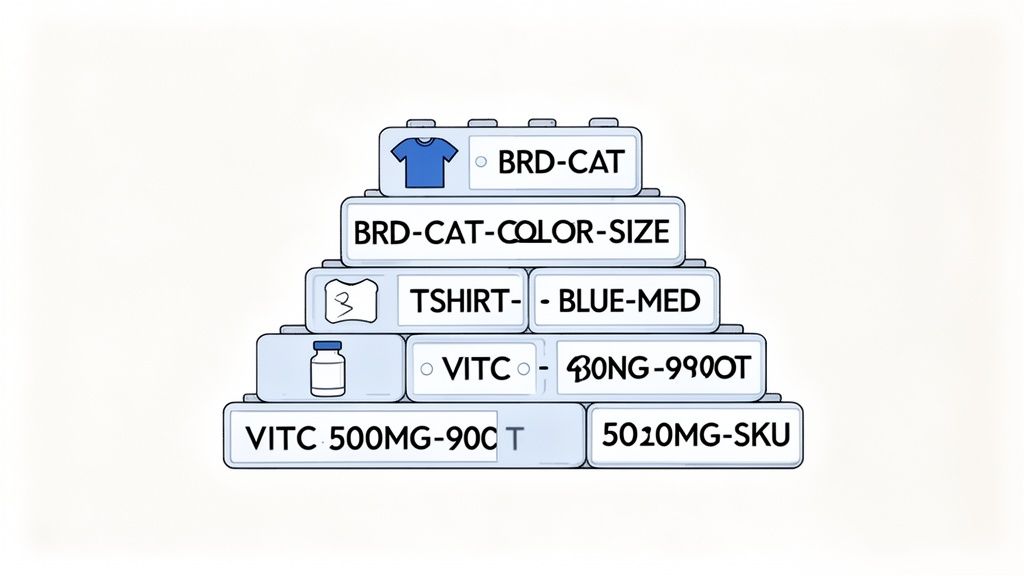
This whole process kicks off with identifying the most important attributes of your products. These are the building blocks of your SKU. Think about what truly separates one item from another on your shelves.
Before you can string together a single SKU, you need to decide on its ingredients. The trick is to order these attributes from the broadest category down to the most specific detail. This creates a natural hierarchy that makes sorting, filtering, and analyzing your sales data incredibly easy later on.
For most e-commerce stores, the winning formula includes some combination of these:
With the number of e-commerce sites projected to hit over 28 million globally by 2025, having a system that can scale is non-negotiable. Poor inventory visibility is a killer, expected to cost the logistics industry $7 billion in lost revenue by 2025 from stockouts alone. That’s a massive number that highlights just how crucial precision is.
Once you've locked in your attributes, you can start assembling them into a consistent format. My advice? Use hyphens. They're clean, easy to read, and break up the code nicely.
Let's walk through a couple of real-world examples:
TS-CRW-BLU-MEDVITC-500MG-90CTThe beauty of this is its pure, simple clarity. Anyone in your company can look at TS-CRW-BLU-MED and know exactly what it is without needing a cheat sheet or a lookup table.
The best SKU systems are self-explanatory. If a new warehouse team member can understand the product from the SKU alone, you've succeeded in creating a powerful and efficient internal language.
To keep things this clear, consistency is everything. Document your chosen abbreviations and structure in a central guide that everyone can access. If you're managing this data in spreadsheets, for instance, you'll want to check out our guide on how to format a sample Excel file for inventory management. This small step ensures that as your team and product catalog expand, your data stays clean, accurate, and totally error-free.
A smart SKU system does more than just tell you where your products are. It unlocks a goldmine of data that can steer your entire business strategy. When you build your stock keeping unit number architecture with purpose, you stop just labeling items and start speaking the language of your business’s performance.
Think about it. Imagine being able to instantly filter your sales reports not just by a product's name, but by granular details like 'blue' items or 'large' sizes. That’s the kind of power a logical SKU gives you. With just a few clicks, you can see precisely what’s flying off the shelves and what’s collecting dust.
This detailed data is pure fuel for accurate demand forecasting. It helps you stop wasting money on overstocking slow-moving variants while making sure you never run out of your bestsellers. In the cutthroat world of ecommerce, mastering your SKUs can be the difference-maker, especially when you're aiming for goals like winning the Amazon Buy Box by getting your pricing, fulfillment, and seller metrics just right.
Let's say a Shopify store owner sells sweaters. Their SKU structure might look something like this: SWTR-GRN-SML.
As they analyze their sales data, a surprising trend pops up: the SML (small) variants of all their GRN (green) sweaters are selling out twice as fast as any other color.
This isn't just a random sales spike—it's a powerful business insight served up directly by your SKU data. It flags a specific market demand that broad, product-level reports would have completely missed.
Armed with this knowledge, the owner can make much smarter purchasing decisions. They can confidently order more small green sweaters and maybe even introduce a few new styles in that popular color. This data-driven approach replaces guesswork with certainty, leading directly to higher profits and less waste from unsold inventory. This is how inventory management transforms from a reactive chore into a proactive growth strategy.
This kind of operational precision isn't just a nice-to-have anymore; it's becoming essential. The global warehouse market is projected to hit a staggering $869.32 billion by 2025, making the humble stock keeping unit the linchpin of supply chain efficiency. In response, 30% of companies are actively trimming down their SKU counts to better handle market volatility, a strategy backed by the supply chain analytics market’s own growth to $10.9 billion. You can dive deeper into this in an in-depth analysis of warehouse trends. These numbers all point to a clear industry shift: businesses are moving toward leaner, smarter inventory systems powered by SKU-level data.
Even the most organized inventory system can get thrown into chaos by a few simple mistakes in how you create your stock keeping unit numbers. These little slip-ups might seem minor at first, but they can quickly snowball into massive data headaches, leading to wrong stock counts, shipping delays, and sales reports you just can't trust. The good news? Most of these pitfalls are surprisingly easy to sidestep once you know what to watch out for.
One of the biggest temptations, especially when you're just starting out, is to use the manufacturer's barcode or UPC as your own internal SKU. Don't do it. This move essentially hands over control of your inventory's language to an outside company. Manufacturer codes can change without warning, they aren't designed for your specific business logic, and they offer zero insight into your own operations.
The whole point of a strong SKU system is internal control. When you create your own unique codes, you're building an inventory language that works for your business, not someone else's.
To build an inventory system that doesn't break, you have to be careful about the characters and formats you use. A few simple rules can save you from countless hours of spreadsheet nightmares down the road.
0123-ABC, your software might just "helpfully" change it to 123-ABC, instantly breaking the link to your product. Always start your SKUs with a letter to be safe.Finally, a common oversight is failing to plan for the future. Once a product is discontinued, its SKU should be retired for good. Reusing an old stock keeping unit number for a new product might seem efficient, but it will corrupt all your historical sales data. Suddenly, trying to do a year-over-year analysis becomes impossible.
For brands looking to clean up their product catalog, taking a structured approach to phasing out old or poor-performing products is essential. You can dive deeper into this process by exploring what is SKU rationalization, which helps keep your inventory lean and profitable. Getting these common mistakes sorted out is a big deal, and for larger catalogs, it's a key part of optimizing thousands of SKUs for product page SEO.
Once you’ve nailed the fundamentals of your stock keeping unit numbers, the next frontier is bringing in the machines. This is where your well-structured SKUs become the high-octane fuel for powerful AI-driven inventory management platforms. These intelligent systems don’t just track what you have; they move into proactive, predictive analytics.
Think of it this way: your SKU is the unique address for every single product variation. An AI platform uses that address to watch every move that item makes.
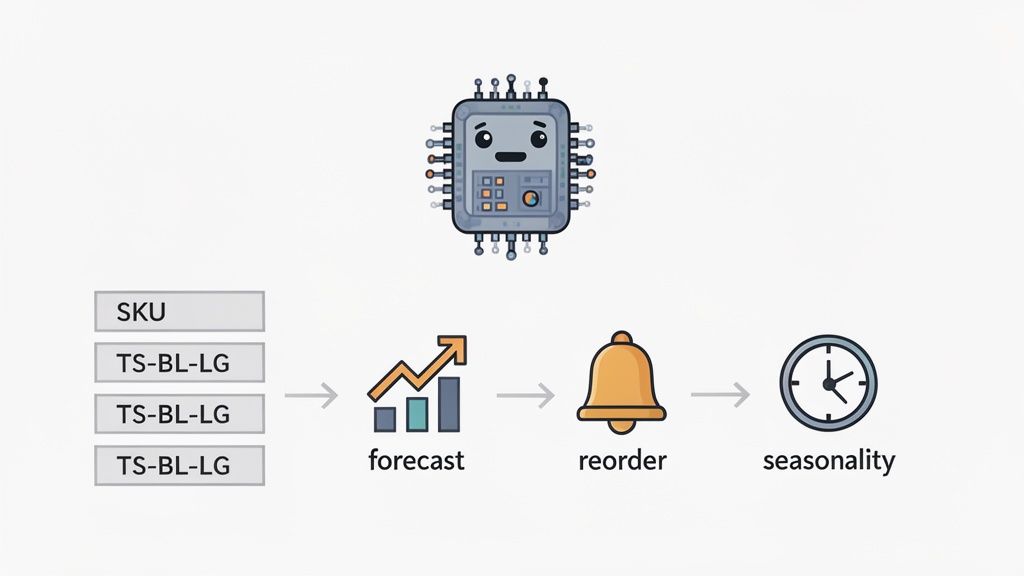
AI tools dig into historical sales velocity, seasonality, and market trends at the individual SKU level. This incredibly granular view allows them to generate scarily accurate demand forecasts and intelligent reordering alerts. Instead of drowning in spreadsheets, you get data-driven recommendations that prevent stockouts before they happen and slash unnecessary carrying costs.
This shift isn't just about saving a few hours a week. It's about unlocking a whole new level of operational intelligence. When you can make proactive decisions based on predictive insights, you start optimizing your entire product assortment and seriously boosting profitability.
The ultimate goal of AI-powered inventory management is to ensure the right product is in the right place at the right time, minimizing waste and maximizing sales opportunities before they even appear on your radar.
This predictive approach is becoming essential as businesses grapple with supply chain chaos. A striking statistic reveals that 30% of companies are planning to reduce the number of SKUs they carry. This kind of data-driven pruning is incredibly effective; studies show businesses with optimized SKU counts see up to a 30% reduction in labor costs by leaning into better automation. You can explore more of these supply chain statistics and trends to see the bigger picture.
By using your stock keeping unit number to feed these advanced systems, you transform a simple identifier into a strategic asset. You can confidently navigate market shifts, eliminate the guesswork, and build a much more resilient ecommerce business. For a deeper look into modern strategies, check out our insights on AI-powered inventory management.
Even with the best plan in place, a few questions always come up when you’re rolling out a new SKU system. Let’s tackle some of the most common ones so you can build an inventory architecture that really works for your business.
Technically, yes. But should you? It's a huge no from me. Think of your SKUs as the permanent addresses for your products in your entire data universe—changing them creates a ripple effect of chaos.
When you alter an existing SKU, you instantly corrupt your historical sales data. That link between your old sales reports and the product itself is severed, making it nearly impossible to track performance over time.
If you absolutely must make a change, the best practice is to treat the product as a brand-new item. Assign it a new SKU and retire the old one for good. This keeps your historical analytics clean and prevents a world of confusion down the road.
There's no single magic number, but the sweet spot for a stock keeping unit number usually falls somewhere between eight and twelve characters. This length is the perfect balance between being descriptive enough to be useful and short enough to be practical.
The goal is a code that’s long enough to be unique but short enough for your team to scan and type without errors. Get too long, and you invite typos that slow down your entire fulfillment process.
Nope. When you add a new product in Shopify, the SKU field is there, but it’s optional. For any serious ecommerce brand, leaving it blank is a massive missed opportunity.
Sure, platforms like Amazon might assign their own identifier if you don't provide one, but you lose all the internal benefits of a system you designed. Taking the time to create your own logical SKUs is a foundational step for gaining deep inventory insights and scaling your operations. Your own system provides business intelligence that a randomly assigned code never will.
Ready to turn your SKU data into predictable growth? Tociny.ai is an AI-powered analytics platform that gives Shopify merchants clear, actionable insights to optimize inventory and make smarter decisions. Join our private beta today.
Tociny is in private beta — we’re onboarding a few select stores right now.
Book a short call to get early access and exclusive insights.