
Think of SKU rationalization as the art of tidying up your product catalog. It’s a data-first approach to figuring out which products to keep, which ones need a new strategy, and which ones it’s time to say goodbye to. The core question is simple: "Is every single product I sell actually earning its keep?"
Imagine your product lineup is a garden. Some plants are blooming, giving you plenty of fruit (your best-selling items). Others, though? They're just sitting there, taking up precious soil, water, and sunlight—your capital, warehouse space, and team's attention. SKU rationalization is the expert gardening your business needs. It’s about methodically pruning the underperformers so the healthy, profitable plants have more room to grow.

This isn't about making cuts based on a gut feeling. It’s a disciplined analysis that can turn a messy, inefficient catalog into a lean, mean, profit-making machine. For D2C and Shopify merchants, this is a direct solution to a huge headache known as SKU proliferation—that all-too-common scenario where an ever-growing product list starts creating more chaos than cash.
Holding onto underperforming products isn't just a missed opportunity; it's an active drain on your business. These slow-moving items are quietly racking up costs that eat away at your bottom line. Every single product in your catalog is using up resources for:
SKU rationalization isn’t just about deleting products. It's about intentional curation. The goal is to make sure every item in your portfolio has a clear purpose and is actively contributing to your business goals.
Let's quickly break down the essentials.
| Concept | Primary Goal | Key Benefit for Merchants |
|---|---|---|
| Strategic Curation | Analyze the product catalog to keep, optimize, or discontinue items. | Creates a focused, high-performing product assortment. |
| Profit Maximization | Eliminate products that drain resources without generating sufficient returns. | Increases overall profitability by cutting hidden costs. |
| Operational Efficiency | Reduce the complexity of managing too many slow-moving SKUs. | Frees up warehouse space, capital, and team focus for growth. |
This proactive approach has become a must-do for smart inventory management. Research shows that brands with bloated product catalogs often see storage and carrying costs chew up 20-30% of their total inventory value every year. On the flip side, brands that get SKU rationalization right often report inventory cost reductions of 15-25% within the first year.
By making deliberate, data-backed choices about what you sell, you transform your product catalog from a potential liability into one of your most powerful strategic assets. If you want to dig deeper, Shopify has some great insights on how merchants are cutting costs with inventory optimization.
Let's be honest, an overgrown product catalog is more than just a messy backend—it's a silent killer of profits. It creates slow, compounding drains on your business that are easy to ignore until they become a massive problem. SKU rationalization is about more than just a quick cleanup; it’s about making smart cuts that lead to real financial, operational, and strategic wins.
The first and most obvious win is a healthier bottom line. Every single product sitting in your warehouse has inventory carrying costs tied to it. We're talking storage fees, insurance, labor, and the ever-present risk of obsolescence. When you finally ditch those underperforming SKUs, these costs don't just shrink—they vanish. That’s cash freed up to pour back into things that actually make you money, like marketing your bestsellers or developing your next big hit.
Beyond the balance sheet, a leaner catalog makes your entire operation run smoother. Fewer SKUs mean less complexity for your warehouse team, and that translates directly into faster, more accurate order fulfillment.
When your team isn't trying to navigate a labyrinth of products that barely sell, they can pick, pack, and ship customer orders much more efficiently. This simpler process naturally leads to fewer picking errors, which means fewer costly returns and fewer headaches for your customer service team. Think of it like decluttering a messy workshop—when you clear out the junk, you can find the right tool instantly and get the job done right the first time.
A focused product catalog isn't just about cutting what's losing money; it's about amplifying what works. It lets you pour your marketing budget, team energy, and best ideas into the products your customers truly love and that drive your profitability.
This newfound operational clarity has a massive impact on your inventory turnover. In fact, businesses that get serious about rationalization often see their inventory turnover improve by 20-35% within 18 months. Even better, a smart strategy can slash dead stock by a staggering 40-60%, unlocking all that capital that was just sitting there collecting dust. You can learn more about how SKU rationalization boosts key inventory metrics on Cin7.com.
The strategic benefits are where SKU rationalization really shines. A leaner, meaner product assortment brings incredible focus to your business and strengthens your brand identity in the market.
Here’s how a focused catalog gives you a serious competitive advantage:
For any Shopify merchant, making SKU rationalization a regular practice is a no-brainer. It turns your catalog from a source of hidden costs and complexity into a powerful engine for profit and sustainable growth. Before you start cutting, it helps to know where you stand. Check out our guide on the inventory turnover ratio calculator to get a baseline.
Knowing the what and why is a great start, but the real magic happens when you put SKU rationalization into practice. The best way to tackle it is with a clear, phased approach. Think of this as your project plan for turning a cluttered, costly catalog into a lean, profitable machine.
Trying to do this without a structured plan is a recipe for getting lost in spreadsheets or making gut decisions that miss the mark. This framework will walk you through the entire process, from digging into the data all the way to communicating the changes with your customers.
Before a single decision is made, you need the right information on the table. The goal here is to build a complete picture of how every single product is really performing. One of the biggest mistakes brands make is looking only at sales volume. True insight comes from layering multiple data points together.
Start by pulling data from your Shopify dashboard and any other tools you use (like your inventory or accounting software). You’ll want to get this information down to the individual SKU level for the most accurate analysis.
Here are the key metrics you absolutely need to collect:
This infographic shows how cleaning up your catalog has a direct, positive impact on your costs, operations, and overall business focus.
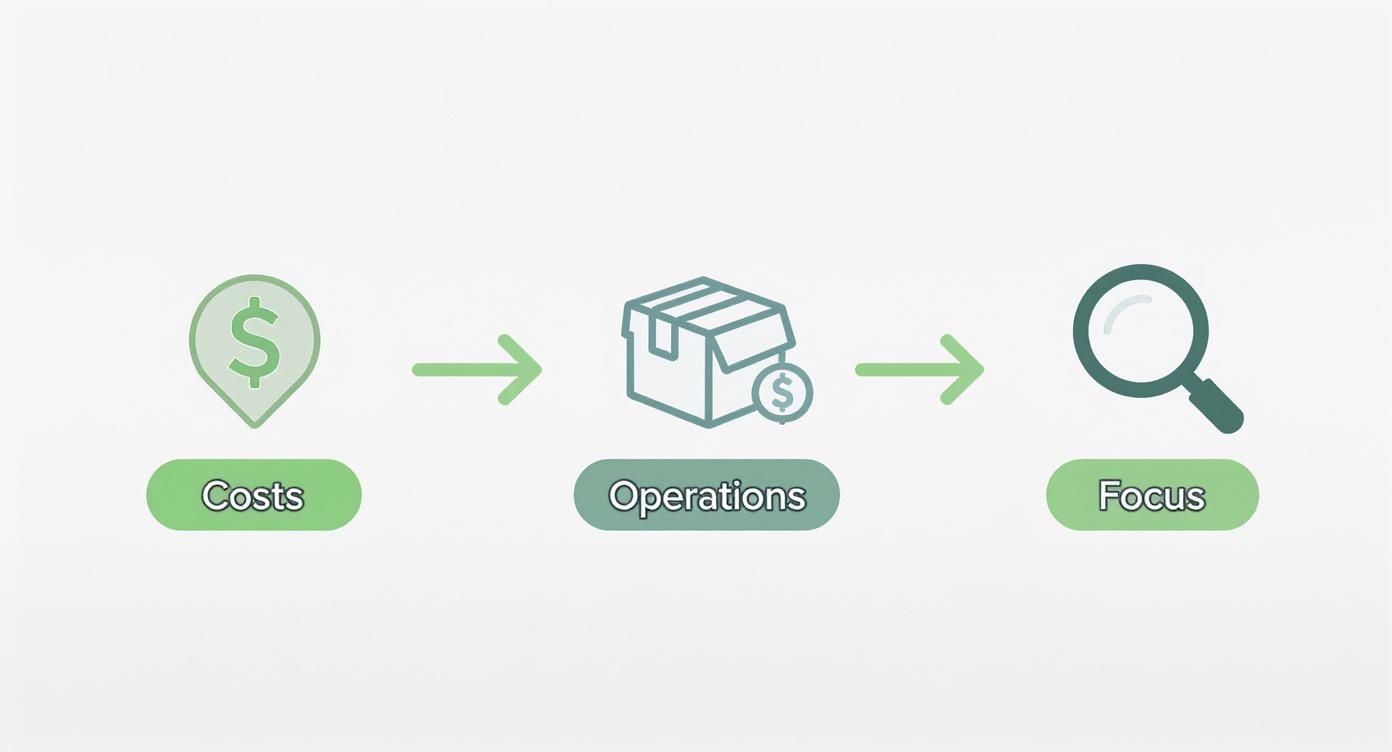
As you can see, cutting down on catalog complexity simplifies everything from warehouse management to marketing, freeing you up to focus on what truly drives growth.
Now that you have the raw materials, it's time to build a clear picture of SKU performance. We've organized the key metrics into a table to help you understand what each one reveals and why it's so critical for your rationalization decisions.
| Metric | What It Measures | Why It's Important for Decisions |
|---|---|---|
| Sales Velocity | The speed at which a SKU sells over a given period. | Quickly identifies your fast-movers versus your shelf-warmers. Slow velocity is a primary signal of an underperforming product. |
| Gross Margin ($ and %) | The profit generated from each sale after COGS. | A high-selling but low-margin product may not be as valuable as it seems. This helps you focus on profitability, not just revenue. |
| Inventory Carrying Cost | The total expense of holding unsold inventory (storage, insurance, obsolescence). | Reveals the hidden financial drain of slow-moving products. Bulky or expensive items with low velocity are prime candidates for removal. |
| Return Rate (%) | The percentage of units sold that are returned by customers. | High return rates signal problems with product quality, customer expectations, or marketing. They erode profits and strain operations. |
| Stock Turn | How many times inventory for a specific SKU is sold and replaced over a period. | Low stock turn indicates capital is tied up in inventory that isn't generating cash. It’s a classic sign of overstocking and inefficiency. |
Using this blend of metrics gives you a multi-dimensional view, ensuring you're not accidentally cutting a product that, while slow-moving, might be highly profitable or strategically important.
With your data compiled, it’s time for the fun part: the analysis. The goal here is to transform that wall of numbers into clear, actionable categories. You need to classify each SKU based on its total contribution to the business, which is what will ultimately guide your keep-or-cut decisions.
One of the most powerful and straightforward methods for this is ABC analysis. This technique segments your entire product catalog into three distinct tiers based on their value to your business:
By classifying your SKUs, you instantly create a hierarchy of importance. Instead of staring at a massive, undifferentiated product list, you now have a clear roadmap showing you exactly where to focus your attention.
For an even sharper analysis, you can layer other criteria on top of this. For instance, combining sales value with demand volatility gives you a much more nuanced view. To learn more about this advanced approach, check out our deep-dive guide on applying ABC-XYZ analysis for Shopify.
SKU rationalization is a team sport, not a solo mission. The products you decide to keep or cut touch almost every part of your business, from marketing and finance to the team packing boxes in the warehouse. Getting buy-in from these key stakeholders before you make a move is crucial for a smooth and successful project.
If you skip this step, you risk creating chaos. Imagine telling your marketing team to scrap a product they just planned a huge campaign around. Or telling your finance team you're writing off thousands in dead stock without warning. Not a good look.
Pull the leaders from these departments into a room (or a Zoom call) and walk them through your findings.
This collaborative process makes sure everyone is on the same page and understands the "why" behind the decisions, making the execution infinitely smoother.
This is where the rubber meets the road. It’s time to turn your analysis into action. This final phase is all about executing your decisions thoughtfully and communicating them clearly to everyone involved—both inside and outside the company.
First, map out a clear discontinuation plan. This means updating your Shopify store, deactivating the SKUs in your inventory management system, and letting your suppliers know you won’t be reordering.
Next, figure out what to do with the inventory you have left. There are a few solid options:
Finally, and this is important, talk to your customers. If a discontinued product had even a small, loyal following, a little communication goes a long way. A simple email or a banner on your site explaining that an item is being phased out can prevent customer frustration and show that you value their business.
Kicking off a SKU rationalization project feels like a huge step forward. But even the best intentions can lead you straight into a few common traps. Knowing what these pitfalls are is the difference between a smooth, profitable initiative and one that causes a ton of internal friction and leaves customers unhappy.
Let's be clear: getting this right means more than just cleaning up your catalog; it means boosting your bottom line.
One of the biggest mistakes is getting star-struck by sales volume. It’s easy to look at a product selling hundreds of units and think, "We can't touch that one." But if its profit margin is paper-thin and it’s a magnet for returns, you might be looking at a "vanity bestseller"—a product that looks good on paper but is actually a drain on your resources.
The real story of a SKU is never just about how many units you move. It’s about its actual contribution to the business. Think about it: a product that sells just 20 units a month but boasts a 60% profit margin with zero returns is often far more valuable than a high-volume SKU with a 5% margin that keeps your customer service team busy.
Another classic blunder is making these decisions in a vacuum. When the inventory team operates in a silo, they risk blowing up carefully laid plans across the entire company. Imagine the marketing team gearing up for a huge campaign for a product you just decided to axe. It’s a recipe for wasted effort and serious frustration.
A successful rationalization project isn’t just an inventory exercise; it’s a cross-functional business strategy. Without buy-in from marketing, finance, and operations, you're setting yourself up for a messy and ineffective execution.
Forgetting the human element—your customers—can also backfire in a big way. You might spot a slow-moving product that seems like an obvious cut. But what if that specific SKU is the favorite of a small but fiercely loyal group of customers who also happen to buy your most profitable items?
Before you cut any product, you have to ask a few questions:
Finally, not having a solid plan for your leftover inventory can turn a smart decision into a costly mess. Just discontinuing a product without a strategy for clearing the remaining stock means your cash is literally just sitting on warehouse shelves, collecting dust.
Before you make the final call, have a clear disposition plan ready to go. This could look like:
By anticipating these common challenges—looking past raw sales data, getting your teams aligned, thinking about your customers, and planning for leftover stock—you can run a SKU rationalization project that strengthens your business from every possible angle.
Let's be honest: trying to rationalize your SKUs by wrestling with spreadsheets is a nightmare. It’s a tedious, manual process that’s incredibly prone to human error. Spending hours just compiling sales data, calculating true profitability, and tracking inventory trends means you’re not spending that time actually growing your business. This is exactly where modern inventory analytics tools come in—they’re a powerful shortcut to smarter, data-backed decisions.
Instead of messing with manual data dumps, platforms like Tociny.ai plug right into your Shopify store. They automatically pull all the crucial data—from sales velocity and profit margins to return rates and carrying costs—and organize it into clear, actionable insights. This isn’t just about saving time; it’s about reaching a level of accuracy and depth that’s nearly impossible with spreadsheets alone.
The real magic of an analytics tool is how it turns an overwhelming flood of raw data into an intuitive visual story. Forget trying to spot trends in endless rows of numbers. These platforms serve up your inventory performance in clean, easy-to-read dashboards. This visual-first approach immediately shines a spotlight on the products driving your business forward and, just as importantly, the ones holding it back.
You can instantly see which SKUs are your true profit generators versus those that are just "vanity sellers"—the ones with high revenue but razor-thin margins. This clarity allows you to move beyond guesswork and make confident choices based on the complete financial picture.
The goal of an analytics platform isn't to replace your judgment—it's to supercharge it. By automating the data crunching, these tools free you up to focus on the strategic decisions that only you can make.
For example, a dashboard might reveal that two similar products are constantly splitting sales, a classic case of product cannibalization that is notoriously tricky to spot manually. That single insight lets you consolidate your offering, focus your marketing spend, and ultimately improve overall performance.
Here’s a look at an inventory dashboard that visualizes key metrics, making it simple to spot trends and outliers at a glance.

This kind of visualization brings critical information—like your best and worst sellers, stockout risks, and total inventory value—right to the surface, no complex report-building required.
Going beyond just flagging slow-movers, the best analytics tools help you understand the why behind the numbers. They give you the power to make more sophisticated decisions that can have a massive impact on your bottom line.
Here are some of the strategic questions these tools help you answer:
Ultimately, these platforms give you a holistic view of your inventory's health. They connect the dots between sales, operations, and finance, making sure every single SKU in your catalog is pulling its weight and contributing to profitability. Using these tools helps you run a more dynamic and effective SKU rationalization process. It also ties directly into predicting future sales, and you can dive deeper into various demand forecast methods to sharpen your strategy even further.
You’ve made it. You now have the complete playbook for SKU rationalization—from understanding what it is and why it matters, to a step-by-step framework for getting it done. But the real win comes from putting that knowledge to work. It’s time to move from analysis to action.
Remember, this isn’t a one-time purge of unpopular products. It's better to think of it as an ongoing strategic discipline, like a regular financial check-up for your brand. Consistently evaluating your product portfolio is what keeps it healthy, focused, and profitable year after year.
The benefits of doing this are crystal clear. When you make deliberate, data-backed decisions about your catalog, you directly impact your bottom line. This entire process is built to deliver on three key goals:
The ultimate goal of SKU rationalization is to transform your product catalog from a source of complexity and cost into a powerful engine for profitable growth. Every single product should earn its place.
This guide was designed to give you the confidence to make that transformation. And you don't need to overhaul everything at once. The journey to a perfectly optimized inventory starts with a single, manageable step.
Start today. Pull up your sales data and just identify your top 10% and bottom 10% performing SKUs based on profitability. That simple move is the first concrete step toward building a more resilient, streamlined, and profitable business. It’s the starting point for turning insight into real, measurable results.
Even with a clear game plan, a few tricky questions always come up when merchants start getting serious about cleaning up their product catalog. Let's tackle some of the most common ones we hear from brands on Shopify.
Thinking of SKU rationalization as a one-and-done project is a classic mistake. For most D2C brands, a full, deep-dive review once a year is a great rhythm to get into. It gives you enough historical data to spot real trends instead of just reacting to a slow week or a random sales spike.
But that doesn't mean you should ignore your inventory's performance the rest of the year. A quarterly health check is a smart move to catch struggling products before they become a real drag on your business. And if you're in a fast-moving space like fashion or consumer electronics? You'll probably need to run the full rationalization process every quarter just to keep up with what customers want.
Not quite. While they sound similar and are definitely related, they're playing different games with different goals. Inventory reduction is all about one thing: lowering the total amount of stock you're holding. It's often a broad-stroke move, like a site-wide clearance sale or cutting back on purchase orders across the board.
SKU rationalization is less of a sledgehammer and more of a scalpel. It’s a strategic process focused on improving the quality of your product mix. You're using data to surgically remove specific, underperforming SKUs to boost your overall profitability and operational efficiency.
So, while inventory reduction just lowers the quantity of your stock, SKU rationalization elevates the quality of your catalog.
Ah, the classic dilemma. This is where you have to look beyond a simple sales report. If a product that barely moves is adored by a small group of incredibly loyal customers—especially customers who also buy your best-selling, high-margin items—cutting it could be a huge mistake. You might save a little on carrying costs, but you risk losing those high-value shoppers for good.
Before you make the call, you need to dig deeper into the numbers for that specific customer group.
Sometimes, the smartest play is to keep that low-volume SKU specifically to serve your VIPs. The trick is making that decision with your eyes wide open, fully understanding the financial and customer relationship trade-offs.
Ready to stop guessing and start making data-driven decisions about your inventory? Tociny.ai connects to your Shopify store to give you clear, actionable insights on SKU performance, helping you spot underperformers and optimize your catalog for maximum profitability. Get early access to Tociny.ai today and turn your inventory data into your most powerful asset.
Tociny is in private beta — we’re onboarding a few select stores right now.
Book a short call to get early access and exclusive insights.