Trying to run a Shopify store on gut feelings and spreadsheets is like trying to sail across the ocean just by looking at the waves right in front of your boat. Demand forecasting software is your brand's navigation system, letting you predict future customer demand with real confidence instead of just reacting to past sales. It’s the key to solving that multi-million dollar inventory balancing act.
For so many direct-to-consumer (D2C) brands, inventory management feels like a constant battle. You're either sinking cash into products that are just collecting dust (overstock) or you're losing sales and letting down customers when a popular item sells out of nowhere (stockouts). This is exactly where demand forecasting comes in, transforming your operations from reactive guessing to a proactive, data-driven strategy.
Think of it as a weather forecast for your business. A good forecast doesn't just tell you it's raining now; it tells you to bring an umbrella tomorrow. In the same way, demand forecasting software doesn't just spit out last month's sales numbers. It digs into historical data, market trends, and even your own promotional plans to help you prepare for sales storms or sunny spells way ahead of time. Making that shift from reacting to predicting is what separates the brands that struggle from the ones that scale.
Moving from spreadsheets to dedicated software isn't just a small upgrade; it's a fundamental shift in how you run your business. The difference is stark when you see it side-by-side.
| Aspect | Manual Forecasting (Spreadsheets) | Demand Forecasting Software |
|---|---|---|
| Accuracy | Low to moderate. Based on simple averages and gut feel. | High. Uses advanced algorithms to analyze multiple data streams. |
| Time Investment | Extremely high. Hours spent weekly on data entry and formula fixes. | Minimal. Automated data pulls and analysis frees up your team. |
| Scalability | Poor. Breaks down as SKU count and order volume grows. | Excellent. Easily handles thousands of SKUs and complex data. |
| Insights | Limited to historical sales. Misses trends and external factors. | Deep. Identifies seasonality, trends, and the impact of promotions. |
| Collaboration | Difficult. Prone to version control issues ("final_v3_final.xlsx"). | Seamless. Centralized platform for teams to work from one source of truth. |
| Risk | High risk of stockouts and overstock, leading to lost revenue. | Low risk. Proactive alerts help prevent inventory imbalances. |
Ultimately, relying on manual methods means you're always looking in the rearview mirror. Software gives you a clear view of the road ahead, turning inventory into a competitive advantage instead of a constant headache.
Sure, intuition and a few spreadsheets might get you off the ground, but that approach hits a wall fast as your business grows. The global demand forecasting software market was valued at a whopping $7 billion in 2023 and is expected to explode to $40 billion by 2033. This isn't just hype—it's driven by real businesses trying to navigate volatile supply chains. Getting predictions right can slash inventory costs by 20-30% and seriously boost your operational efficiency.
At its core, forecasting is about taming uncertainty. By blending your historical sales data with forward-looking signals, you can finally align your inventory with what customers actually want. This protects your revenue and, just as importantly, your customer relationships. This process is a cornerstone of a wider strategy you can learn about in our guide to https://tociny.ai/blog/what-is-demand-planning.
Getting your forecast wrong is about so much more than just having the wrong number of units on a shelf. Stockouts actively erode customer trust and send frustrated buyers straight to your competitors. On the flip side, overstocking ties up precious cash flow, racks up holding costs, and often forces you into deep discounts that can cheapen your brand's image.
To really see the full picture, it helps to understand how this fits into the broader world of predictive analytics for retail. At the end of the day, adopting a systematic approach to forecasting isn’t just about optimizing stock levels—it’s about building a more resilient, profitable, and customer-obsessed D2C brand.
Good demand forecasting software isn't running on magic. It’s a detective, piecing together clues—data signals—to build a surprisingly clear picture of what your customers are going to buy next. It's all about connecting the dots.
At the center of it all are four critical types of data. Once you understand how the software reads each one, the "magic" behind its powerful insights for your Shopify store disappears. Think of them as the key ingredients for getting your predictions right.
The most important signal, hands down, is your own historical sales data. This is your store's biography—a detailed log of every sale, return, and customer interaction you’ve ever had. It tells the story of your brand and reveals the foundational patterns in how people buy from you.
Modern software digs much deeper than just looking at last month's average. It gets granular, analyzing the sales velocity for every single SKU, figuring out which products are your steady bestsellers, and flagging the ones with choppy or dying demand. This historical baseline is the bedrock of any good forecast; without it, you're just guessing.
Getting this part right is what helps you avoid the most common (and expensive) inventory mistakes.
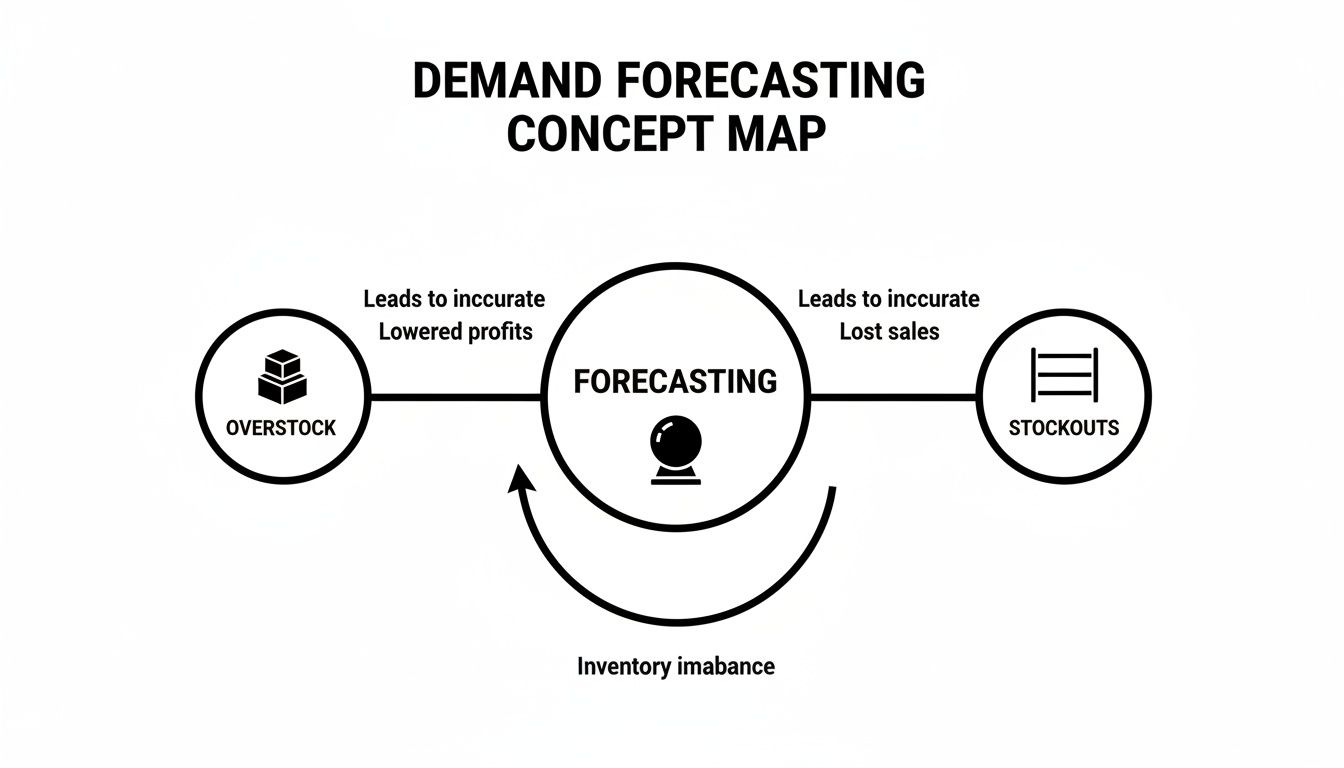
As you can see, a solid forecast is a balancing act. It’s what keeps you from sinking cash into dusty, overstocked shelves on one end and losing sales to frustrated customers on the other.
Next up is seasonality, which is just the predictable rhythm of your business. These are the recurring peaks and valleys in demand that show up around the same time every year, usually tied to holidays, weather, or big cultural moments.
A swimwear brand knows sales will pop in the spring and die down in the fall. A home goods store can bank on a rush for cozy blankets the minute the temperature drops. Demand forecasting software doesn't just know this happens; it quantifies these cycles so you’re never caught flat-footed by a predictable surge.
By truly understanding the 'when' behind your sales, you can get your inventory ready far in advance. This means no more stockouts during your busiest weeks and no more cash tied up in seasonal gear after the moment has passed.
While seasonality is often out of your control, promotions and marketing campaigns are demand spikes you create yourself. A well-timed flash sale, a big influencer push, or a sharp ad campaign should directly cause a jump in orders.
Great forecasting software doesn’t just react to these events—it plans for them. By looking at how past promos performed (like how that 20% off coupon lifted sales for a specific product), the system learns to predict the impact of future campaigns. This lets you stock up before you hit "launch," ensuring you can actually fulfill all those new orders and get the best possible ROI from your marketing spend.
Finally, the most sophisticated tools look outside your own store's data to consider market trends and external factors. This is where AI-powered platforms really pull ahead of the pack. They can parse broader signals that influence how your customers are shopping.
This might include things like: * Competitor Activity: Is a major competitor about to sell out of a similar product? That could send a wave of new customers your way. * Economic Indicators: Are consumer spending habits tightening up? That might affect how people respond to your premium products versus your budget-friendly ones. * Social and Cultural Trends: Did one of your products just go viral on TikTok? You need to know, and you need to know now.
By pulling in these external signals, the software gives you a much more complete and resilient prediction. It connects the dots between what’s happening inside your business and what’s happening in the wider world, creating a forecast that isn't just accurate, but smart.
Think of traditional forecasting methods like driving a car using only the rearview mirror. You're making decisions based entirely on where you've been. It works if the road is perfectly straight, but for a modern D2C brand, the road is full of twists, turns, and unexpected detours.
Artificial Intelligence (AI), on the other hand, is like having a full GPS system with real-time traffic updates, weather alerts, and satellite imagery. It doesn't just look at the past; it analyzes everything happening right now to map out the best route forward. For D2C brands navigating the chaos of e-commerce, this shift from reactive to predictive is a massive advantage.
AI-powered demand forecasting software moves way beyond simple historical averages. It dives deep, using sophisticated algorithms to crunch hundreds of variables at once—social media chatter, competitor pricing, ad spend, even weather patterns—to find connections a human team could never spot.

The real magic of AI isn't just about getting a more accurate number. It’s about being able to act before you have to. Instead of your data just confirming that sales spiked last July, an AI model can tell you why it spiked and predict a similar, larger surge coming up this year based on a unique mix of factors.
Imagine an AI tool noticing a small but growing trend for a specific color gaining traction on TikTok and Instagram. It links this to one of your SKUs, checks competitor stock levels, and flags that you need to ramp up inventory now—weeks before your competition even realizes what's happening.
AI-driven forecasting isn't just about being more accurate; it's about being smarter and faster. It lets your brand jump on opportunities before they become obvious, turning inventory management from a defensive cost center into an offensive growth engine.
This proactive approach is what separates brands that thrive from those that just survive. The numbers don't lie: AI-powered software can produce forecasts that are up to 50% more accurate than old-school methods. When you consider that poor forecasting is behind 45% of retail stockouts and costs businesses a staggering $634 billion a year, that improvement is game-changing. It's no surprise that brands adopting AI report 35% better fill rates, which directly translates to more revenue and happier customers.
Here's the kicker: AI gets smarter over time. Unlike a static spreadsheet formula that you have to manually update, a machine learning model is constantly refining itself with every new sale, every marketing campaign, and every bit of market data it processes.
This continuous learning loop means your forecasts get sharper and more reliable:
This self-improving brain ensures your forecasting engine evolves right alongside your business and the market. To see what this looks like in the real world, check out our guide on AI in demand planning and its benefits. By bringing AI into the fold, modern D2C brands can stop guessing and start strategically shaping their future.
Putting a powerful demand forecasting tool in place is just the starting line. To really see what it’s doing for your business, you need to connect its predictions to real-world results. This isn't about getting lost in complex algorithms or confusing charts; it's about tracking the key performance indicators (KPIs) that directly impact your bottom line.
Think of these metrics as your store’s vital signs. They tell you whether your inventory strategy is healthy or if something needs immediate attention. By zeroing in on a few crucial numbers, you can draw a straight line from better forecasts to a more profitable, resilient business.
Let’s break down the three most important metrics every Shopify merchant should have on their radar.
The most fundamental metric is Forecast Accuracy. Put simply, this is your software’s report card. It measures how close the system's predictions were to what your customers actually bought. While no forecast will ever hit 100% perfection, the goal is to get as close as possible, consistently.
Imagine your software predicted you'd sell 100 units of a best-selling t-shirt, and you actually sold 95. That's a 95% accuracy rate—fantastic. But if it predicted 100 and you only sold 50, that 50% accuracy rate flags a major disconnect. High forecast accuracy is the bedrock of a healthy inventory system because it directly influences every other operational metric.
Good demand forecasting software doesn't just give you a forecast; it tracks its own accuracy over time. This feedback loop is essential for the system to learn and improve, ensuring your predictions get sharper with every sales cycle.
Next up is the Stockout Rate, which is the direct and painful result of under-forecasting. This metric tracks how often a customer lands on a product page only to find it's out of stock. A high stockout rate is a blaring alarm that your forecasts are too conservative, and it hurts your business in more ways than one.
The most obvious cost is lost sales—you can't sell what you don't have. But the damage runs much deeper. Stockouts frustrate loyal customers, chip away at brand trust, and can send shoppers straight to your competitors. A customer who finds their favorite item sold out today might not even bother checking back tomorrow.
Driving down your stockout rate is one of the fastest ways to lift revenue and boost customer satisfaction.
On the flip side, you have Inventory Holding Costs—the silent killer of over-forecasting. This metric adds up all the expenses tied to storing unsold products on your shelves. When your forecast is too optimistic, you end up with excess inventory, and that idle stock quietly eats away at your profits.
These costs go far beyond just warehouse rent. They include insurance, potential damage or obsolescence (think expired goods or last season's fashion), and the massive opportunity cost of having cash tied up in products that aren't moving. For e-commerce businesses, this has become a colossal problem, with companies losing a collective $1.75 trillion each year to excess inventory.
This is where advanced demand forecasting software makes a huge difference. By using AI, it can push forecast accuracy up to 85-90%, which in turn can slash stockouts by as much as 50%. You can dig into more data on how AI is transforming the demand planning market on techsciresearch.com.
By keeping a close eye on these three metrics—forecast accuracy, stockout rate, and holding costs—you get a clear, 360-degree view of your inventory health and can measure the true ROI of your forecasting efforts.
Alright, let's get practical. How do you actually pick the right tool from a market that feels more crowded by the day? For a busy Shopify merchant, the best demand forecasting software isn't the one with a million features—it’s the one that gives you clear, actionable insights without needing a data science degree to figure it out.
Think of it this way: you're not just buying software, you're choosing a partner for growth. The right tool should feel like a new member of your team, one who untangles the complexity and empowers you to make smarter inventory calls. To find that perfect fit, you have to ask the right questions and zero in on what really matters for a direct-to-consumer (D2C) brand.
This is all about moving past flashy feature lists and focusing on the core stuff that will actually save you time, cut costs, and boost your revenue.
When you start digging into different options, it’s incredibly easy to get overwhelmed. Use this checklist as your guide to cut through the marketing noise and evaluate each tool based on what will truly impact your day-to-day operations and long-term success.
| Feature/Aspect | Key Questions to Ask | Why It Matters for D2C |
|---|---|---|
| Seamless Shopify Integration | Is it a genuine one-click setup? Does it pull sales, product, and promo data automatically without CSVs? | A native, deep connection is non-negotiable. It ensures your forecasts are always based on real-time, accurate data from your store. |
| Intuitive User Interface (UI) | Can you understand your inventory situation at a glance? Is the dashboard built for an e-commerce operator, not an analyst? | A clean, visual layout means you spend less time digging through menus and more time acting on insights. You should be able to log in and instantly know what needs attention. |
| Actionable Recommendations | Does it tell you what to do? Does it translate data into simple instructions like, "Order 50 units of SKU X by Tuesday"? | Raw data is useless. You need a tool that turns complex forecasts into concrete purchase orders you can act on immediately to prevent stockouts and reduce overstock. |
| Scalability | Can the software handle double the SKUs and triple the orders next year? Does the model adapt as your sales patterns evolve? | Your tools need to grow with you. The last thing you want is to outgrow your software and have to repeat this entire process in 12 months. |
| Transparent Pricing | Is the pricing model clear and predictable? Are there hidden fees or complex usage-based charges that could lead to surprise bills? | A clear pricing structure allows you to budget effectively and ensures the cost aligns with the value you're getting, without nasty surprises. |
| D2C-Focused Support | Does the support team understand the unique challenges of e-commerce? Are they responsive and knowledgeable about your business model? | A great provider is more than a vendor; they're a partner. Responsive, expert support turns a good tool into an indispensable asset for your brand. |
This checklist isn't about finding a tool that does everything; it's about finding the tool that does the right things for your Shopify store. By focusing on these key areas, you'll be in a much better position to choose a solution that genuinely supports your growth.
Let's break down the three most critical elements from that list. Getting these right is the difference between a tool that creates more work and one that saves you from it.
A native, deep connection with Shopify is non-negotiable. The software should automatically pull all your essential data—products, sales history, inventory levels, and promotions—without you ever touching a CSV file. This is the only way to ensure your forecasts are always based on the most current, accurate information. A true one-click setup is the gold standard.
Is the dashboard designed for someone running an e-commerce business, not a data analyst? A cluttered or confusing interface is a major roadblock. Look for a clean, visual layout that presents key information—like stock level predictions and sales trends—in a way that’s easy to grasp in seconds. You shouldn’t have to hunt for the insights you need.

This is where the magic happens. A forecast that just spits out raw data or complex charts isn't helping you. What you really need are clear, direct recommendations.
A great tool doesn't just show you the problem; it gives you the solution. It should translate all that complex data into a simple instruction you can act on, like: "Order 50 more units of SKU X by next Tuesday to avoid a stockout."
Your software’s job is to do the heavy lifting so you can focus on execution.
Choosing the right demand forecasting software is a strategic move that directly impacts your bottom line. By prioritizing seamless integration, an intuitive interface, and genuinely actionable insights, you can find a tool that doesn't just predict demand but helps you build a more resilient and profitable business.
For Shopify merchants, sticking with a specialized tool is almost always more effective than trying to wrestle with a generic enterprise solution. You can learn more by exploring different options in our guide to inventory planner software built specifically for e-commerce brands like yours.
So, you’ve picked your new demand forecasting software. That’s the first step. The real magic happens when you weave it into your daily operations and, most importantly, start trusting what it tells you. This isn't about flipping a switch and watching profits roll in; it's about building a smarter, leaner workflow for how you manage inventory.
The journey starts with a few simple moves. First, you'll connect the software to your Shopify store. Any solid tool will make this a one-click affair, automatically syncing your historical sales data, product info, and current stock levels. No more wrestling with CSV uploads or fiddling with complex settings.
Once it's plugged in, the software gets to work. It’ll start churning through months—or even years—of your sales history, hunting for patterns, seasonal spikes, and the sales velocity of every single SKU. The first forecasts it spits out become your new baseline, a data-driven starting point that’s already miles ahead of spreadsheet guesswork.
Here’s where a lot of merchants stumble: learning to trust the machine. It’s tempting to second-guess the system or override its suggestions based on a gut feeling. While your own expertise is crucial for context—like knowing a big PR feature is about to drop—the whole point is to let the software handle the number-crunching.
Another common pitfall is expecting 100% accuracy right out of the gate. No forecast is ever perfect. The goal isn't perfection; it's continuous improvement.
The real win with forecasting software comes when you treat it like a strategic partner. Feed it good data, give it time to learn the unique rhythm of your business, and use its insights to guide your decisions—not just to confirm what you already think.
This partnership is what lets you shift from constantly reacting to sales swings to proactively building an inventory strategy that works.
Let's look at a Shopify fashion brand that was perpetually stuck in an inventory nightmare. They were either sold out of their hottest dresses mid-season or drowning in unsold coats long after the last frost. Their manual planning was eating up over 10+ hours a week and still wasn't getting the job done.
After they brought in a dedicated forecasting tool, everything changed.
The results were huge. Within three months, the brand hit a 98% in-stock rate on its core collection, slashed inventory holding costs by 15%, and got those 10+ hours back every single week. That’s the real ROI of putting your software to work: less guesswork, fewer lost sales, and more time to actually grow the business.
Stepping into the world of demand forecasting software can feel a bit overwhelming, almost like you're learning a new language. To help clear things up, here are some straight-up answers to the questions we hear most often from Shopify merchants who are tired of guesswork and ready for data-driven inventory planning.
Think of this as your quick-reference guide to building confidence and making a smarter move for your store.
This is the big one, right? While every store’s journey is a little different, most merchants start seeing real, tangible improvements within the first 30 to 90 days. Once you connect your Shopify store, the software needs a short window to crunch your historical sales data and churn out its first solid forecasts.
The wins you'll notice almost immediately are:
It’s a common myth that forecasting tools are only for the big players. Honestly, it’s often the smaller, growing brands that need it most. When you're scrappy and growing, every single dollar counts. Tying up precious cash in products that just sit on the shelf can seriously slow you down.
A good forecasting tool is like a secret weapon for smaller stores. It helps you pour your limited budget into the products you know will sell, leveling the playing field and giving you the kind of inventory intelligence that was once reserved for massive corporations.
Absolutely not. Let's be clear: modern demand forecasting tools, especially the ones built specifically for Shopify merchants, are designed for founders and operators, not data analysts. The entire point is to take all that complex data and spit out simple, actionable advice.
Instead of throwing a confusing algorithm at you, the software should just tell you what to do. Think: “You need to order 75 units of SKU X by next Wednesday to avoid a stockout.” The best platforms do all the heavy lifting in the background so you can stay focused on what you do best—running your business. It's all about turning powerful data into simple tasks that help you grow.
Ready to stop guessing and start growing? Tociny.ai delivers the clarity and actionable insights you need to finally master your inventory. See how our AI-powered platform helps D2C brands reduce stockouts and boost their bottom line. Learn more about Tociny.ai.
Tociny is in private beta — we’re onboarding a few select stores right now.
Book a short call to get early access and exclusive insights.