So, what exactly is inventory management software?
Imagine trying to run a bustling Shopify store with nothing but scribbled notes, messy spreadsheets, and that constant, nagging fear of overselling. That chaotic, reactive scramble is what life is like without a proper system in place.
Inventory management software steps in to replace that chaos with clarity. Think of it as a brilliant, always-on operations manager for your digital stockroom, transforming a static list of products into a dynamic, revenue-driving asset. It gives you a single source of truth for what you have, where it is, and when you need more.
At its core, this software gives you a real-time, unified view of your stock across every single place you sell—your Shopify site, an Amazon storefront, social media shops, and even that weekend pop-up. For any modern D2C brand, juggling all those channels is impossible without this kind of central command center.
The main job of this software is to stamp out painful guesswork. Instead of frantically updating a spreadsheet after every single sale (a process just begging for human error), the system handles it for you instantly and automatically.
This simple shift delivers some huge wins right away:
For any D2C brand, inventory isn't just a list of items in a warehouse; it's your biggest investment. Good management software makes sure that investment is working for you, not against you, by turning products into predictable cash flow.
There's a reason the global market for these tools is booming. Valued at around USD 3.85 billion in 2025, it's projected to rocket to USD 8.94 billion by 2033. As a Pheonix Research report highlights, this growth shows just how essential these systems have become for taming modern supply chain complexity.
Ultimately, this software lays the foundation for you to actually scale your business. It flips your operations from reactive to proactive, empowering you to make smarter purchasing decisions and build a more resilient brand. To dig deeper, you can explore our high-level overview of inventory management in our dedicated guide.
Choosing inventory management software can feel like you're staring at a wall of technical jargon. Forget the generic feature lists for a minute. Let's talk about the specific tools that actually solve the real, everyday headaches for a D2C brand running on Shopify.
Think of these features less as abstract functions and more as direct answers to your biggest operational problems. As you can see below, the right software sits at the very heart of your operations, directly impacting your cash flow, keeping customers happy, and fueling sustainable growth.
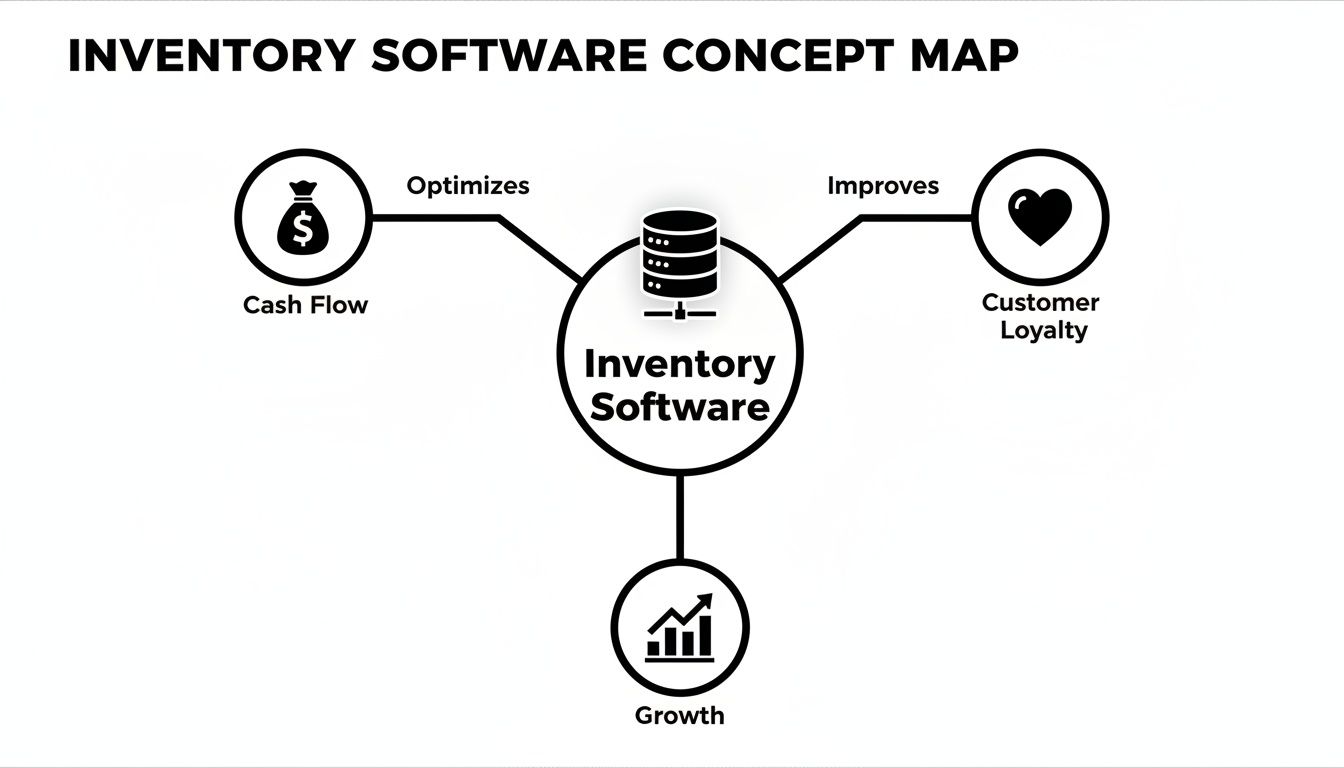
This isn't just about counting boxes. Getting your inventory control right is the engine that powers your financial health and customer satisfaction—the two pillars you need to build a business that lasts.
So, what are the non-negotiables? Here’s a breakdown of the core features that offer the most bang for your buck, turning chaos into clarity for your Shopify store.
This table cuts through the noise, laying out the must-have features and, more importantly, why they matter to your bottom line.
| Feature | What It Does | Why You Need It (The Benefit) |
|---|---|---|
| Real-Time Stock Syncing | Instantly updates inventory levels across all sales channels (Shopify, Amazon, Instagram, etc.) the moment a sale is made. | Prevents overselling and stockouts, eliminates manual data entry errors, and builds customer trust by ensuring the stock count is always accurate. |
| Automated Purchasing & Alerts | Notifies you when stock for a specific SKU hits a predetermined low level and can even draft purchase orders for you. | Turns reordering into a proactive, data-driven process instead of a last-minute scramble. Frees up cash by preventing both overstocking and understocking. |
| Intelligent Demand Forecasting | Analyzes historical sales data, seasonality, and market trends to predict future customer demand for your products. | Helps you make smarter buying decisions, plan promotions confidently, and avoid tying up capital in slow-moving or seasonal items. |
| Order & Fulfillment Management | Centralizes order processing from all channels, tracks fulfillment stages, and integrates with shipping carriers. | Gives you a single dashboard to manage the entire order lifecycle, reduces shipping errors, and provides customers with timely updates. |
| Lot & Expiration Tracking | Tracks specific batches (lots) of products and their expiration dates, crucial for perishable or regulated goods. | Ensures you're selling the oldest stock first (FIFO), reduces spoilage and waste, and maintains compliance for industries like food, beverage, and cosmetics. |
| Multi-Location & Warehouse Support | Manages and tracks inventory levels across multiple warehouses, 3PLs, or physical retail locations from one system. | Provides a unified view of all your stock, no matter where it's stored. Enables efficient order routing from the closest warehouse to the customer, saving on shipping costs. |
Each of these features addresses a specific, high-stakes part of running an e-commerce business. Together, they create a powerful system that not only saves time but actively helps you grow smarter.
The ultimate nightmare for any Shopify merchant? Overselling a hot item during a flash sale. This is what happens when your inventory levels don't update instantly across every place you sell—your website, Amazon, Instagram Shop, or even a physical pop-up.
Real-time stock syncing is the only real cure for this.
When a product sells on one channel, the best inventory management software automatically adjusts the available count everywhere else within seconds. This creates a single, undeniable source of truth for your stock levels. It completely eliminates the manual errors and embarrassing "oops, we're out of stock" emails that destroy customer trust.
Do you know exactly when to reorder your best-sellers? Guessing is a dangerous game. It usually leads to one of two expensive mistakes: you either run out of stock and miss out on sales, or you order way too much and tie up your cash in products that just sit there.
Automated purchase orders and low-stock alerts take the guesswork out of the equation.
By setting minimum stock levels (or reorder points), the system does the heavy lifting for you:
This flips reordering from a panicked, reactive chore into a calm, proactive, and data-driven process. The stakes are high here; poor tracking is a massive problem, with inventory mismanagement causing up to 30% of stock discrepancies in retail. It's no surprise that the global market for this software is set to hit USD 3,321 million by 2025, with North America leading the charge at 39.29% of the market. That's a 74.57% jump from 2021, showing just how fast brands are moving to automate.
Historical data is great for telling you what sold last month. But intelligent demand forecasting is what helps you predict what you’re going to sell next month. This is where modern inventory software really starts to feel like a superpower.
Using your past sales data, seasonality, and market trends, these systems can predict future demand with impressive accuracy. This allows you to:
A great forecasting feature doesn't just throw numbers at you; it helps you make smarter decisions. It’s the difference between driving by looking in the rearview mirror and having a GPS for the road ahead.
For Shopify merchants, the fulfillment process is deeply tied to inventory management. Understanding logistics, right down to the basics of what a tracking number is and how it works, is key to keeping customers happy. A solid inventory system gives you visibility into that entire journey, from warehouse shelf to customer doorstep.
Features are one thing, but results are what really move the needle. Let's get past the technical jargon and connect the dots between solid inventory management software and the real-world impact on your bottom line. For any Shopify store, the ROI isn’t just about saving a few hours a week—it’s about fundamentally improving your financial health.
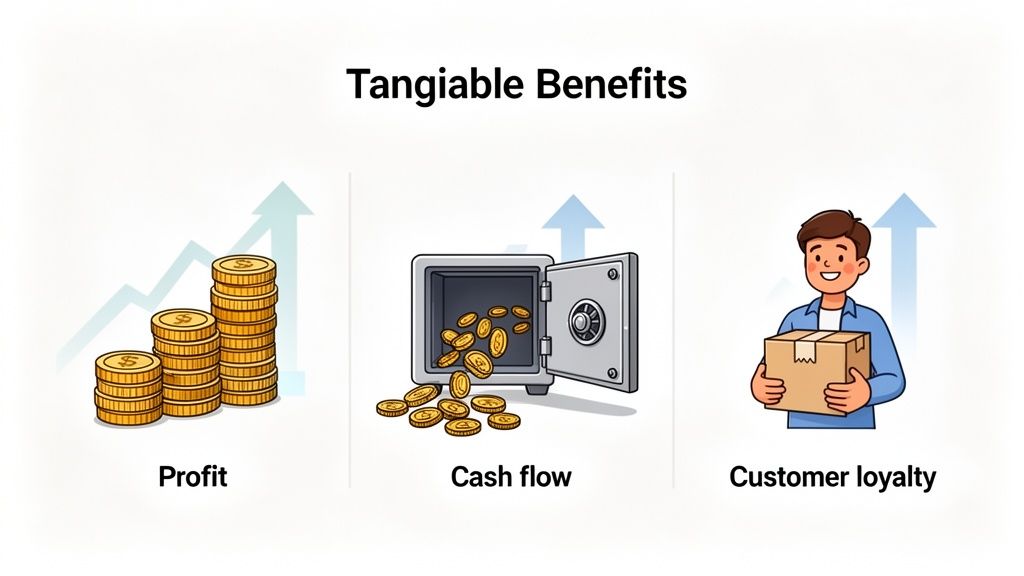
We can boil these powerful outcomes down to three game-changers: healthier profit margins, unlocked cash flow, and customers who actually stick around. These aren't just fluffy concepts; they are tangible assets you build by getting a real grip on your stock.
Every single product just sitting on a warehouse shelf is quietly costing you money. These carrying costs—think storage fees, insurance, and the risk of a product becoming dated—are a slow but steady drain on your profits. Eventually, you’re forced into profit-killing clearance sales just to get rid of it all.
Good inventory management software hits this problem head-on.
By giving you a clear picture of sales data and forecasting what's coming, it helps you order what you need, right when you need it. No more guesswork. This smarter approach directly cuts down on overstock, which means:
Put it this way: every dollar you don't spend storing a slow-moving product is a dollar that goes straight back into your pocket.
Cash flow is the lifeblood of any D2C brand. When all your capital is tied up in boxes of inventory that isn't moving, you can't spend it on marketing, new product development, or that key hire you desperately need. Plenty of businesses fail not because they aren't profitable, but because they simply run out of cash.
Data-driven purchasing, powered by inventory software, is the key to unlocking that trapped capital.
Instead of just guessing how many units of a new product to order, the software digs into historical trends and seasonality to recommend a smart starting quantity. This stops you from making a huge, risky bet on an unproven item.
For example, a fashion brand heading into winter can use forecasting to avoid going all-in on a niche coat style that data shows has a very short selling window. That freed-up cash can be pumped into marketing their proven best-sellers, generating a much stronger return. It’s all about giving your business the agility to jump on real opportunities.
What happens when a customer eagerly buys a product, only to get an email the next day saying it was actually out of stock? It’s a huge letdown. Their trust in your brand takes a hit, and they might not come back. Inaccurate stock levels are a silent killer of customer loyalty.
Real-time inventory syncing across all your channels—your Shopify site, Amazon, social media—ensures that what a customer sees online is what you actually have in the warehouse.
This accuracy creates a smooth, reliable shopping experience, which is absolutely essential for building a brand people trust. A solid system leads directly to:
Ultimately, smart inventory control isn't just an operational fix; it's a customer experience upgrade. When you consistently deliver on your promises, you build the kind of loyal customer base that drives sustainable, long-term growth.
Picking the right inventory management software is a huge decision. It's not just another app subscription; it's a commitment that will shape how your store operates for years to come. The market is blowing up, too. It's projected to jump from USD 2.48 billion in 2025 to USD 3.64 billion by 2029, driven almost entirely by the needs of e-commerce brands like yours. For a deeper dive into these numbers, check out this comprehensive inventory management software market report.
With so many options out there, it’s easy to get lost in feature lists and sales pitches.
This checklist is designed to cut through all that noise. It'll give you the exact questions to ask so you can find a solution that doesn't just fix today's headaches but is ready to handle whatever you throw at it tomorrow.
The business you run today isn't the one you'll be running in two years. A system that feels just right for 100 orders a month will absolutely buckle under the weight of 10,000. Real scalability isn't just about handling more volume—it's about handling more complexity.
Before you even think about signing a contract, you need to grill vendors on growth:
A truly scalable platform should feel like a partner that helps you grow, not a bottleneck that holds you back.
Choosing software is like hiring a key employee. You wouldn't hire someone who can only handle today's workload; you hire for the potential to take on bigger challenges. Your software choice should reflect that same forward-thinking mindset.
Your inventory software can't live on an island. It has to talk seamlessly to all the other tools that run your business. A clunky, half-baked integration creates more manual work than it saves, which completely defeats the point.
Think of your tech stack like a set of gears in a machine. If they don't mesh perfectly, the whole thing grinds to a halt. The goal is a smooth, automated flow of information. To see this in action, take a look at our guide that breaks down a real-world inventory management system example.
Your integration checklist must include:
Don't just take their word for it. Ask for a live demo that shows you exactly how these connections work.
The most feature-packed software on the planet is worthless if your team hates using it. A steep learning curve always leads to frustrated employees, expensive mistakes, and, ultimately, nobody using the tool you just paid for.
Usability isn’t a "nice-to-have." It’s a core requirement for getting any ROI. When you’re looking at the dashboard, ask yourself: was this designed for the fast-paced world of e-commerce, or does it feel like a clunky system from another era? A clean, intuitive interface empowers your team to make smarter decisions on the fly without needing a user manual for every little task.
With these core pillars in mind, let's put it all together into a practical checklist. The table below is your cheat sheet for comparing different software options head-to-head. Use it to keep your evaluation process organized and ensure you don’t miss any critical details.
| Evaluation Criteria | Questions to Ask | Importance (High/Medium/Low) |
|---|---|---|
| Shopify Integration | Is the integration native and real-time? Does it sync all product data, orders, and stock levels two-ways? | High |
| Scalability | Can it handle a 10x increase in orders and SKUs without performance issues or surprise fees? | High |
| User Interface (UI) | Is the dashboard intuitive? Can a new team member figure out the basics in under an hour? | High |
| Core Inventory Features | Does it support bundling/kitting, multi-location, purchase orders, and barcode scanning? | High |
| Reporting & Analytics | Can I easily generate reports on sell-through rate, stock turnover, and profitability by SKU? | High |
| Forecasting | Does it offer demand forecasting? Is it basic or AI-powered for greater accuracy? | Medium |
| Integrations | Does it connect seamlessly with my accounting, shipping, and 3PL software? | Medium |
| Customer Support | What are their support hours? Is support included, or is it a paid add-on? What do user reviews say? | Medium |
| Pricing Structure | Is the pricing clear? Are there hidden fees for extra users, orders, or integrations? | Medium |
| Onboarding & Training | Is there a structured onboarding process? Do they provide training materials and documentation? | Low |
This checklist forces you to look beyond the marketing hype and focus on what truly matters for your business. A "yes" to these questions from a potential vendor is a strong signal that you're on the right track.

Most inventory management software is great at one thing: telling you what already happened. It can pull up reports showing which products were hot last quarter or how many units you sold during last year’s Black Friday sale. While that’s useful, it’s a bit like driving a car by only looking in the rearview mirror. You see where you've been, but you have no clue what’s coming up around the next bend.
This is where Artificial Intelligence completely changes the game.
AI-powered forecasting doesn't just look backward; it makes intelligent, calculated predictions about the future. It doesn't just see last December's sales figures. It digs into complex patterns, subtle market shifts, and emerging trends to tell you what your customers are actually going to want next December. This flips inventory management on its head, turning it from a reactive chore into a proactive, strategic advantage.
Let's be honest, traditional forecasting methods are pretty basic. They often lean on simple calculations like moving averages, where you might look at the last three months of sales to guess what the next month will look like. It’s a step up from a wild guess, but this approach has massive blind spots. It gets completely thrown off by sudden sales spikes, seasonal shifts, or the impact of a new marketing campaign.
AI forecasting, on the other hand, is like having a team of expert data analysts working for you 24/7. An AI engine can juggle dozens of variables all at once, including:
By weaving all this information together, AI creates a much richer, more accurate picture of what future demand really looks like.
One of the biggest headaches for D2C brands is drowning in data but not knowing what to do with it. An AI-first platform doesn't just throw more charts at you; it translates all that complexity into clear, direct recommendations.
So, instead of just showing you that a product's sales are slowing down, an AI system might flag it as being at high risk of becoming dead stock in the next 60 days. That gives you a crucial window to do something about it—like creating a product bundle or launching a targeted flash sale—before your cash gets permanently locked up on a warehouse shelf.
AI-powered inventory management doesn't just give you more data; it provides strategic clarity. It's the difference between having a list of all the ingredients in a kitchen and having a Michelin-star chef telling you exactly what to cook with them.
For Shopify merchants, this level of insight is pure gold. The software can suggest the ideal reorder points for every single SKU to maximize your cash flow, making sure you don't over-invest in one product at the expense of another. You can dive deeper into how this works by exploring our guide on AI-powered demand forecasting.
The real power of AI in inventory management is its ability to keep you several steps ahead of the competition. While your competitors are busy reacting to last month's sales reports, you're already positioning your inventory for next month's trends.
Think about these practical applications:
While AI is making huge waves in backend operations like forecasting, its influence is also popping up in customer-facing experiences. For example, the technology is now enabling highly personalized and interactive AI-driven shopping experiences in fashion, showing just how versatile it is across the e-commerce world. For merchants, this means the tools are simply getting smarter on both sides of the business.
Ultimately, adopting an AI-first approach gives you an operational agility that is nearly impossible to match with traditional methods alone.
Getting new software up and running feels like a huge win. But let's be real—a powerful tool is only as good as its setup. A smooth launch is more than just flipping a switch. It’s about dodging the common landmines that can blow up your progress and tank your ROI right from the start.
The single biggest mistake we see? Migrating messy, incomplete product data into a shiny new system. This is the classic "garbage in, garbage out" trap. If your current spreadsheets are a tangled mess of wrong SKUs, mismatched product names, or out-of-date cost data, you’re just moving the chaos into a prettier interface. The software will then dutifully spit out flawed forecasts and bogus reports based on that bad info.
This one error creates a domino effect of expensive problems, from ordering the wrong stuff to completely miscalculating your profit margins. Before you even think about going live, you have to block out time for a serious data cleanup.
Another classic blunder is forgetting about the people who will actually use the software every day. You might know the system like the back of your hand, but if your warehouse manager or ops lead doesn't, they'll default to their old spreadsheets in a heartbeat. It’s not that they’re trying to resist change; it's just human nature when you hand someone a complex tool without showing them how it makes their life easier.
The fix? Involve your team early and often.
A successful software launch isn't a tech project—it's a people project. The goal is to build confidence, not just install a program. When your team feels comfortable and capable, they'll actually want to use the new system.
Finally, so many brands stumble because they treat the implementation like a casual side project with no real deadline. Without a firm go-live date and a clear, step-by-step plan, the whole thing just drags on. It loses momentum and gets shoved to the back burner the second a more "urgent" fire pops up.
You have to treat this launch like a major marketing campaign. Set a realistic date, then work backward to build a timeline with clear milestones. Hold people accountable. This creates a healthy sense of urgency and makes sure crucial steps like data cleaning and team training actually get done on time. If you can sidestep these common mistakes, your new inventory management software will start paying for itself from day one.
Jumping into a new inventory system can feel like a big step, so it’s natural to have a few questions. Let's tackle some of the most common ones we hear from Shopify merchants to clear things up before you make a move.
The price tag on inventory management software can swing pretty widely, and it's almost always tied to your store's size and complexity. Most platforms you'll look at these days operate on a subscription model (SaaS) with different tiers.
Here’s a rough breakdown of what to expect:
A quick pro tip: don't just look at the monthly fee. Always ask about the total cost of ownership. Are there one-time setup fees? Extra charges for adding team members? Costs for specific integrations? Get the full picture upfront.
This is the classic "it depends" answer, but it really comes down to two things: how complicated your business is and how clean your data is. If you have a single Shopify store with well-organized product data, you could be up and running in just a few days.
On the other hand, if you're juggling thousands of SKUs across multiple warehouses with data that’s… let’s just say, a little messy… you should plan for a few weeks. A huge chunk of that time isn't about the software; it's about cleaning up your own data. Getting all your SKUs, costs, and supplier info right before you migrate is non-negotiable. Most brands start feeling the positive impact on their accuracy and efficiency within the first 30 days after going live.
Think of it like pouring the foundation for a house. If you rush the prep work and build on shaky ground (or messy data), you’re just creating bigger problems for yourself later. Take the time to get the data right from the start. Your future self will thank you.
It absolutely has to. A modern inventory management software shouldn't be another island in your tech stack; it needs to be the central command center for your entire operation.
Any decent platform will have a library of native, direct integrations with the tools you already use. At a minimum, look for:
Don't just take their word for it that an integration "exists." Ask for a demo. See exactly how the data flows from one system to the other and make sure it works for your specific process.
Ready to stop guessing and start making data-driven decisions? Tociny.ai uses AI to give you clear, actionable insights into your inventory, helping you eliminate overstock and prevent stockouts. Join our private beta for early access.
Tociny is in private beta — we’re onboarding a few select stores right now.
Book a short call to get early access and exclusive insights.