Think of an inventory monitoring system as the central nervous system for your stock. It's the tech that gives you a real-time view of your inventory levels, how fast products are selling, and what's happening across your supply chain. It replaces tedious manual spreadsheets with a smart, dynamic dashboard that not only tracks what you have but also helps predict what you'll need.
For a direct-to-consumer (D2C) brand, this is the difference between constantly reacting to sales data and proactively shaping your business's future.
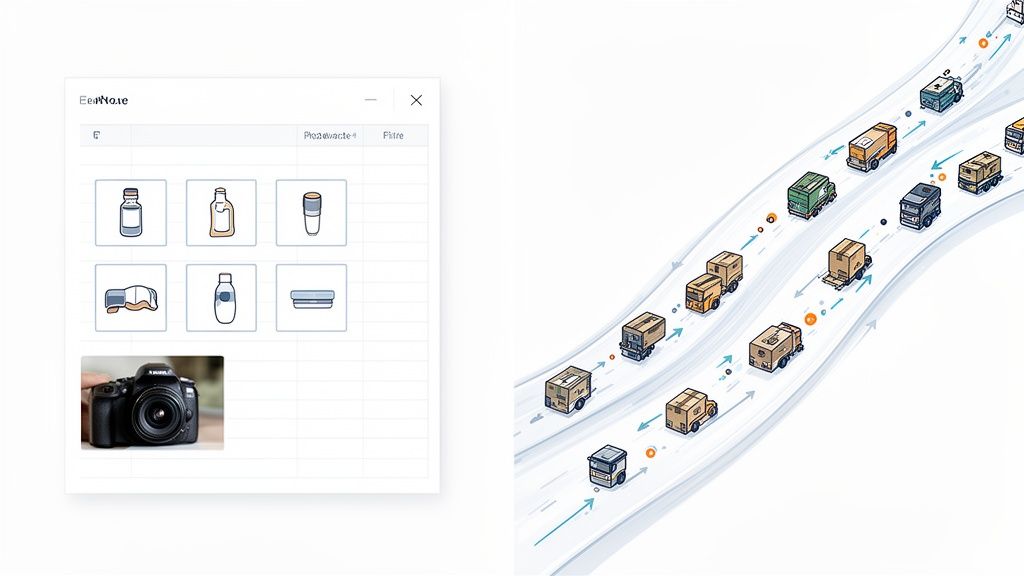
Imagine trying to navigate a busy highway using a single photo taken once a day. That's what relying on a spreadsheet feels like. You see the cars at one frozen moment, but you completely miss the rush hour buildup, the unexpected traffic jams, and the actual flow of vehicles.
An inventory monitoring system, on the other hand, is your live satellite feed with traffic analytics. It shows you exactly where every product is, how fast it's moving, and where it's headed next.
This leap from static counting to dynamic analysis is non-negotiable for modern e-commerce brands, particularly those on platforms like Shopify. A single viral video on social media can wipe out your stock in hours, leaving unprepared merchants scrambling to fulfill backorders and deal with unhappy customers. A proper monitoring system turns your inventory from a simple list of items into a strategic asset by revealing the "why" behind every stock movement.
Instead of just looking back at what sold yesterday, an inventory monitoring system helps you anticipate what’s likely to sell tomorrow. This proactive stance empowers you to make smarter, data-driven decisions that have a direct impact on your bottom line.
Here’s what that looks like in practice: * Avoiding Costly Stockouts: You can finally stop losing sales on your best-sellers because you’ll know exactly when to reorder, long before you run out. * Reducing Overstock Waste: No more tying up precious cash in slow-moving products that just sit on shelves, killing profits and eating up warehouse space. * Optimizing Cash Flow: By buying the right amount of stock at the right time, you keep your cash flowing, freeing up capital to invest in growth.
The proof is in the numbers. The global market for inventory management software has exploded, jumping from USD 1,567.32 million in 2020 to a projected USD 2,874.65 million by 2026. That's a powerful 10.8% compound annual growth rate, driven by the intense demand for real-time stock visibility in a booming e-commerce world. You can explore more on these market trends to get the full picture.
For a growing D2C brand, inventory isn't just a line item on a balance sheet; it's the physical manifestation of your cash flow. Managing it effectively is one of the most direct ways to control profitability.
To truly grasp the impact, it helps to see the old way and the new way side-by-side. The contrast between wrestling with spreadsheets and leveraging an automated system is stark.
| Aspect | Manual Tracking (Spreadsheets) | Automated Monitoring System |
|---|---|---|
| Data Entry | Manual, time-consuming, and prone to human error. | Automated, pulling data directly from sales channels. |
| Visibility | Static snapshot. You only know what stock was at the last count. | Real-time. See current stock levels across all locations, 24/7. |
| Decision Making | Reactive. Based on outdated information and guesswork. | Proactive. Driven by live data, trends, and predictive forecasts. |
| Scalability | Poor. Becomes unmanageable as your product catalog and sales grow. | High. Scales effortlessly with your business. |
| Accuracy | Low. One typo can throw off your entire inventory count. | High. Eliminates manual errors for trustworthy data. |
Ultimately, manual methods are defined by their limitations, while automated systems are defined by their capabilities. This fundamental distinction is why so many ambitious brands are making the switch. They're choosing to invest in a system that can keep up with their growth.
To really get why a modern inventory monitoring system is such a game-changer, you have to look under the hood. It’s not about one single trick, but how several powerful tools work together to create an intelligent engine for your entire operation.
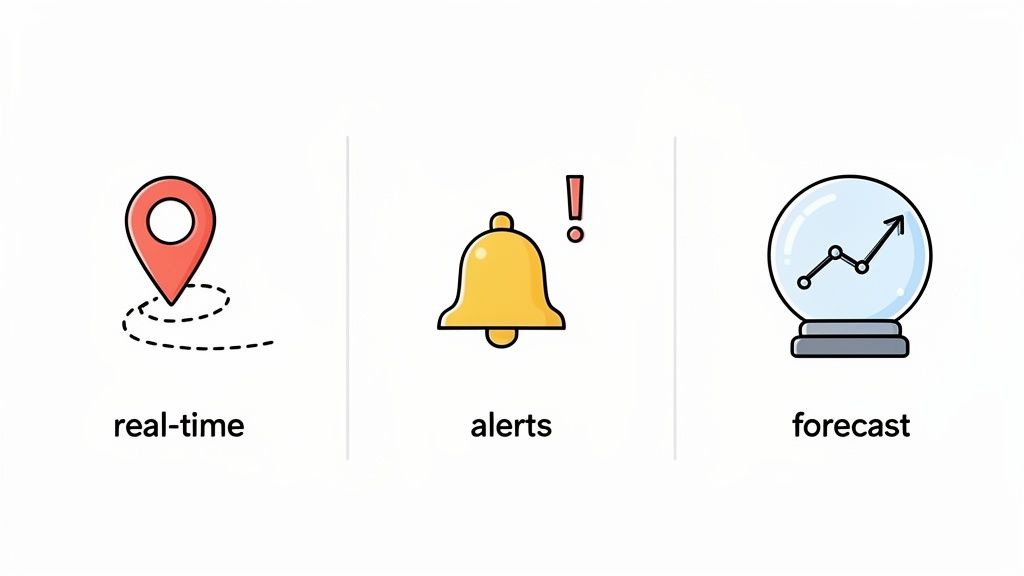
These systems are built on three foundational pillars that directly impact your ability to grow and stay profitable. Let's break them down, starting with what's happening right now and moving toward what's coming next. Each one solves a very specific headache that plagues fast-growing D2C brands.
Imagine trying to run your business by checking inventory just once a week. That data is stale the second you record it. This lag creates a dangerous gap between what you think you have and what’s actually on the shelf—and that's where stockouts and lost sales are born.
Real-time tracking closes that gap for good. Think of it as a live GPS for every single item you sell. It syncs directly with sales channels like Shopify to update your counts the instant an order comes through. This constant flow of data kills the guesswork, giving you one single, trustworthy source of truth.
Here’s how it plays out for a Shopify brand: A D2C skincare brand launches a new vitamin C serum that gets an unexpected shout-out from a major influencer. With real-time tracking, the brand manager sees the sales velocity spike instantly. Instead of finding out they're sold out two days later, they can immediately allocate the remaining stock, update the website to manage expectations, and get an emergency reorder in with their supplier to ride the wave of buzz.
While real-time tracking tells you what's happening now, automated alerts tell you what needs your attention immediately. These alerts are like a smart assistant constantly watching your inventory, flagging critical events before they blow up into full-blown crises. You no longer have to hunt for problems; the system brings them right to you.
And these aren't just basic "low stock" notifications. A solid inventory monitoring system can be set up to ping you about all sorts of conditions.
These automated triggers flip your workflow from constant manual checking to strategic exception management. You end up spending your time solving problems, not looking for them.
This is where an inventory monitoring system goes from being a tool to a true strategic partner. Using AI, predictive demand forecasting chews through historical sales data, seasonality, recent trends, and even your marketing calendar to project future customer demand with impressive accuracy. It’s like having a crystal ball that’s grounded in cold, hard data.
This capability moves you beyond just reacting to sales, allowing you to actually anticipate what your customers will want. Instead of guessing how many units you’ll need for the holiday season, the system gives you a data-backed recommendation. That kind of insight is crucial for optimizing your purchase orders and making sure your capital is tied up in products that will actually sell.
For brands that want to go deeper, understanding the nuances of AI-powered sales forecasting features is a great next step.
When you combine real-time data, smart alerts, and predictive insights, you create a powerful feedback loop. You get the clarity to manage today, the awareness to react to sudden changes, and the foresight to plan for a much more profitable tomorrow.
A powerful inventory monitoring system is a lot like a high-performance car. It's built for speed and efficiency, but you won't get very far if you don't know how to read the dashboard. The raw data your system spits out is just the start; real growth comes from knowing which numbers to watch and what they're telling you about the health of your business.
It’s easy to get caught up in vanity metrics, like total units sold. They feel good, but they often hide deeper problems. To build a truly profitable D2C brand, you need to get comfortable with the key performance indicators (KPIs) that connect your inventory decisions directly to your bottom line. These are the numbers that tell the real story about your cash flow, product performance, and operational efficiency.
First up is your Inventory Turnover Rate. This metric tells you how many times you sell through and replace your entire stock over a set period, usually a year. Think of it as a measure of how "fresh" your inventory is. A high turnover means products are flying off the shelves. A low rate? That suggests your cash is stuck in items that are gathering dust.
A sluggish turnover rate can be a red flag for a few different issues: * Overstocking: You might be ordering way too much at once, putting a serious strain on your cash flow. * Weak Sales: The products might not be clicking with your audience, pointing to a problem with marketing or product-market fit. * Operational Snags: Delays somewhere in your supply chain could be slowing the whole cycle down.
Calculating it is simple: Cost of Goods Sold (COGS) / Average Inventory Value. For most D2C brands, a healthy turnover rate lands somewhere between 4 and 6, but this can swing wildly depending on your industry. A fast-fashion brand will have a much higher rate than a high-end furniture store. The trick is to track this metric over time and watch for trends.
While turnover gives you that big-picture view, the Sell-Through Rate zooms in on how individual products are performing. It measures the percentage of units sold compared to the number you received from your supplier in a given timeframe, usually a month. This is your go-to metric for grading the success of a new product launch or a recent marketing push.
A high sell-through rate is a powerful signal that you've got a winner. It validates your purchasing decisions and tells you exactly where to double down with your marketing budget.
Let's say you get 100 units of a new skincare serum and sell 85 of them in the first month. Your sell-through rate is a fantastic 85%. But if another product is limping along at 15%, that’s your cue to start asking questions. Is the price off? Is the product page not convincing enough? This metric helps you pinpoint exactly what to investigate.
Now for the metric that ties it all together: Gross Margin Return on Inventory (GMROI). This KPI answers the most critical question for any merchant: "For every dollar I invest in inventory, how many dollars am I getting back in profit?" It perfectly blends your sales speed with your profitability, making sure you're not just selling a lot, but selling smart.
The formula is: Gross Margin / Average Inventory Cost. A GMROI above 1.0 means you're making money on your inventory investment. If it dips below 1.0, you're actually losing money for every dollar tied up in that stock.
Imagine you have two products. Product A has a killer sell-through rate but razor-thin margins. Product B sells a bit slower but has a huge margin. GMROI cuts through the noise and shows you which product is truly the better investment for your business. A good inventory monitoring system will crunch these numbers for you, turning a flood of data into a clear roadmap for making profitable decisions.
To help you keep these straight, here’s a quick rundown of the essential KPIs every D2C brand should have on their radar.
This table breaks down the most important inventory metrics, how to calculate them, and why they are so crucial for understanding the financial health and operational efficiency of your Shopify store.
| Metric | What It Measures | Why It Matters for D2C Brands |
|---|---|---|
| Inventory Turnover Rate | How many times inventory is sold and replaced over a period (usually a year). | Indicates sales velocity and inventory efficiency. A low rate can signal overstocking or poor sales, tying up valuable cash. |
| Sell-Through Rate | The percentage of units sold versus the number of units received from a supplier in a set period. | Perfect for evaluating individual product performance, especially for new launches or promotions. It tells you what's hot and what's not. |
| Gross Margin Return on Inventory (GMROI) | The gross profit earned for every dollar invested in inventory. | The ultimate profitability metric. It ensures you're not just moving units but actually making money on the products you sell. |
| Days of Inventory Outstanding (DIO) | The average number of days it takes to sell your entire inventory. | Measures how long your cash is tied up in stock. A lower DIO means faster conversion of inventory into cash, improving liquidity. |
| Stock-to-Sales Ratio | The amount of inventory you have on hand versus the number of sales you're making. | Helps you maintain a healthy balance. Too high, and you're overstocked; too low, and you risk stockouts and lost sales. |
Keeping a close eye on these numbers is non-negotiable. They move you from guessing about your business to truly understanding it, allowing you to make proactive, data-backed decisions that drive sustainable growth.
Taking the plunge and adopting a dedicated inventory monitoring system can sound like a huge undertaking, but it’s really just a series of manageable steps. For Shopify merchants, the name of the game is a seamless transition—one that levels up your store without throwing your daily operations into chaos. This isn't about a disruptive, rip-and-replace overhaul; it's a strategic upgrade.
It all starts with an honest look at where you are right now. A powerful new system won't magically fix messy data. Think of it like building a house: you need a solid, level foundation before you even think about putting up the walls. That means taking the time to get your existing inventory data squeaky clean.
Before you even glance at a new tool, your current data needs to be in order. This is, without a doubt, the most critical step for a successful integration. The old "garbage in, garbage out" mantra has never been more true. An AI-powered system needs clean, accurate historical data to give you forecasts and recommendations you can actually trust.
Start by auditing your product information. This means getting into the weeds with things like:
This cleanup work can feel tedious, but it pays off big time down the road. If you're wrestling with disorganized spreadsheets, our guide on how to format a sample Excel for inventory can give you a clear, structured template to follow. Clean data is the fuel for your new inventory system.
With your data prepped and ready, you can start shopping for the right partner. Not all inventory systems are built the same, especially when you consider the unique needs of a growing D2C brand. The goal is to find a solution that feels like a natural extension of your Shopify dashboard, not some clunky, bolted-on piece of software.
Zero in on platforms that offer deep, native Shopify integrations. This is non-negotiable. It ensures all your data—from sales and stock levels to customer info—flows between the two systems in real-time, killing the need for manual data entry. For a deeper dive into what’s out there, exploring the different options for integrating with Shopify is a great next step.
The right tool doesn't just show you data; it gives you clear, actionable insights. An intuitive interface that highlights what actually matters is way more valuable than a complicated dashboard filled with confusing charts.
The move to cloud-based tools has made this whole process much more accessible. In fact, projections show that over 70% of businesses will switch to cloud-based inventory solutions by 2025, pushing the market to an estimated $10.5 billion by 2035. This shift is all about scalability and lower operating costs—two things every Shopify merchant cares about. You can read up on the inventory management software market growth to see why this trend is picking up so much steam.
The last piece of the puzzle is getting your team on board and actually using the system's insights in your day-to-day work. A tool is just a tool; it's the people using it effectively that solve problems. A smooth rollout depends on team-wide buy-in and a clear plan for how this new data will shape your decisions.
Kick things off with focused training sessions. Make sure everyone, from the marketing manager to the person running your warehouse, knows how to find the information that’s relevant to their job. This empowers your entire team to be proactive.
This infographic breaks down the flow of key metrics your new system will help you master—from tracking how fast your inventory sells to measuring its actual profitability.
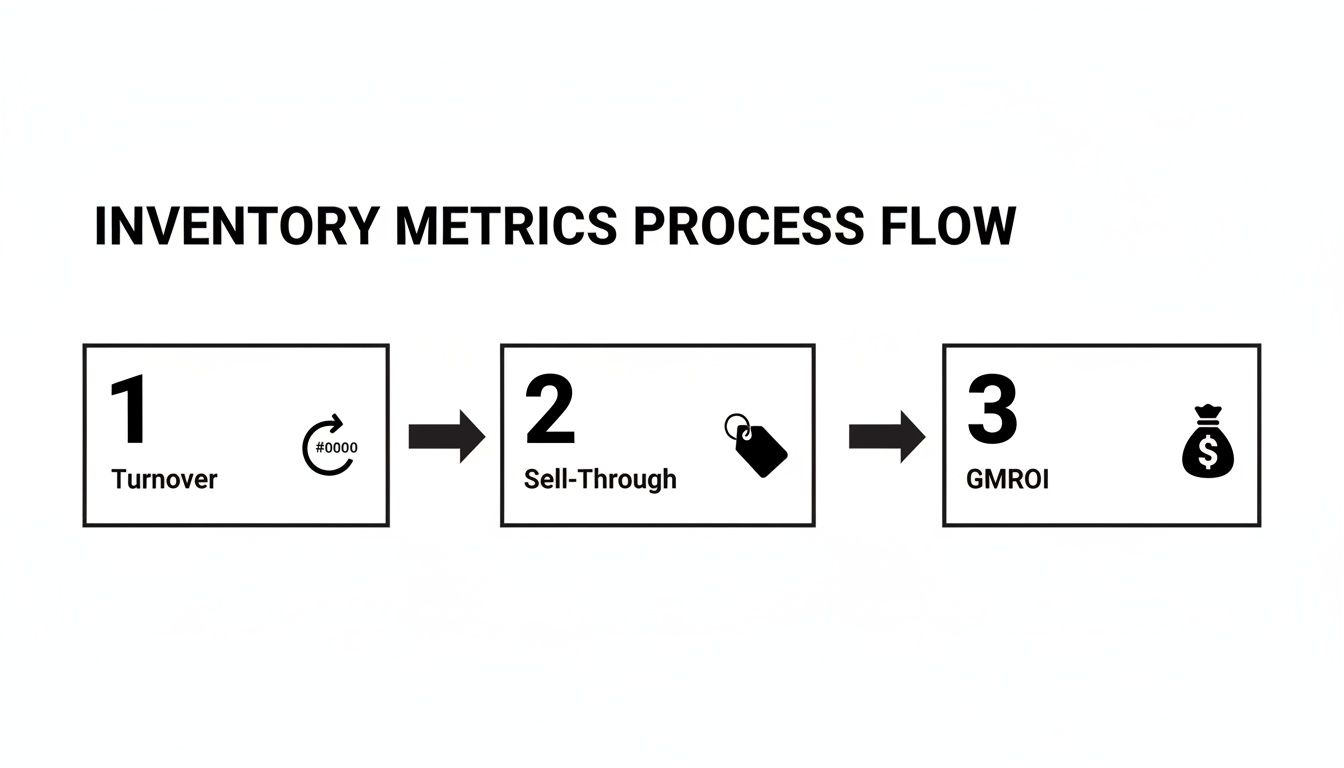
As you can see, one metric naturally leads to the next, giving you a complete picture of your inventory's health and financial performance. By following this data trail, you can start making smarter, more confident decisions at every point in your product's lifecycle.
Of course. Here is the rewritten section, crafted to sound completely human-written and natural, following the provided style guide and examples.
Getting a powerful inventory monitoring system is a huge step, but the tool itself is only half the battle. Real success comes from using it right. I’ve seen too many brands invest in great software only to stumble over the same common, avoidable mistakes that keep them from seeing a real return.
These missteps can turn a promising investment into just another subscription fee draining your bank account. By knowing what to look out for, you can make sure your system becomes the growth engine it’s supposed to be, not a source of constant frustration.
This is the big one. The most fundamental mistake you can make is assuming the system will magically clean up your messy data. An inventory monitoring system is only as smart as the information you feed it. If you’re pushing in incomplete SKUs, inconsistent product names, or wonky historical sales data, its forecasts and recommendations will be just as flawed.
Think of it like asking your GPS for directions but giving it a misspelled address—you’re not going to end up where you want to go. The same logic applies here. Before you flip the switch, take the time to do a full physical inventory count and standardize all your product data. It’s tedious work, but it pays off.
A cautionary tale: I worked with a fast-growing snack brand that integrated a new system without cleaning their data first. The AI-powered forecasts kept recommending massive orders for a product that barely sold, tying up thousands in cash. The culprit? Years of manually entered sales data had lumped returns and promotional giveaways into the same sales column, tricking the algorithm into seeing a bestseller that just wasn't there.
One of the best things about an inventory monitoring system is the automated alerts. But setting up generic, out-of-the-box notifications is a fast track to alert fatigue. Your team will start ignoring important warnings because they're buried in constant, meaningless pings.
Don't just turn on the default "low stock" alert for every single product. You need to get strategic.
Customizing your alerts turns noise into signal. Every notification should trigger a specific, strategic action, keeping your team focused on what actually matters.
Another common trap is seeing your new system as a complete replacement for human strategy. These tools are incredible at crunching numbers and spitting out recommendations, but they have zero context for the nuances of your brand, your upcoming marketing campaigns, or a sudden pivot in your industry.
Think of your system as an expert analyst, not the CEO. It provides the data-driven insights; your team provides the context. Use its forecasts as a baseline, then layer your own strategic knowledge on top. If you’re about to launch a huge influencer collaboration, you’ll need to adjust your inventory plan, no matter what the historical data says. The brands that win are the ones that create a workflow where human expertise and artificial intelligence work together, making each other smarter.
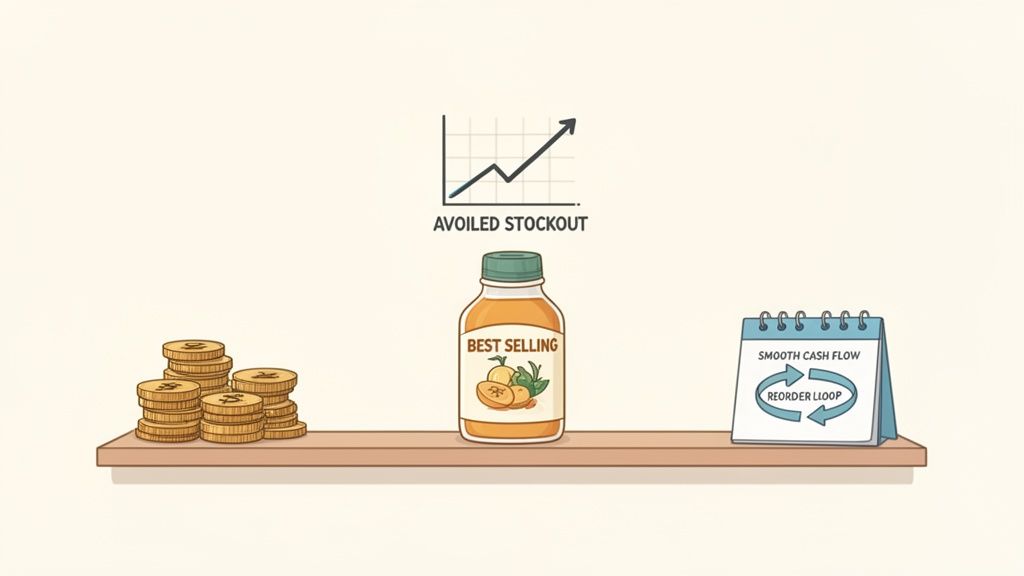
So, how does an inventory monitoring system actually put more money in your pocket? It's not just about fancy features; the connection between smart inventory tracking and your bottom line is direct and measurable. The return on investment (ROI) isn't some vague promise—it shows up on your balance sheet by turning raw inventory data into tangible profit.
This financial impact really comes from three key areas. First, you stop overstocking, which slashes the holding costs that eat away at your margins. Second, you prevent stockouts on your bestsellers, capturing sales you would have otherwise lost for good. And finally, you get your entire purchasing cycle in sync, which frees up cash you can pour back into growing the business.
Every dollar tied up in a product that isn't selling is dead weight. It’s that simple. Overstock drains your cash, hogs valuable warehouse space, and almost always leads to profit-killing clearance sales down the road. An AI-powered system attacks this problem head-on by forecasting demand with a level of accuracy that just wasn't possible before.
Picture a fashion brand gearing up for a new season. Instead of placing a huge, speculative order based on last year’s trends, the system dives into current sales velocity and market signals. It might recommend a smaller, more precise initial purchase, keeping cash in the bank and preventing a massive season-end sale that would demolish their margins.
By aligning what you buy with what people are actually buying, you cut down on excess stock and all the costs that come with it. This precision is a primary driver of ROI, turning potential losses into protected profit.
There are few things more painful than seeing a bestselling product go out of stock right at its peak. Every one of those missed sales is lost revenue, and even worse, it can send loyal customers straight to your competitors. An intelligent inventory monitoring system is your best defense against these costly slip-ups.
The market for this tech is exploding for a reason. Projections show the inventory management software space is set to surge from USD 1,551.1 million in 2025 to a whopping USD 5,698.8 million by 2033. For small and mid-sized stores, stockouts can cost up to 4-8% of annual revenue—exactly the kind of problem AI-driven forecasts are built to solve.
When it comes down to it, better inventory monitoring means better cash flow. When you buy the right amount of the right products at exactly the right time, your money isn't just sitting on a shelf. It’s working for you, ready to be deployed for a new marketing campaign, product development, or any other growth initiative.
This optimized purchasing cycle is where a system like Tociny.ai really pays for itself. For businesses looking to get a custom-fit solution, exploring AI development services can lead to tailored systems that truly nail inventory accuracy. By turning your inventory into a dynamic, cash-generating asset, you build a much more resilient and profitable business. You can learn more about how to predict consumer demand with AI in our related guide.
Jumping into the world of inventory monitoring can definitely bring up a few questions, especially if you're used to managing everything right inside Shopify. We get it.
So, let's clear the air and tackle some of the most common things merchants ask when they're thinking about adding a dedicated system to their stack.
Think of Shopify's native inventory tracking like the speedometer in your car. It's fantastic at telling you one thing with perfect accuracy: your current speed (or, in this case, your current stock level). It’s simple, reliable, and absolutely essential for day-to-day operations.
An inventory monitoring system, on the other hand, is the full GPS navigation system with live traffic updates. It doesn't just tell you where you are right now; it analyzes your sales velocity, spots trends, and projects the best route forward to avoid traffic jams (stockouts) and dead ends (overstock).
It’s the strategic layer on top of basic counting that helps you move from simply knowing what you have to truly understanding what you'll need.
You'll feel the operational relief almost immediately. Within the first couple of weeks, the daily guesswork of checking spreadsheets and manually tracking products disappears. Your team gets a single, reliable source of truth, which cuts down on confusion and saves a ton of time.
The real financial impact starts to show up within the first 90 days. That's when most brands see a measurable drop in stockouts on their bestsellers and a healthier cash flow. But the game-changing ROI—the big savings on holding costs from smarter, data-backed purchasing—typically crystallizes around the six-month mark. By then, the system has really learned your unique sales patterns, making its forecasts incredibly sharp.
This is a question we hear all the time, but honestly, it's often the smaller, growing brands that get the biggest bang for their buck, and fast. When you're growing, every single dollar of capital is precious.
Tying up your limited cash in products that just sit on the shelf can be a silent killer. On the flip side, stocking out of that one product that just went viral on TikTok means leaving a massive pile of money on the table.
An inventory monitoring system helps you build profitable, scalable habits from the get-go. It gives you the data-driven foundation to grow smarter and sidestep the inventory headaches that stall so many promising brands. It’s not about how big you are now; it's about building the operational muscle to handle the growth you're aiming for.
Ready to stop guessing and start planning with confidence? Tociny.ai provides the AI-powered insights Shopify merchants need to optimize stock levels, reduce overstock, and capture every sale. Join our private beta for exclusive early access and one-on-one guidance. Learn more at tociny.ai.
Tociny is in private beta — we’re onboarding a few select stores right now.
Book a short call to get early access and exclusive insights.