Running an ecommerce store can feel like you're trying to navigate a busy highway blindfolded, especially when it comes to inventory. This section breaks down the real costs of that guesswork—the kind Shopify merchants deal with every single day, from revenue that simply vanishes to cash that's hopelessly tied up in unsold products.
Think of AI demand forecasting as your strategic co-pilot, giving you the clarity to finally see the road ahead.
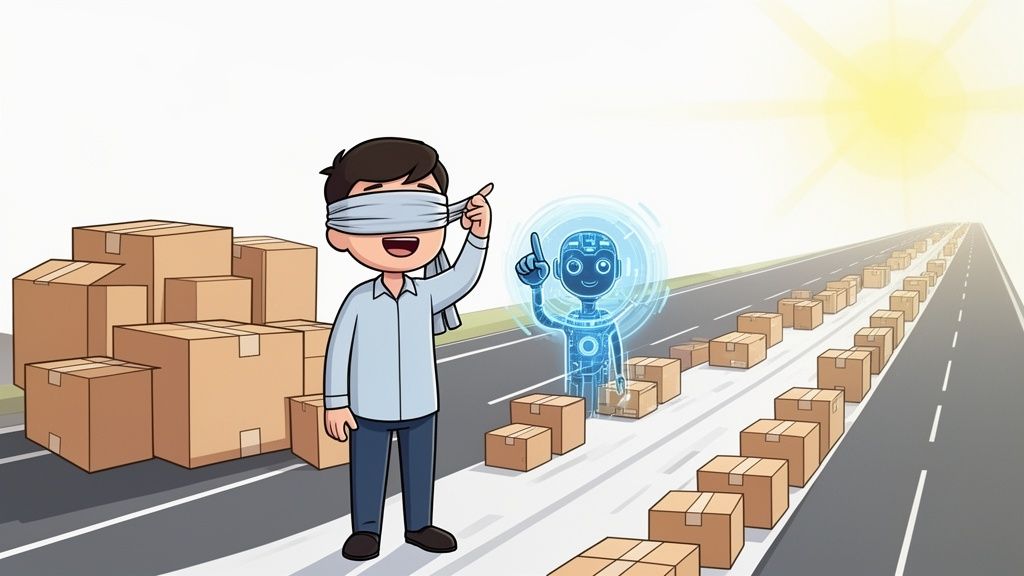
For too many Shopify merchants, managing stock is a shaky balancing act between gut feelings and dusty spreadsheets. You're constantly trying to guess what your customers will want next week, next month, or during the chaotic holiday rush. This manual approach isn't just stressful; it's incredibly expensive.
The fallout hits every part of the business. An unexpected stockout on a bestseller means lost sales and frustrated customers who might just shop somewhere else next time. On the flip side, overstocking a slow-mover locks up precious cash that you could be pumping into marketing or developing your next big product. It's a painful, reactive cycle of missed chances and wasted money.
The real issue with traditional methods is that they just can't keep up with the speed of modern commerce. They lean heavily on simple historical averages, completely missing the dynamic, real-world factors that actually influence ai demand.
This guesswork creates a serious financial drain:
Shifting from reactive, gut-feel decisions to a proactive, data-driven strategy is how you turn inventory into a competitive advantage. It’s about making smarter choices based on what is likely to happen, not just what has already occurred.
To truly get past the guesswork, you need more than just better predictions. Implementing effective inventory reorder strategies is the other half of the puzzle, turning AI-driven insights into action. This is where a clear view of future ai demand becomes absolutely essential.
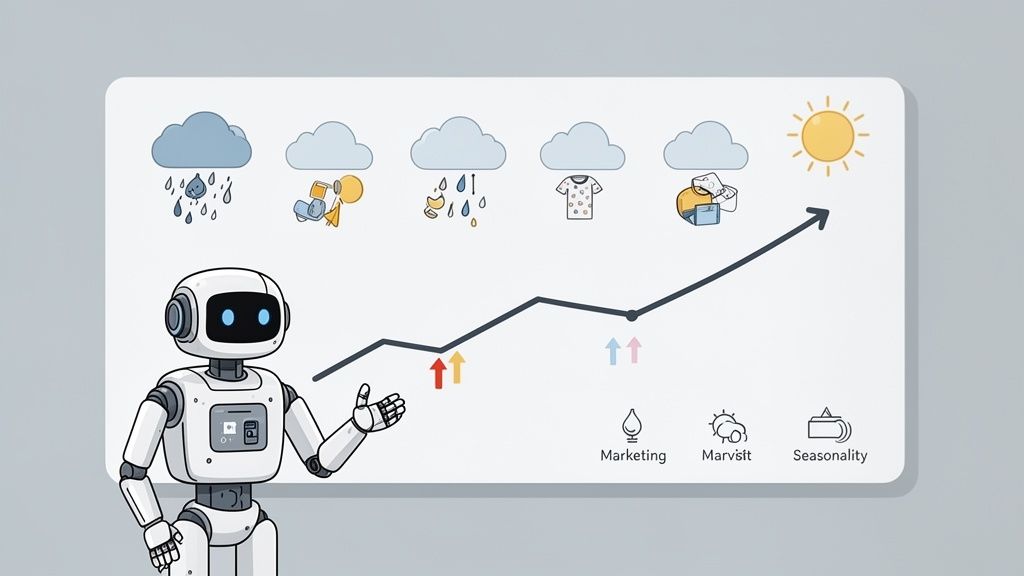
Let's cut through the jargon. Think of AI demand forecasting as a super-smart weather forecaster, but for your products. A standard forecast might look at past sales and say, "We sold 100 units last June, so we'll probably sell 100 again." It’s a decent guess, but it’s looking backward.
AI forecasting flips that script. It doesn't just glance at old sales data; it dives deep into dozens of interconnected factors happening right now. We're talking about everything from your upcoming marketing campaigns and seasonal hype to what your competitors are charging and which products are suddenly trending on TikTok.
So, what's the magic behind it? It's all about machine learning algorithms and predictive analytics. Think of machine learning as the system's brain. It's constantly learning from new data, spotting subtle patterns that are practically invisible to the human eye.
Predictive analytics is what the brain does with that insight. It takes those hidden patterns and projects what’s likely to happen next. For example, it might notice that a 15% bump in Instagram engagement for a specific SKU leads to a sales spike three weeks later. That's a connection a simple spreadsheet would never make.
An AI forecast isn’t a crystal ball—it's a science built on the concrete data your business is already generating. Its power comes from understanding how dozens of different factors influence each other at the same time.
And this capability is catching on for a reason. The global artificial intelligence market shot up from USD 11 billion in 2020 to around USD 128 billion in 2024. That’s a growth of over 1,000%, showing just how seriously businesses are taking AI for smarter decision-making.
The best part? You don't need a PhD in data science to use it. Modern tools like Tociny.ai are built to put this power in your hands. They plug right into your Shopify store, crunch all the complex data behind the scenes, and serve up the insights on a clear, actionable dashboard.
While AI is our focus, it's worth seeing how it stacks up against the different inventory forecasting methods merchants have relied on for years. This new approach automates the heavy lifting, turning messy data into a reliable forecast that lets you make confident inventory moves.
If you want to go deeper on the nuts and bolts, our complete guide on demand forecasting methods breaks it all down. Ultimately, it’s about letting you focus on strategy, not getting lost in the numbers.
An AI forecast is only as good as the ingredients you feed it. While old-school methods lean almost entirely on past sales numbers, a modern AI demand forecasting system is like a master chef, blending a wide variety of data sources to create a much more nuanced and reliable prediction of what your customers will actually buy.
This isn't magic; it's a science built on the concrete data your business is already generating. By looking beyond simple sales history, AI starts to understand the why behind the numbers. It connects the dots between a marketing campaign and a sales lift, or a price drop and a surge in demand, learning from these relationships to make smarter predictions for the future.
To truly see what's coming, AI needs to look at multiple layers of your business activity. These rich data streams are what give it a multi-dimensional view of your market, moving far beyond a simple "we sold X units last year."
Here are some of the key inputs it analyzes:
An AI model doesn’t just see that you sold 500 units; it understands the specific conditions—a holiday, a marketing push, a competitor's stockout—that created that outcome. That's what allows it to forecast future scenarios with much greater precision.
The difference between these approaches is stark. One relies on a single, often misleading, historical number, while the other creates a dynamic, living picture of your business. Understanding how to measure and improve your predictions is vital, which is why we've detailed how to calculate demand forecast accuracy in our comprehensive guide.
The table below breaks down the critical difference in the data each approach uses. On one side, you have manual guesswork based on limited history. On the other, you have an automated system that connects countless data points to build a complete picture of demand.
| Data Input | Traditional Forecasting (Manual) | AI-Powered Forecasting (Automated) |
|---|---|---|
| Sales History | Uses past averages (e.g., Last Year's Sales) | Analyzes detailed historical data and trends |
| Promotions | Relies on manual adjustments and guesswork | Automatically correlates marketing events to sales |
| Pricing | Often ignored or requires manual calculation | Models demand elasticity based on price changes |
| Seasonality | Applies simple seasonal factors | Detects complex, multi-layered seasonal patterns |
| External Factors | Cannot process external market signals | Can incorporate market trends and competitor data |
As you can see, AI isn't just a slightly better calculator. It's working with a fundamentally richer, more complete set of information, which is why it delivers a fundamentally better result.
It’s one thing to understand the data that fuels AI demand forecasting, but the real question is: what does it actually do for your Shopify store? The answer isn't buried in complex analytics; it’s in tangible results that directly pad your bank account. By finally ditching the guesswork for data-driven precision, you can turn inventory from a constant headache into your most valuable asset.
This is all about translating those fancy algorithms into real-world cash. Think about heading into Black Friday with total confidence, knowing you’ve got just the right amount of stock to capture every sale without tying up money in products that are just going to sit there.
This map shows how an AI engine pulls together different data streams to build a forecast you can actually trust.
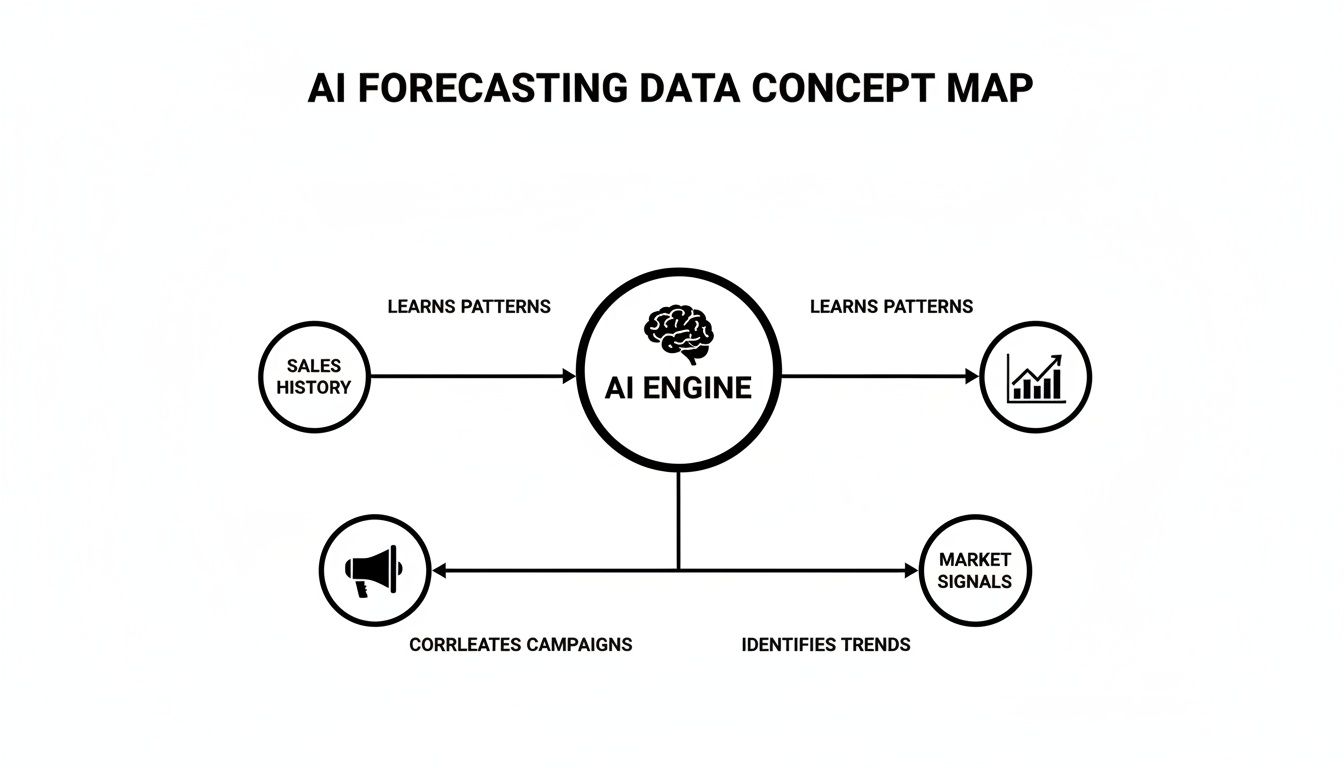
As you can see, it’s not just looking at old sales data. The system combines your sales history, marketing plans, and even what’s happening in the broader market to create a full picture of what’s coming.
Stockouts are silent profit killers. Seriously. Every time a customer hits that dreaded "out of stock" page, you don’t just lose one sale—you risk losing them for good. AI-powered inventory management sees demand spikes coming before they hit, making sure your bestsellers are always on the shelf when your customers are ready to pull out their wallets.
By analyzing trends and the real impact of your promotions, the system tells you exactly when to reorder and how much. It turns missed opportunities into locked-in revenue.
On the flip side, you’ve got overstock—the slow-moving inventory that quietly eats away at your resources. All those extra products are just capital sitting on a shelf, money that you could be using for marketing, new product development, or just about anything else to grow your business. Plus, you’re paying storage fees and eventually resorting to deep discounts that tank your margins.
AI forecasting gives you the clarity to buy smarter. By predicting demand with far greater accuracy, it helps you run a lean, efficient operation, ensuring your money is working for you, not gathering dust.
Just think about all the hours your team sinks into spreadsheets—manually pulling reports, trying to calculate reorder points, and building purchase orders. It’s a grind. AI takes that entire process off your plate.
It crunches all the complex data and gives you simple, clear replenishment recommendations. This isn’t some future fantasy; corporate AI adoption has already hit 72% as businesses realize how much time it saves. You can find more on this business shift at Intuition.com. This frees up you and your team to focus on the strategic work that actually moves the needle for your brand.
At the end of the day, a smarter approach to AI demand creates a healthier bottom line through three core wins:
Bringing AI-powered forecasting into your business sounds like a huge, expensive tech project, right? The reality is a whole lot simpler. Modern tools are built specifically for platforms like Shopify, turning what used to be a complex data science job into something that feels more like installing a new app.
The whole point is to get you from setup to making smarter inventory decisions as fast as possible, no coding or data science degree required.
First things first, you need to connect the AI platform to your Shopify store. This is usually handled with a direct integration that just takes a couple of clicks to authorize. Once you give it the green light, the system securely pulls in your historical sales data, product info, and any past promotions you've run. This initial sync is the foundation for everything else.
Right away, the AI gets to work analyzing your store’s unique sales patterns. Within the first 24-48 hours, the platform crunches all that data to generate its first forecast. And this isn't a one-and-done deal; the AI keeps learning, getting smarter and more accurate as new sales roll in every day.
You don't need to be a data scientist to get all the benefits. The heavy lifting—like processing data, spotting trends, and building predictive models—all happens behind the scenes. You just get the clear, actionable insights.
Once the initial number-crunching is done, you’ll see a dashboard that brings your future demand to life. This is where the magic happens, turning abstract data into a practical tool you can use immediately.
Typically, your dashboard will show you a few key things:
Suddenly, making an informed purchasing decision is straightforward. You can look at the AI's recommendations, weigh them against your own gut feelings and industry knowledge, and place purchase orders backed by solid data, not just guesswork. For a deeper look at how these pieces fit together, our guide to demand forecasting breaks down how a complete inventory picture is built. The entire process is designed to feel empowering and low-risk, giving you the confidence to trust the numbers.
The thought of plugging artificial intelligence into your inventory planning can be… a lot. It’s an area filled with intimidating jargon, misconceptions, and a healthy dose of fear. Many merchants pump the brakes, worried about eye-watering costs, mind-numbing complexity, or losing the hands-on control they’ve worked so hard to maintain.
Let's clear the air. We need to tackle these myths head-on, because the reality of modern AI tools is that they’re built to be your ally, not some robotic replacement. The world of AI has changed fast. What was once walled off for massive corporations with bottomless budgets is now genuinely accessible and practical for growing Shopify stores just like yours.
This is probably the biggest hurdle. There’s a lingering idea that adopting AI means a massive, six-figure upfront investment in software, plus the cost of hiring a team of specialists to run it. For small and medium-sized businesses, that’s a non-starter.
But that’s an outdated picture. The rise of Software-as-a-Service (SaaS) platforms has completely flipped the script. Modern tools like Tociny.ai run on affordable, scalable subscription models. You pay a predictable monthly fee that makes sense for your current size and can grow with you. There's no scary capital investment. It's less about buying a complex system and more about subscribing to a service that starts delivering value from day one.
Another major fear is the sheer complexity of it all. Merchants worry they’ll need a data science degree just to make sense of the dashboard, let alone act on any of its insights. For today's best AI inventory tools, this couldn't be further from the truth.
Think about it: these platforms are designed for busy business owners and inventory managers, not programmers. The whole point is to translate complex ai demand data into something simple and actionable. They do this with intuitive interfaces and clear visuals that get straight to the point.
The goal of a modern AI tool isn’t to bury you in algorithms or code. It’s built to empower you with data-driven recommendations that feel like plain English. The output should be clear advice, like "order 50 more units of SKU #12345," not a complex statistical model you have to decipher yourself.
This one is personal. It’s the fear that AI will take the wheel, forcing you to blindly follow its recommendations and stripping you of your own hard-won expertise and gut feelings. This comes from a fundamental misunderstanding of what these tools are designed to do.
An AI forecasting tool is a strategic advisor, not an automated dictator. It provides incredibly powerful, data-backed suggestions, but you always, always have the final say. The system is there to do the heavy analytical lifting—the tedious number-crunching you don’t have time for. That frees you up to apply your unique market knowledge and strategic vision to make the final, well-informed decision.
Let’s be honest, jumping into any new technology brings up some big questions. When it’s something as critical as your inventory and cash flow, you need straight answers before you even think about making a move. Here are the most common questions Shopify merchants ask, broken down into simple, no-fluff responses.
This is always the first question, and for good reason. The short answer? It's far more accurate than doing it by hand.
Think about it this way: when you forecast manually, you're probably looking at last year's sales, maybe factoring in a recent trend. An AI model, on the other hand, is like having a whole team of analysts working 24/7. It crunches dozens of variables all at once—your historical sales, seasonality, upcoming promotions, marketing spend, and even external factors like competitor pricing.
This comprehensive approach allows it to spot subtle patterns a spreadsheet could never catch. For most stores, this translates to a 20-30% drop in forecast errors. That means fewer stockouts on your winners and less cash collecting dust in products that just won't move. It’s not here to replace your gut feeling; it’s here to supercharge it with data.
AI doesn't just make a slightly better guess based on the past. It calculates the most likely future by understanding all the little things that actually drive your sales. The result is a prediction you can actually rely on.
While pretty much any store can see improvements, some businesses get a truly massive lift from AI.
If you’re juggling a large catalog with tons of SKUs, you know the headache. The same goes for stores with intense seasonal spikes (hello, Black Friday) or a packed promotional calendar. These situations create a level of complexity that’s nearly impossible for a human to manage without making costly mistakes. AI thrives in that chaos.
Fast-growing brands also find it invaluable. When your sales are doubling year-over-year, last year’s data isn't much help, is it? An AI system adapts to that rapid growth in real-time, helping you scale your inventory operations smoothly instead of constantly playing catch-up.
This isn't one of those projects that takes six months to show a return. Once you connect your store, most merchants start seeing actionable insights within the first 24-48 hours. The AI gets to work on your historical data right away, generating its first round of forecasts and replenishment suggestions almost immediately.
But what about tangible business results? You'll typically see a real drop in stockouts and more balanced inventory levels within your first one to three buying cycles. The magic happens when you start acting on those AI-powered recommendations. That's when the insights turn into confident, data-backed decisions that directly impact your bottom line.
Ready to stop guessing and start forecasting with confidence? Tociny.ai replaces spreadsheet chaos with clear, AI-driven recommendations that help you prevent stockouts and reduce overstock. Join our private beta today and turn your inventory into a competitive advantage.
Tociny is in private beta — we’re onboarding a few select stores right now.
Book a short call to get early access and exclusive insights.