Inventory management is simply the system you use to order, store, and sell your products. But for a Shopify brand, it's really about having the right product, in the right quantity, at the right time—without sinking all your cash into boxes sitting on a shelf.
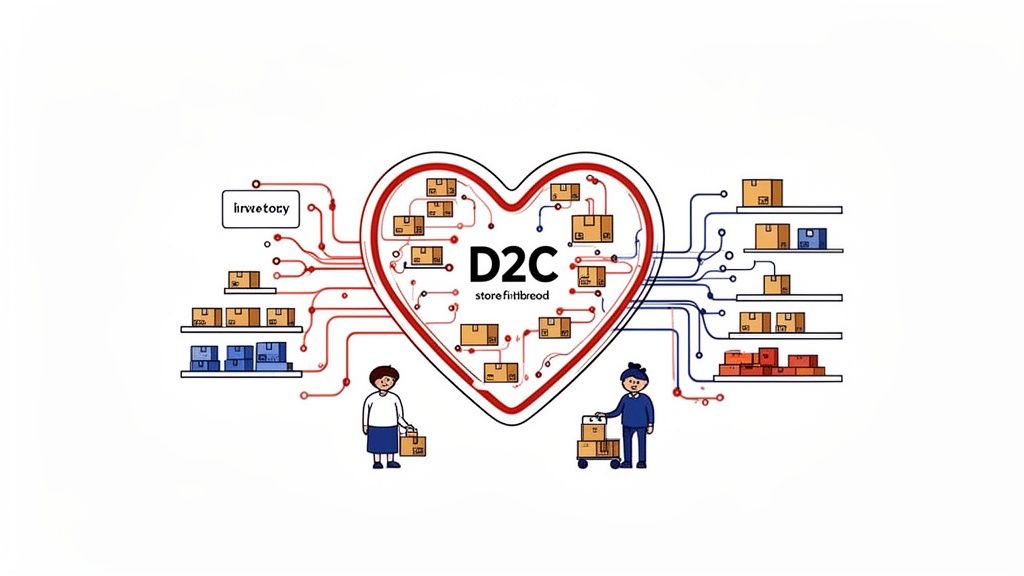
For any growing D2C brand, inventory management isn’t just another task on the to-do list. It’s the central nervous system of your entire operation. Think of your inventory as the lifeblood of your business. If it moves too slowly, your cash gets trapped in unsold goods, and you're stuck with overstock. If it moves too fast without being replenished, you’re looking at stockouts, angry customers, and lost sales.
Nailing this flow—from sourcing products to shipping them out—is what separates the brands that thrive from those that just survive. It has a direct impact on your profits, customer loyalty, and your reputation. In today's e-commerce world, where supply chains are unpredictable and trends shift overnight, a "wait-and-see" approach is a surefire way to fall behind.
Let's be clear: the consequences of dropping the ball on inventory go way beyond a messy stockroom. The financial hit can be huge, quietly chipping away at your margins and suffocating your growth. Without a solid plan, brands often get stuck in a painful cycle of expensive mistakes.
An effective inventory management system isn't about eliminating problems entirely—it's about seeing them coming and having the intelligence to react before they hurt your bottom line or your customers.
Think about these common scenarios that bleed cash:
The goal is to shift from putting out fires to preventing them in the first place. That means using data to predict what your customers will want, not just reacting to orders as they roll in. Once you understand the core principles and get the right tools in place, inventory management stops being a source of stress and becomes your biggest competitive advantage. For a deeper look, check out these foundational best practices for inventory management to build a stronger operational framework.
And remember, your strategy doesn't end in the warehouse. Making sure your products are displayed well, whether online or in-person with optimized retail displays, also drives sales and reflects how well your inventory is moving. At the end of the day, a smart inventory strategy is the most powerful tool you have for building a resilient and profitable Shopify brand.
So, your Shopify dashboard is packed with numbers. Sales, sessions, conversion rates... it's a lot. But buried in all that data is the real story of your business's health. The trick isn't just to have the data; it's to turn it into smart, profitable decisions.
Think of key performance indicators (KPIs) as your store's vital signs. Like a doctor checking your pulse and blood pressure, these metrics help you diagnose problems before they get serious, spot hidden opportunities, and keep your operations humming. They cut through the noise and answer the questions that really matter:
To get a handle on your inventory performance, you need a go-to set of metrics. This table breaks down the most critical KPIs, what they tell you, and why they’re non-negotiable for a growing D2C brand.
| KPI | What It Measures | Why It's Critical for Your Store |
|---|---|---|
| Inventory Turnover Rate | How many times you sell and replace your entire inventory in a year. | It's the ultimate measure of efficiency. A low rate signals overstocking and tied-up cash; a high rate shows strong sales. |
| Sell-Through Rate | The percentage of stock sold versus what you received in a specific period (usually a month). | This is your product performance radar. It tells you which new items are instant hits and which are duds, fast. |
| Gross Margin Return on Investment (GMROI) | How much gross profit you make for every dollar invested in inventory. | This connects sales velocity to actual profitability. It answers: "Is selling this product really making me money?" |
| Weeks of Supply (WOS) | How many weeks your current inventory will last based on recent sales trends. | Your early warning system for stockouts. It helps you time reorders perfectly to avoid disappointing customers. |
| Stockout Rate | The percentage of orders you couldn't fulfill due to having no stock. | This directly measures lost sales and customer frustration. Keeping this number low is crucial for brand loyalty. |
By keeping an eye on these numbers, you move from guessing to knowing. They give you the clarity needed to make confident decisions about purchasing, marketing, and pricing every single day.
Let's dive deeper into the three metrics that every founder needs to live and breathe. Forget the complicated formulas for a second; these are the practical tools you’ll use to turn your inventory into a profit-generating machine.
This is the big one. Your inventory turnover rate tells you how many times you sold and replaced your entire stock over a given period, usually a year. A healthy turnover rate is a sign of strong demand and efficient operations.
For instance, if your annual COGS is $500,000 and your average inventory is valued at $100,000, your turnover rate is 5. You sold through your entire inventory five times that year. For many e-commerce brands, that's a solid number, but the "right" rate really depends on your industry.
While turnover gives you the 30,000-foot view, the sell-through rate is your magnifying glass. It measures the percentage of units sold against the number of units you received from your supplier, usually within a month. This makes it perfect for judging the performance of a specific product or a new collection.
Tracking these numbers is just step one. The real magic happens when you use them to make strategic moves. This is the leap from simply managing inventory to actively optimizing it for profit.
"Data is the new oil. It's valuable, but if unrefined it cannot really be used. The goal is to turn data into information, and information into insight." - Carly Fiorina, former CEO of Hewlett-Packard
This is the ultimate gut-check for profitability. GMROI tells you exactly how much gross profit you earned for every single dollar you invested in inventory. A product might have a fantastic sell-through rate, but if the margin is paper-thin, it's not doing much for your bottom line. GMROI brings sales velocity and profitability together.
When you consistently watch these three KPIs, you create a powerful feedback loop. Your data starts telling you a clear story: which products to reorder with confidence, which ones need a marketing nudge, and which you should probably cut loose. You ensure every dollar of your capital is working as hard as you are.
Every D2C brand owner is fighting a constant, often silent, battle against two major profit killers: overstock and stockouts. I like to think of them as twin dragons, each feasting on your margins in its own destructive way. One hoards your treasure by tying up cash in unsold goods, while the other breathes fire on customer trust, leaving behind a trail of lost sales.
Your sword and shield in this fight? Smart inventory management.
Let's say you're selling a popular line of skincare. Heading into summer, you place a massive order for your best-selling sunscreen, banking on a huge sales rush. But then the weather turns out to be dreary and cool, demand fizzles, and you're left sitting on a mountain of product that expires in six months. That’s the overstock dragon, and it just took a huge bite out of your cash flow.
Having too much inventory might feel safer than having too little, but that feeling is a dangerous illusion. Overstock quietly drains your business of its most critical resource: cash. And the cost goes way beyond what you paid for the product itself.
Now, let's flip the script. Imagine your new line of winter coats goes viral on TikTok right before Black Friday. The orders start pouring in, but you completely sell out of the most popular size by noon. Every single person who lands on that product page and sees "Sold Out" is a guaranteed lost sale. That's the stockout dragon, and its damage is both immediate and painful.
A stockout is more than just a missed transaction; it's a broken promise to your customer. It tells them you weren't prepared for their excitement, and it gives them a reason to visit your competitor.
The scale of these challenges is massive, and you're not alone in facing them.
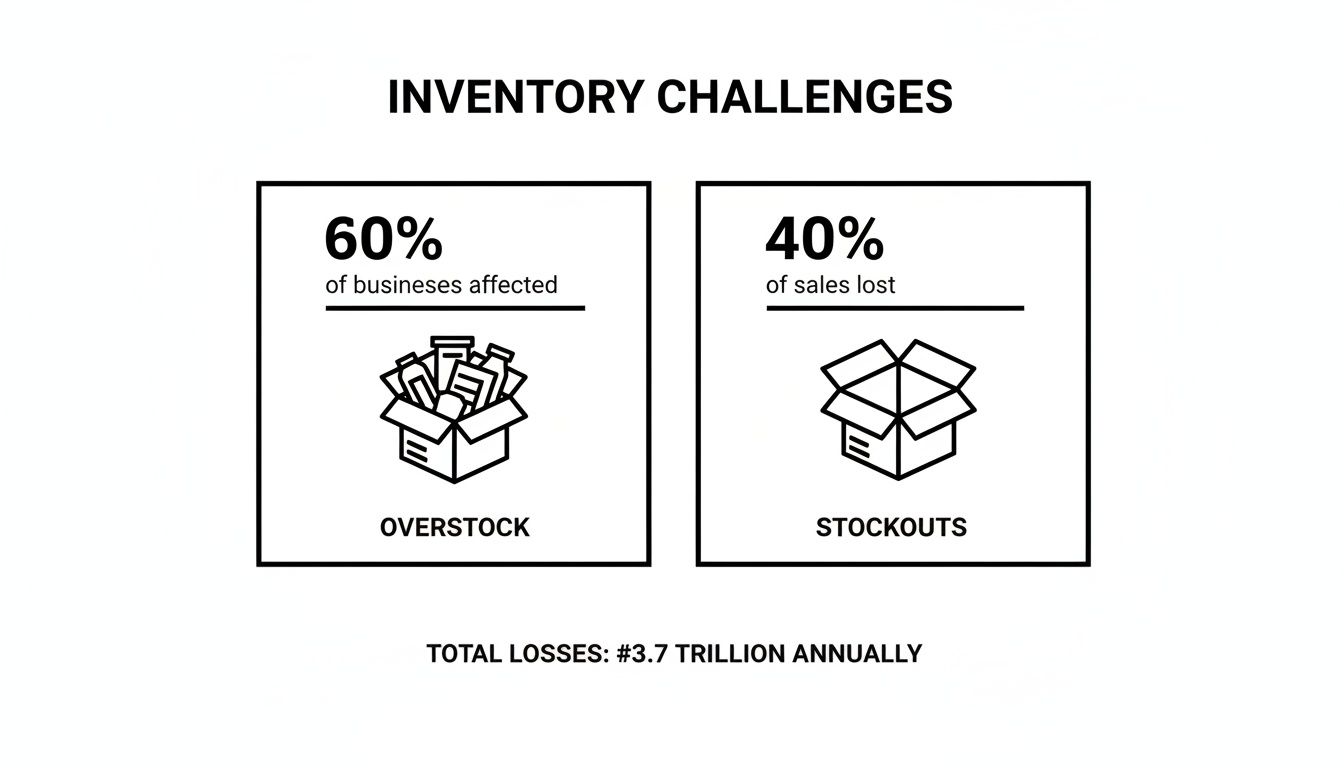
The data makes it crystal clear: both overstocking and stocking out are huge financial drains. A balanced approach isn't just nice to have; it's essential for survival.
The consequences of stocking out are severe:
Slaying these dragons means moving from reactive guesswork to proactive, data-driven planning. To really get a handle on overstock and stockouts, you have to dig into the top inventory optimization techniques. By using real data to understand your demand patterns and supplier lead times, you can finally find that sweet spot—having just enough stock to thrill your customers without crippling your cash flow.
Predicting what your customers will want to buy next often feels like guesswork. One month a product is flying off the shelves, and the next, it’s gathering dust. This volatility is one of the toughest parts of managing inventory well, but you don't need a crystal ball to get it right—you just need a solid approach to demand forecasting.
At its heart, demand forecasting is just an educated guess about future sales based on the data you already have. It's about using your past performance and what's happening in the market to make smarter bets on how much product to order. Nail this, and you're already on your way to avoiding those painful stockouts and costly overstock situations.
Many brands start with what’s known as quantitative forecasting. Think of this as driving a car by only looking in the rearview mirror. Your past sales give you a clear picture of the road you've just traveled, and if conditions are stable, it can be a decent guide for what’s ahead.
For instance, a simple method is the moving average. A brand might look at their sales for a specific SKU over the last three months—say, 100 units in January, 120 in February, and 110 in March. They'd average those numbers to predict they’ll sell around 110 units in April. It’s a logical, straightforward place to begin.
The problem is, these traditional models are built on one huge assumption: that the future will look a lot like the past. For a business with incredibly stable, predictable sales, that might be enough. But for most D2C brands on Shopify, the market is anything but stable.
The digital marketplace moves at a breakneck pace. A single viral TikTok video, a new marketing campaign, or a sudden shift in consumer trends can make your historical sales data almost irrelevant overnight. Relying only on past performance here is like using a road map from 2010 to navigate a city in 2024—the landscape has completely changed.
Here’s exactly why these old-school methods fall short for modern e-commerce brands:
Forecasting isn’t about finding a perfect, magical number. It’s about reducing uncertainty and making a more intelligent, data-backed bet on what you’ll need to satisfy your customers and grow your business.
This is where the limitations become a major business risk. A forecast that’s off by even 15-20% can be the difference between a profitable quarter and one spent writing off dead stock. While it's good to understand these foundational techniques, modern brands need a more dynamic approach. If you're interested in a deeper dive, you can learn more about various demand forecast methods and see how they stack up.
Ultimately, traditional methods can't see the bigger picture. They can't connect the dots between your sales history, your marketing calendar, and the external trends shaping your industry. This gap is precisely where more advanced solutions, particularly those powered by AI, come in to provide the clarity you need to thrive.
Alright, let's move from the "what" to the "how." This is where your inventory strategy stops being an idea and becomes a real, working system. Building a modern workflow isn't about finding some secret formula; it's about creating a repeatable, data-driven process that can grow right alongside your brand. The goal here is to finally ditch the frantic spreadsheet updates and daily fire-fighting.
The absolute first step? Get all your data in one place. Your inventory levels, sales history, and supplier lead times can't be scattered across different files and platforms. Creating a single source of truth is the bedrock for every smart decision you'll make from here on out.
This shift away from manual guesswork is happening everywhere. The market for inventory management software hit USD 3.9 billion in 2024 and is climbing fast as more brands get serious about efficiency. For Shopify merchants, real-time visibility is no longer a luxury. In fact, 77% of retailers are planning to use sensor and analytics-driven systems by 2025 to kill stockouts and boost accuracy. You can dive deeper into these trends over on gminsights.com.
Let's be honest: not all products are created equal. So why would you manage them all the same way? ABC analysis is a refreshingly simple but incredibly powerful way to sort your inventory based on its value, letting you focus your energy where it actually counts.
Think of it like organizing your closet. The stuff you wear all the time is right there at the front, easy to grab. The things you only wear once in a while get tucked away. ABC analysis applies the same logic to your SKUs, breaking them into three tiers:
Just by sorting your products this way, you instantly create focus and start protecting your most valuable assets first.
Once you know which products are your top priorities, you can set up automated triggers to make sure you never run out. This is where reorder points and safety stock become your two best friends. They work together to build a smart buffer against all the things that can go wrong.
A reorder point (ROP) is simply the stock level that tells you, "Hey, it's time to order more." It’s not just a random number; it's calculated based on how fast you sell the product and how long it takes your supplier to deliver it.
Reorder Point Formula: (Average Daily Sales x Lead Time in Days) + Safety Stock
That second part of the formula, safety stock, is the extra inventory you keep on hand just in case. It’s your cushion against a sudden spike in demand or a shipment that gets delayed. Without it, one late truck could mean a stockout. Finding the right amount is a balancing act—too little and it’s useless, too much and you're just creating overstock.
Let's make it real. Say you sell 10 units of a bestselling A-Item every day, and your supplier takes 14 days to get a new shipment to you. You'd need 140 units just to cover that lead time. If you decide to keep 30 units as a safety buffer, your reorder point becomes 170. The moment your inventory dips to 170 units, an alarm bell goes off to place a new order.
By setting these simple rules, you go from panicked, last-minute ordering to a calm, predictable system. Your workflow becomes proactive, keeping inventory flowing and your customers happy.

This is where inventory strategy gets a serious upgrade. While traditional forecasting methods spend all their time looking in the rearview mirror at historical sales, artificial intelligence (AI) gives you a forward-looking view. Think of it as the ultimate power-up for your Shopify store.
AI-powered platforms like Tociny.ai go way beyond what basic software can do. They chew through massive, complex datasets in real-time to find patterns a human could never hope to spot. This lets them generate ridiculously accurate demand forecasts that factor in way more than just your past sales figures.
Imagine a system that doesn't just know your sales history but also understands current market trends, the ripple effects of your ad spend, and even outside influences like upcoming holidays or weather patterns. That's the magic of predictive analytics in modern inventory management.
Instead of just reacting when sales happen, AI anticipates them. This shift is fueling massive growth, with the AI inventory software market expected to jump from $2.51 billion in 2025 to $4.79 billion by 2032. Brands using AI are cutting their carrying costs by up to 20-30% while slashing the stockouts that plague nearly a third of all e-commerce orders. You can dig into more of these future inventory management trends on barcloud.com.
This intelligent approach is the direct solution to the overstocking and stockout headaches we talked about earlier. It turns your data from a simple record into your most profitable asset.
Beyond just forecasting, AI brings a few other game-changing tricks to the table for your Shopify store. It essentially acts as a vigilant co-pilot, constantly scanning your operations for risks and opportunities you might otherwise miss.
One of the coolest features is anomaly detection. The system automatically flags weird sales patterns—like a sudden, out-of-the-blue spike in demand for a typically slow-moving product—before they spiral into major problems. This gives you a heads-up to figure out if it's a real trend or just a fluke.
AI doesn't just give you better data; it gives you better questions to ask about your business. It flips the script from a reactive process to a proactive strategy, letting you focus on growth instead of constantly putting out fires.
Ultimately, the best AI systems can automate your most critical decisions. By crunching the numbers on lead times, sales velocity, and your target service levels, they recommend precise reorder quantities. This kind of smart automation is the core of great inventory planning. If you want to dial this process in, our guide on the replenishment of stocks offers deeper, actionable strategies.
By bringing these tools into your workflow, you ensure every purchasing decision is backed by solid data, not just a gut feeling—securing both your bottom line and your customers' happiness.
As you start dialing in your inventory strategy, a few practical questions always pop up. Let's tackle some of the most common ones we hear from Shopify merchants, with straightforward answers you can use right away.
There’s no magic number here. Reordering isn't about a fixed date on the calendar, like "the first of every month." It's a dynamic calculation that's different for every single product you sell.
The right time to reorder depends on a constant dance between three factors:
This is exactly why modern inventory management is all about data. AI-driven platforms like Tociny.ai are built for this. They watch these moving parts for every SKU, 24/7, and flag the perfect moment to reorder so you don't have to.
For a small but growing business, you don't need a super complex system, but you definitely need more than just guesswork. The sweet spot is usually a hybrid approach that combines two powerful concepts.
First, start with a simple inventory accounting method like First-In, First-Out (FIFO). This isn't just an accounting term; it's a practical rule that the first products you bought are the first ones you sell. This is absolutely critical for anything with an expiration date or that’s sensitive to trends, preventing your stock from becoming obsolete.
Second, layer ABC analysis on top of that. This is just a smart way to prioritize. It helps you identify your most valuable, money-making products (your "A-items") so you can give them the lion's share of your attention. This simple combo keeps your cash flow healthy and makes sure your energy is focused where it delivers the biggest returns.
Look, if you're just starting out with a handful of products and a trickle of orders, a spreadsheet can get the job done. But the moment you start to scale, it transforms from a simple tool into a massive liability.
A spreadsheet is a static record of the past. A true inventory management system is a dynamic tool for navigating the future.
As your business grows, spreadsheets will inevitably fail you in three big ways:
Ready to move beyond guesswork and manage your inventory with confidence? Tociny.ai uses AI to provide clear, actionable insights, helping you reduce overstock, prevent stockouts, and make data-driven decisions that fuel profitable growth. Get early access to Tociny.ai today!
Tociny is in private beta — we’re onboarding a few select stores right now.
Book a short call to get early access and exclusive insights.