Picture this: your Shopify store is on a roll. Sales are climbing, and everything feels great. Then, a flash sale hits, and your number-one bestseller goes out of stock. At the same time, you've got a warehouse full of products that just aren't selling, tying up cash you desperately need. It’s a classic headache for growing brands, and it shines a spotlight on the need for a modern inventory planner software.
For many D2C brands hitting their stride, trying to manage inventory with spreadsheets is like navigating a bustling city with a folded paper map. Sure, you might get where you’re going eventually, but you have no visibility into real-time traffic, surprise detours, or faster routes. This old-school approach creates friction and financial leaks that can quietly sink your business before you even know what's happening.
The most obvious pain point is lost revenue from stockouts. When a ready-to-buy customer lands on a product page only to see that dreaded "out of stock" message, that sale is usually gone for good. In fact, studies have found that stockouts crush customer loyalty—nearly one-third of shoppers will jump ship and buy from a competitor without a second thought.
At its core, manual planning is just educated guesswork. You look at last month's numbers, tack on a percentage for growth, and place an order. The trouble is, this approach is completely blind to the critical factors an inventory planner software is built to analyze.
This reactive cycle keeps you in a constant state of "firefighting." You're either rushing emergency orders for bestsellers or slashing prices to offload dead stock.
An inaccurate forecast isn't just a small miscalculation; it creates a painful ripple effect. Overestimate demand, and you tie up precious capital in unsold goods. Underestimate it, and you erode customer trust while sending them straight to your competition.
Beyond the sting of lost sales, overstocking brings its own set of nightmares. That excess inventory isn't just sitting there; it's frozen cash that could be fueling your marketing, developing new products, or funding other growth initiatives. Every single day an item sits on a warehouse shelf, it’s costing you money.
These expenses are known as carrying costs, and they cover everything from warehousing fees and insurance to labor and the risk of products becoming obsolete. To see just how quickly these costs add up, check out our guide on what is inventory carrying cost. This slow financial drain is a direct result of manual planning's biggest failure—its inability to accurately predict what customers will want. That’s precisely the problem a modern inventory planner software is designed to solve.
If you've ever felt like your inventory management is just a frantic game of whack-a-mole, you're not alone. Moving away from spreadsheets isn't just about finding a fancier calculator; it’s about upgrading from a simple stock counter to a strategic command center for your entire product catalog.
This kind of software plugs directly into your Shopify store, pulling in your historical sales data. But instead of just spitting numbers back at you, it transforms that history into a clear, forward-looking action plan. All the tedious calculations that bog you down? Automated. What you get is a living, breathing view of your business's health.
At its heart, inventory planning software is all about demand forecasting. Think of it like a sophisticated weather report for your sales. Instead of just looking at last month's numbers and hoping for the best, it analyzes sales patterns, seasonality, and emerging trends to predict what customers will want to buy, and when.
This means you can see a holiday rush coming weeks in advance or spot a product that's slowly losing steam before it becomes dead stock. This predictive power then fuels its next critical function: automated purchasing recommendations. This is like putting your inventory on autopilot. The software crunches the forecast numbers and tells you exactly what to order, how much, and when to do it. The goal is to get stock on your shelves just in time, without you having to constantly watch over it.
This whole process is designed to break the chaotic cycle of manual inventory planning. You know the one.
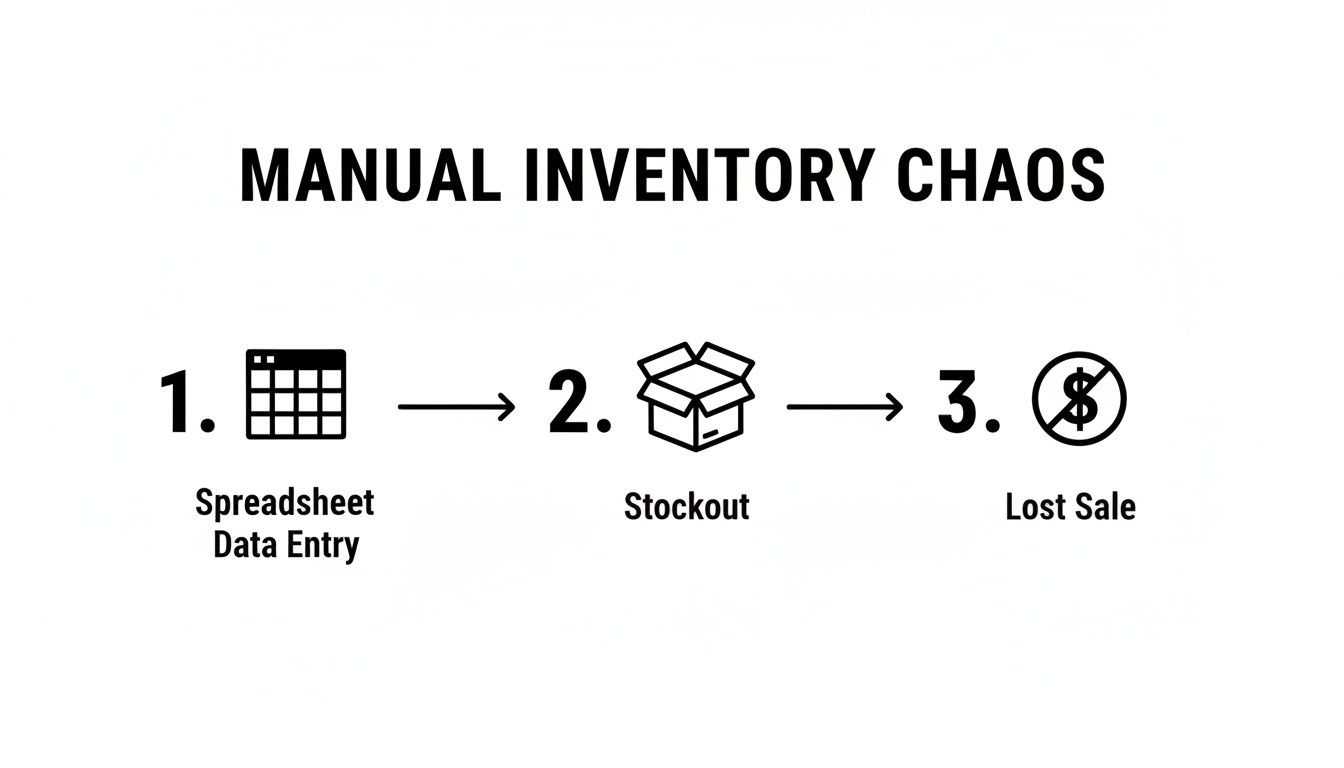
As you can see, spreadsheets often lead directly to stockouts, which means lost sales. It’s a painful, reactive loop that modern software is built to fix.
To really get why this is so different from a spreadsheet, let's compare them side-by-side.
| Feature | Manual Spreadsheets | Inventory Planner Software |
|---|---|---|
| Forecasting Method | Based on simple historical averages or "gut feelings" | Uses advanced algorithms, seasonality, and trend analysis |
| Accuracy | High risk of human error, typos, and outdated formulas | Automated data sync eliminates manual errors |
| Purchasing | Manual calculations for reorder points; easy to miss | Generates automated, data-driven purchase recommendations |
| Scalability | Becomes unmanageable as SKU count and order volume grow | Easily handles thousands of SKUs and complex supply chains |
| Strategic Insight | Limited to what you can manually build and interpret | Provides alerts for overstock, stockouts, and lost revenue |
| Time Investment | Hours of weekly data entry and analysis | Frees up time for strategy, marketing, and growth |
The difference isn't just about efficiency; it's about moving from a reactive position to a proactive one, where you're making strategic decisions instead of just plugging operational holes.
To truly appreciate what this software does under the hood, it helps to understand the core metrics it manages for you. These aren't just buzzwords; they're the levers you pull to optimize cash flow and keep customers happy.
By automating these calculations, the software takes human error and emotion out of the equation. It replaces a gut feeling like, "We should probably order more of this," with a data-driven command: "Order 75 units of SKU-123 in three days to meet projected demand and avoid a stockout."
So, what does this look like in your day-to-day? An inventory planner connects to your Shopify store and is constantly pulling in sales data, stock levels, and product info. It then feeds all of this through its forecasting engine.
The output isn't another complicated spreadsheet you have to decipher. It's a simple, prioritized to-do list.
For instance, it might tell you: 1. Purchase Order: Create a PO for 150 units of your best-selling skincare set from Supplier A. It needs to arrive before the Black Friday rush. 2. Overstock Alert: You have $5,000 tied up in last season's t-shirts that aren't selling. Consider a flash sale to liquidate that stock and free up cash. 3. Stockout Risk: Your fastest-moving coffee blend is projected to sell out in 8 days, but your supplier's lead time is 14 days. You need to place an expedited order immediately.
This is what it's all about: turning raw data into clear, actionable steps. A system like Tociny.ai is designed to translate complex analytics into these exact kinds of straightforward recommendations. You can learn more about how our AI-powered platform works and see this translation in action. Ultimately, it’s this jump from numbers to confident decisions that defines the real value of modern inventory planning.
Let's be honest, not all inventory planning tools are built the same. While plenty of apps can count your stock, the real magic for a growing e-commerce brand comes from a handful of intelligent features. These are the tools that shift you from just tracking products to strategically managing them.
Think of this as your buyer's guide. We're breaking down the non-negotiable features that give you a genuine competitive edge.
Choosing the right software is a big deal. For ambitious D2C brands, this decision often goes hand-in-hand with picking the right e-commerce platform. It's worth exploring a detailed e-commerce platform comparison to see how these foundational systems need to work together. Once your store is set up, a powerful inventory planner becomes the engine that drives your profitability.
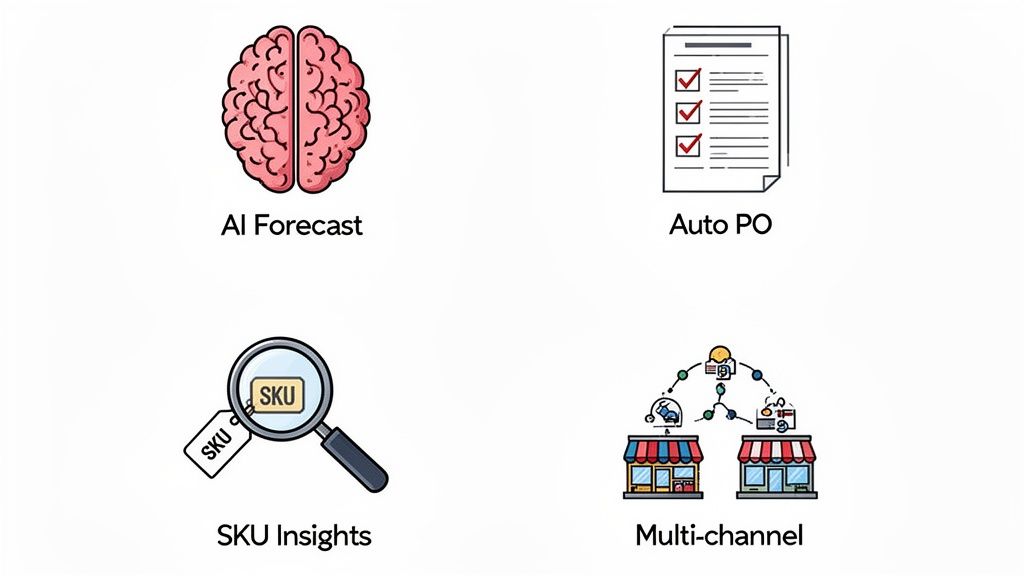
Here are the core features every direct-to-consumer brand should demand from their inventory planning solution.
Old-school forecasting methods often just look at simple historical averages. That’s like trying to drive forward by only looking in the rearview mirror. You'll completely miss the nuances of new market trends, seasonal spikes, and subtle shifts in what your customers want. AI-powered demand forecasting is a different beast entirely.
Think of it as an intelligent engine that actually learns from your sales data. It spots complex patterns and projects future demand with far greater accuracy.
This kind of proactive insight helps you stay way ahead of the curve. You can see how AI transforms sales forecasting from a reactive guessing game into a real strategic advantage.
Okay, so you have an accurate forecast. Now what? The next logical step is knowing exactly what to do with that information. That's where automated purchasing recommendations come into play. This feature is your digital purchasing assistant, taking all the guesswork out of replenishment.
Instead of sweating over a spreadsheet to calculate reorder points, the software does it for you. It looks at the forecast, your current stock levels, and supplier lead times to generate a clear, prioritized list of purchase orders. It tells you what to order, how much to order, and precisely when to place the order so stock arrives just in time. This is how you stop both costly stockouts and cash-draining overstock.
"Moving from reactive ordering to data-driven replenishment was a game-changer for us. It got our team out of spreadsheets and let them focus on growth, all while knowing our inventory was optimized to meet demand without tying up a ton of capital."
Do you really know which products are your profit drivers and which ones are just expensive shelf-warmers? A great inventory planner acts like a profitability detective, giving you deep insights right down to the individual SKU (Stock Keeping Unit).
This goes way beyond just tracking sales numbers. A solid analysis tool should help you answer the tough questions for every single product in your catalog:
By classifying your inventory based on its true value and sales velocity, you can make much smarter calls on marketing spend, product development, and where to put your inventory dollars.
For any modern D2C brand, sales rarely happen in just one place. You're probably selling on your Shopify store, through Instagram, maybe on Amazon, and even at a physical pop-up shop. Without a central hub, managing inventory across all those channels is a recipe for disaster.
Think of multi-channel integration as the central nervous system connecting all your sales points. It creates a single, unified view of your inventory, ensuring that a sale on one channel instantly updates the available stock everywhere else.
This is what stops you from accidentally selling the same T-shirt twice, which only leads to canceled orders and seriously unhappy customers. A good inventory planner gives you one source of truth, so you can scale your sales channels with confidence, not chaos.
Switching to a modern inventory planner isn't just about shuffling boxes more efficiently; it's a direct investment in the financial engine of your business. All those features we've talked about translate into real, measurable gains that beef up your bottom line. We’re talking about unlocking cash, padding your profits, and building a much more resilient operation.
Let's move past the abstract talk and dive into some concrete, data-driven scenarios. This is where you see the return on investment (ROI) loud and clear.
Excess inventory is essentially cash frozen in time, sitting on a warehouse shelf instead of fueling your growth. Smart inventory planning software hits this problem head-on by making sure you order only what you need, right when you need it.
Picture a Shopify store with $200,000 tied up in inventory. A common industry benchmark suggests that 20-30% of that stock could be excess or on its way to becoming obsolete. An inventory planner's job is to carve that number down.
A conservative 15% reduction in overstock does more than just tidy up your warehouse. For that $200,000 inventory, it frees up a cool $30,000 in working capital. That's cash you can immediately pump into high-impact activities—think new marketing campaigns, product development, or opening up another sales channel.
Without intelligent forecasting, that money stays trapped in products that aren't moving, silently bleeding you dry through carrying costs like storage fees, insurance, and the risk of it all becoming worthless.
If overstocking is a slow bleed, a stockout is a sudden, sharp wound. It costs you so much more than just the price tag of the missed sale. The damage ripples out, hitting customer trust, your brand's reputation, and future revenue streams.
Let's say your top-selling product is a $50 skincare serum, and you normally sell 20 units a day. During the peak holiday rush, you run out of stock for just three days.
Here’s a breakdown of the immediate and long-term financial pain:
That single stockout event didn't just cost you $3,000; it actively handed your hard-won customers over to the competition and made your brand look unreliable. An effective inventory planner is built specifically to prevent these disasters.
At the end of the day, smart inventory management is all about improving profitability. The connection is direct and incredibly powerful. By dialing in your stock levels, you kill the need for those aggressive, margin-crushing discounts just to clear out dead inventory.
At the same time, making sure your hero products are always in stock means you maximize sales at full price—which is exactly where your fattest margins are. It’s a two-pronged attack: fewer markdowns on duds and more full-price sales on winners. The result is a healthier overall profit margin.
This isn't just theory; the market sees it, too. Demand for these tools is exploding, with the inventory management software market projected to leap from USD 2.38 billion in 2025 to USD 8.48 billion by 2035. This growth is being driven by e-commerce brands who know they need real-time visibility and sharp forecasting to cut carrying costs and prevent stockouts in cutthroat sectors like health and fashion. You can explore more data on this expanding market to see just how competitive it's getting.
Picking the right inventory planner can feel like a make-or-break decision for your brand. Let's be honest, it is. But you can turn an overwhelming task into an empowering one by knowing exactly what to look for. For Shopify merchants, the mission is to find a partner that fixes today's inventory headaches and is ready to grow with you tomorrow.
First thing's first: seamless Shopify integration. This is the absolute, rock-solid, non-negotiable starting point. If a planner doesn't sync perfectly with your store’s data—sales, products, SKUs, and customer info—it’s a non-starter. A true integration pulls all that data automatically, in real-time. No more manual CSV uploads, and no more costly errors that come with them.
Once you’ve confirmed a solid integration, it’s time to look at the user interface (UI). What good is a powerful tool if you need a data science degree just to figure it out? The best inventory planners take heaps of complex data and present it in a way that’s clean, simple, and intuitive.
Look for a dashboard that gives you an at-a-glance overview of your inventory health. Can you instantly see which products are about to sell out? Can you spot your slow-movers without digging through a dozen reports? The goal here is clarity, not complexity.
A great inventory planner doesn't just show you numbers; it tells you a story about your business. It should translate raw data into actionable insights, making it obvious what your next strategic move should be.
Your business isn’t standing still, and your software shouldn’t hold you back. The planner that works for you today with 100 SKUs needs to perform just as flawlessly when you hit 1,000 or even 10,000. Scalability is a huge deal.
You need to ask potential software partners how their system handles growth.
Choosing a scalable solution from the get-go means you won't have to go through a painful migration process a year or two down the road.
Before we dive into the final criteria, here's a quick checklist to help you compare your options side-by-side. Use this table as a scorecard when you're doing demos and talking to sales reps.
| Evaluation Criterion | Why It Matters | Questions to Ask |
|---|---|---|
| Shopify Integration | A poor sync creates data errors, wastes time on manual uploads, and leads to bad purchasing decisions. | "Is the integration native? Does it sync in real-time? What data points are pulled from Shopify?" |
| User Experience (UI/UX) | A confusing interface means you won't use the tool to its full potential, no matter how powerful it is. | "Can I get a live demo? How long does it take a new user to feel comfortable? Are the reports easy to understand?" |
| Forecasting Accuracy | The core job of a planner is to predict future demand. Inaccurate forecasts lead directly to stockouts or overstock. | "What forecasting models do you use? How does your system handle seasonality, trends, and promotions?" |
| Scalability | Your software needs to grow with your business, not hold you back. | "What is the SKU limit? Can your system handle our peak order volume? Do you support multi-location and multi-channel?" |
| Customer Support | When something goes wrong, you need fast, knowledgeable help from a real person. | "What are your support hours? Do you offer live chat or phone support? What's your average response time?" |
| Pricing Model | Hidden fees and confusing pricing tiers can kill your ROI. You need predictability. | "Is your pricing based on revenue, SKUs, or orders? Are there any setup fees or hidden costs? What's included in each plan?" |
This checklist should give you a solid framework for making an informed decision, ensuring you pick a tool that truly aligns with your business goals.
Finally, let's talk about the human and financial sides of the equation. When you have an urgent question right before a big sale, you need to know you can reach responsive and knowledgeable customer support. Look for companies that offer clear ways to get help, whether it's through live chat, email, or a detailed knowledge base.
Pricing needs to be just as transparent. Watch out for solutions with sneaky hidden fees or complicated pricing tiers that punish you for growing. A good partner offers a clear, predictable pricing model that scales with the value they provide. As you evaluate different planners, it's also helpful to understand the broader tool ecosystem; checking out lists of the top Shopify apps can give you a good feel for what separates a great software partner from an average one.
By carefully working through these four areas—integration, user experience, scalability, and support—you'll be able to confidently choose an inventory planner that empowers your brand to thrive.
Let's be honest, most inventory planning software feels like it was built for data scientists, not store owners. You get powerful tools, sure, but they often bury you in complex dashboards and endless spreadsheets. While it’s a step up from manual tracking, you can still find yourself drowning in numbers, trying to figure out what they actually mean for your business.
The next leap forward isn't about adding more charts or metrics. It's about cutting through the noise and getting straight to the point.
That’s exactly why we built Tociny.ai. We believe powerful insights shouldn't require a Ph.D. in statistics. Instead of clutter, we give you clarity. Our AI-native platform goes beyond basic forecasting to give you plain-English advice on what to stock, how to price it, and when to buy more. It’s about making smarter decisions, faster.
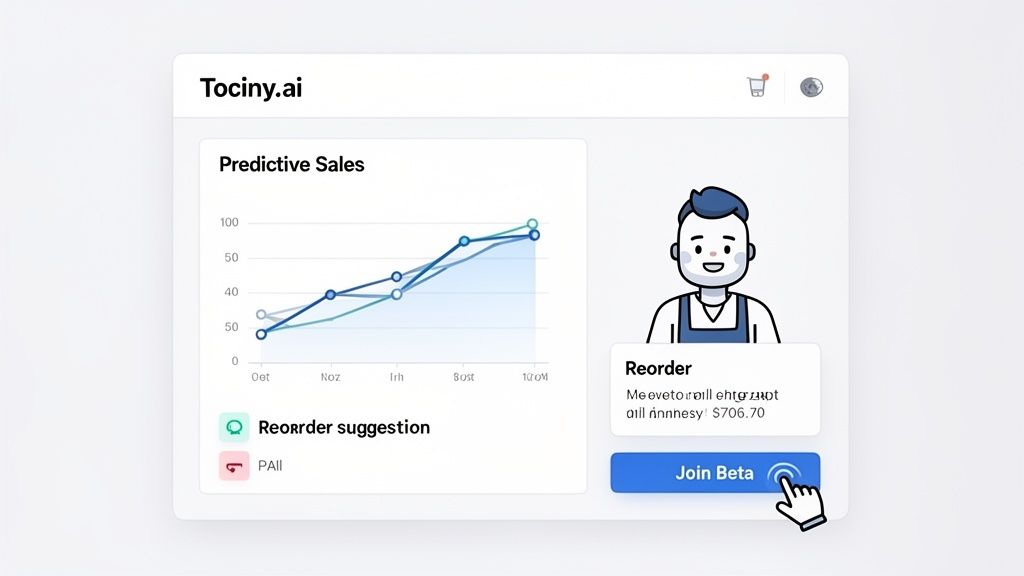
As a founder of a growing D2C brand, your time is your most precious resource. We engineered Tociny.ai to give you that time back. Our entire interface is designed to give you instant understanding and guide your next move.
This relentless focus on simplicity and action is what defines a modern inventory planner software. It’s about making smart inventory management accessible to everyone on your team, not just the data experts.
The point of advanced AI shouldn't be to create more complicated tools. It should be to make sophisticated decisions incredibly simple. True innovation is turning complex predictions into straightforward, profitable actions.
We're convinced that smarter inventory planning is the key to profitable growth for ambitious D2C brands. Tociny.ai is currently in a private beta, and we're inviting a small group of Shopify stores to experience the future of inventory management firsthand.
As an early partner, you’ll get exclusive access to our platform and receive one-on-one guidance from our team to help dial in your inventory strategy. This is a unique chance to help shape the tools you'll use to scale your business.
If you’re ready to graduate from spreadsheets and confusing dashboards to a world of clear, AI-driven recommendations, we invite you to apply for our private beta. Let's build a more intelligent way to grow, together.
Jumping into a new system, even one with clear benefits, always brings up a few practical questions. How much of a headache is the setup? Is my brand big enough for this? What's the real difference with this AI forecasting stuff?
It's smart to ask. Making the switch to a dedicated inventory planner is a big step, but it’s nowhere near as complicated as you might think. Let's tackle the most common uncertainties we hear from merchants.
The thought of a long, drawn-out software setup is enough to make any founder sweat. Thankfully, the days of multi-month enterprise integrations are long gone for modern D2C brands.
Most cloud-based tools designed for platforms like Shopify can be connected in just a few minutes. The initial data sync—where the software pulls in your historical sales, product, and purchasing data—might take a few hours depending on your order volume. But you can often see your first forecasts and get genuinely useful insights within 24 hours. The whole point is to get you value fast, not bog you down in a setup nightmare.
This is a big one, but the answer is almost always a hard "no." In fact, building smart inventory habits from the start is one of the most powerful things you can do to set yourself up for scalable growth.
The right time to get an inventory planner isn't when you're a massive operation; it's the moment manual methods start to feel painful.
If you're losing hours every week in a spreadsheet maze or you've just felt the sting of your first stockout on a bestseller, you're ready. Bringing in a planner early stops bad habits from taking root and makes sure your cash is funding growth, not just sitting on a warehouse shelf.
Waiting until your inventory is a five-alarm fire means you've already burned through revenue and customer goodwill. A much smarter move is to install the system that prevents the fire from ever starting.
So what's the big deal with AI? Traditional forecasting usually relies on simple math, like averaging your sales over the last 90 days. This approach is totally blind to context. It can't tell the difference between a random one-day sales spike and the true beginning of a seasonal buying frenzy.
AI-powered forecasting, on the other hand, is dynamic. It's like having a data scientist on your team who can spot complex patterns, seasonality, and emerging trends that a simple formula would completely miss.
Here’s where it gets good: * It actually learns. An AI model gets smarter as it sees more of your sales data. That means your forecasts become more accurate over time, not less. * It connects the dots. It can identify subtle relationships, like how running a sale on one product might cannibalize or boost the sales of another. * It looks forward, not just back. It adapts to shifts in the market and changes in customer behavior, giving you a much more reliable picture of what’s coming.
It’s the difference between driving while looking in the rearview mirror and driving with a clear map of the road ahead.
Ready to stop guessing and start planning with confidence? Tociny.ai replaces confusing spreadsheets with clear, AI-driven recommendations to help you optimize stock, reduce stockouts, and grow your Shopify store profitably. Apply for our private beta today.
Tociny is in private beta — we’re onboarding a few select stores right now.
Book a short call to get early access and exclusive insights.