Imagine having a crystal ball for your Shopify store. That’s pretty much what predictive analytics for ecommerce brings to the table. Instead of just staring at last month's sales reports to figure out what happened, this technology uses AI to tell you what's likely to happen next, shifting your entire strategy from reactive to proactive.
Think of your standard business reports like the rearview mirror in your car—they show you exactly where you've been. Super useful for understanding past performance, like which products flew off the shelves last quarter.
Predictive analytics, on the other hand, is the GPS on your dashboard. It takes all the available data—your history, current conditions, and smart algorithms—to map out the best route forward. It helps you anticipate the turns, avoid the traffic jams, and get to your destination faster.
For an ecommerce brand, this means getting beyond basic dashboards. It’s about using the goldmine of information you already have—sales history, customer clicks, abandoned carts—to make incredibly educated guesses about the future. This forward-looking approach is what separates the high-growth stores from the ones always playing catch-up.
Predictive analytics is more than just a buzzword; it’s a genuine shift in how online stores operate. It’s designed to answer the tough, forward-looking questions that your basic reports simply can't touch:
Answering these questions with data, not just gut feelings, has a direct impact on your bottom line. It’s a powerful capability that was once locked away in enterprise boardrooms. Now, it's accessible to Shopify merchants through platforms like Tociny.ai, which turn these complex models into simple, actionable recommendations.
This approach empowers businesses to anticipate trends rather than just react to them. By analyzing patterns in historical and transactional data, predictive models can identify the likelihood of future outcomes, enabling proactive decision-making.
So, how does this forward-thinking approach stack up against the old way of doing things? Let’s break it down.
| Aspect | Traditional Reporting | Predictive Analytics |
|---|---|---|
| Focus | Backward-looking ("What happened?") | Forward-looking ("What will happen?") |
| Output | Dashboards, historical charts | Forecasts, probabilities, recommendations |
| Goal | To understand past performance | To anticipate future outcomes |
| Example | "We sold 500 units last month." | "We project to sell 650 units next month." |
Ultimately, while traditional reporting is essential for knowing your numbers, predictive analytics is what gives you a strategic edge to shape your future numbers.
The ecommerce world is getting more crowded by the day. To stand out, you need hyper-efficient operations and a customer experience that feels personal. That's exactly why advanced analytics is no longer a "nice-to-have."
The market numbers tell the story. The global e-commerce predictive analytics space is projected to explode to USD 25.4 billion by 2034, driven by a massive compound annual growth rate (CAGR) of 26.4%. This isn't just a niche trend. This growth shows that retailers are leaning heavily on AI to forecast demand, personalize shopping, and get an edge. You can discover more about the ecommerce predictive analytics market growth and see for yourself why this is quickly becoming a core part of any serious online retail strategy.
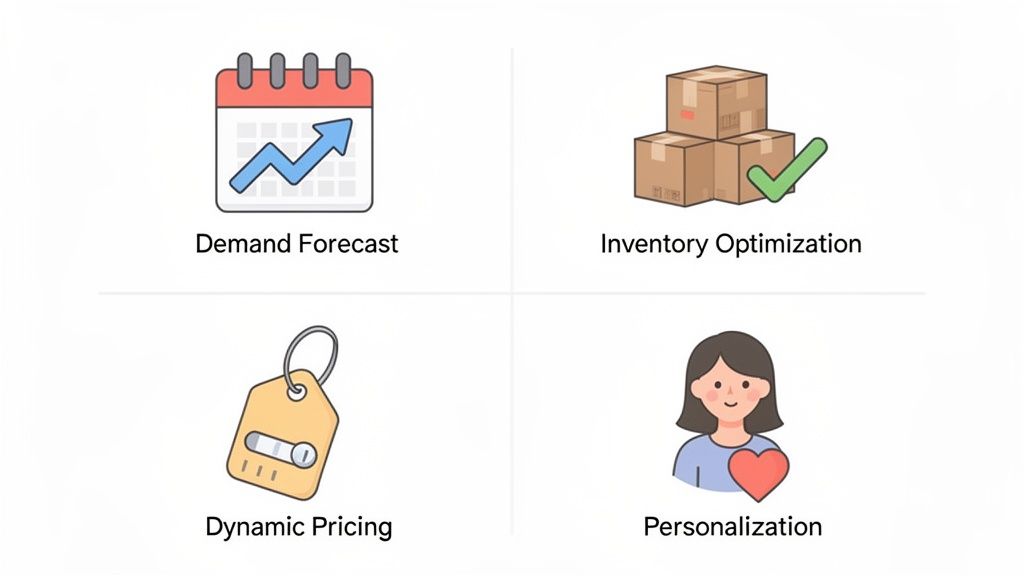
It’s one thing to understand the what of predictive analytics, but the real magic is in seeing what it does for your bottom line. This isn't about feeding numbers into a black box; it's about making smarter, faster, and more profitable decisions across four critical pillars of your ecommerce business.
When you shift from reactive guesswork to data-backed foresight, you stop just responding to the market and start anticipating it. Let’s break down exactly how this technology fuels real, measurable growth.
Solid demand forecasting is the bedrock of any healthy retail operation. Predictive analytics takes this crucial task from a simple glance at last year's sales to a dynamic, forward-looking projection. It chews through historical data, seasonality, the ripple effects of marketing campaigns, and even broader market trends to predict what your customers will want to buy, and when.
Think about it: you can prepare for a holiday sales rush with surgical precision. You can anticipate how a new influencer collaboration will spike demand for a specific SKU. You can even see how something as random as a heatwave might boost sales for your summer collection. For a deeper dive, check out our guide on improving https://tociny.ai/blog/demand-forecast-accuracy.
Few things are more painful than seeing "out of stock" on a bestseller or, just as bad, having cash tied up in a warehouse full of products nobody wants. Predictive analytics goes right at this problem by connecting your demand forecasts directly to your inventory levels. It doesn’t just tell you what will sell—it tells you how much you need on hand to meet demand without overstocking.
Inventory headaches are a huge deal in ecommerce. In fact, stockouts and overstocking hit 43% of online retailers every year. Those mistakes cost major markets over $1.1 trillion in lost sales between 2017 and 2022. Platforms like Tociny.ai are helping Shopify merchants get ahead of this, using historical patterns and real-time signals to cut excess inventory by up to 30% while improving on-shelf availability by 25%.
This kind of accuracy ensures your capital is working for you, not sitting on a shelf collecting dust.
Pricing is a constant balancing act. Go too high, and you scare off buyers. Go too low, and you're leaving cash on the table. Predictive models analyze a whole universe of factors to pinpoint that sweet spot.
These models look at things like: * Customer purchase history: What are different segments actually willing to pay? * Competitor pricing: How are others in the market moving? This keeps you competitive without starting a race to the bottom. * Inventory levels: Got too much of something? The model might suggest a strategic discount to clear it out. * Perceived product value: Is your price aligned with what customers feel the product is worth?
This opens the door to dynamic pricing that maximizes revenue and margin for every single product in your catalog.
The days of one-size-fits-all marketing are over. Modern customers expect an experience that feels like it was built just for them. One of the clearest ways to improve ecommerce conversion rates is to stop shouting at everyone and start talking to individuals.
By analyzing browsing behavior, purchase history, and demographics, predictive models can help you: * Recommend the right products: Show customers items they are statistically likely to love next. * Prevent customer churn: Spot the subtle signs of a customer who might be drifting away and send a targeted offer to bring them back. * Segment audiences for marketing: Build hyper-focused email and ad campaigns that resonate on a personal level.
By forecasting customer lifetime value (CLV), you can focus your retention efforts on your most valuable shoppers, ensuring they feel recognized and remain loyal to your brand for years to come.
This level of personalization doesn't just bump up a single sale. It builds real, lasting relationships with your customers and turns them into repeat buyers.
Predictive analytics isn’t magic. It's more like a master chef crafting a signature dish—the final result is only as good as the ingredients. For your ecommerce store, those "ingredients" are the raw data points your business generates every single day.
You're likely already sitting on a goldmine of this information. The real trick is knowing which data points matter most and how they work together to paint a clear, forward-looking picture of your business. This is the foundation everything else is built on.
The most powerful predictions always start with the data you own and control. This internal data is a detailed history of your business performance and customer interactions, forming the backbone of any reliable forecast.
The primary categories include:
At its core, predictive analytics connects the dots between these internal data streams. It finds the hidden relationships—like how a specific email campaign drove sales for a slow-moving product—that are nearly impossible for a human to spot.
While your internal data is the main course, it doesn’t tell the whole story. Your store doesn't operate in a vacuum. External signals provide crucial context about the wider world, adding a layer of sophistication and accuracy to your predictions.
Think about it: forecasting winter coat sales using only last year's data, without looking at this year's weather forecast, would be a recipe for disaster. You'd almost certainly miss the mark.
Key external signals include: * Seasonality and Holidays: The predictable annual patterns, from Black Friday to Mother's Day, that always create demand fluctuations. * Market Trends: Broader industry shifts, like a growing interest in sustainable products or a new fashion trend going viral on social media. * Economic Factors: Data on consumer spending habits or economic downturns that can impact your customers' purchasing power. * Competitor Actions: Major sales events or big product launches from your rivals that can pull customer attention and dollars away from you.
By layering these external signals over your internal data, the predictive engine gets a much clearer, more complete picture of the forces shaping future demand.
Once you have your ingredients (data), you need a recipe (a model) to turn them into something useful. The good news is you don't need to be a data scientist to get the gist of how these "recipes" work.
Here are two of the most common types used in ecommerce: 1. Regression Models: These are perfect for forecasting numbers. A regression model looks at the relationship between different variables (like ad spend, seasonality, and past sales) to predict a future number, like next month's total revenue or the demand for a specific SKU. 2. Clustering Models: These models are all about segmentation. A clustering algorithm groups similar things together. For an ecommerce store, it can analyze customer data to identify distinct segments—like "high-spending loyalists" or "one-time bargain hunters"—so you can tailor your marketing with incredible precision.
Properly organizing your data is the critical first step to using these models. If you're wrangling data in spreadsheets, you can learn how to format your Excel files for analytics to make sure they're ready for analysis. Ultimately, these models are what transform your raw data from a simple record of the past into a strategic guide for the future.
Bringing predictive analytics for ecommerce from a buzzy concept into a real-world tool can feel like a massive undertaking. But the path to getting it up and running is more straightforward than you might think, especially if you're on Shopify. This isn't about needing a Ph.D. in data science overnight. It’s about following a clear, logical roadmap to connect your data, pick the right tools, and start turning those insights into action.
The whole process boils down to a few key phases: syncing your store’s data, choosing a platform that actually works for you, checking that the predictions are solid, and finally, weaving those new insights into how you run your business every day.
First things first: you have to get all your data into one place. Your predictive engine needs a steady diet of clean, consistent information to spit out anything useful. For Shopify merchants, this just means setting up a seamless link between your store and whatever analytics platform you choose.
Thankfully, modern tools make this part easy. Many have one-click integrations that pull in all the essential data streams without you having to lift a finger. This usually includes:
Getting this initial sync right is the foundation for everything else. A solid data connection means your predictive models are always working with the latest information, making your forecasts far more reliable and quick to react to what's happening in your business right now.
The diagram below gives you a simple visual of how these different data inputs come together to create a powerful prediction.
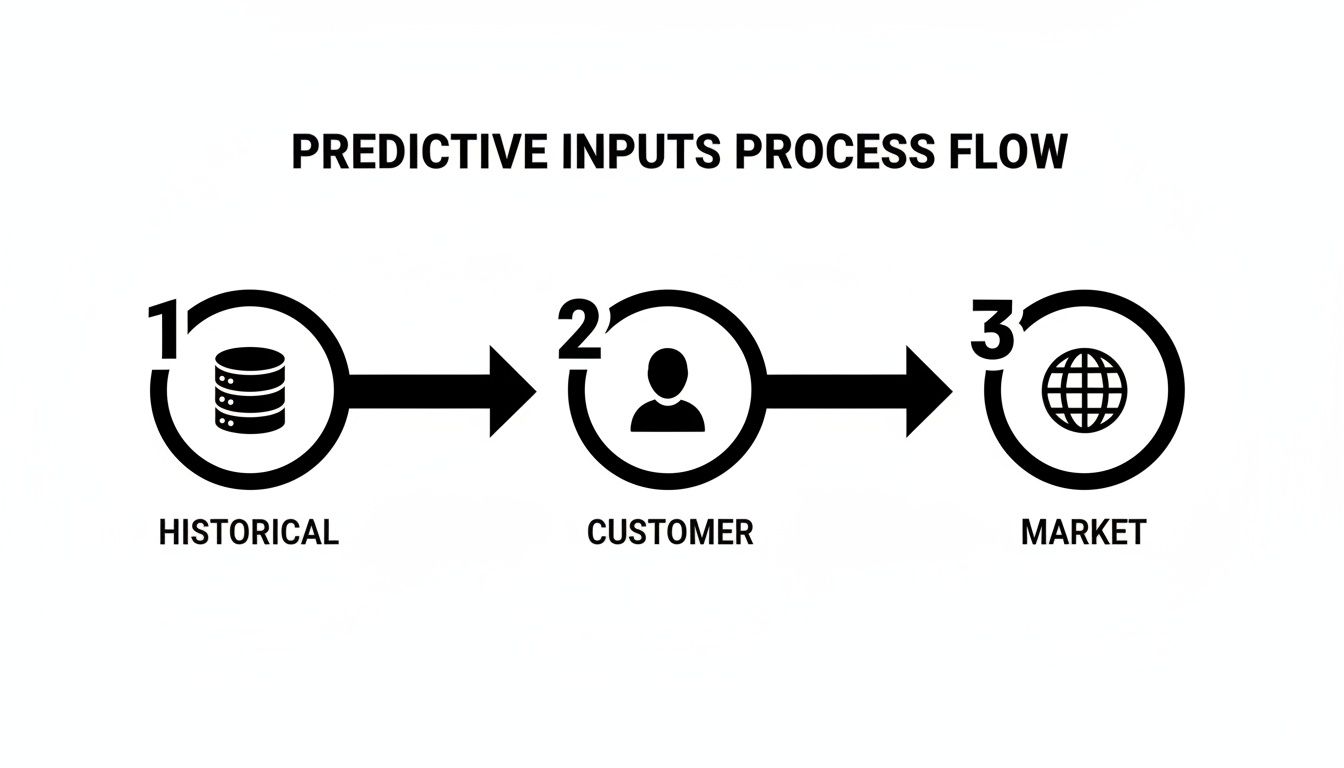
As you can see, it’s about enriching your own historical and customer data with outside market signals to get the full picture.
Once your data is flowing, you need the right software to translate it into something you can use. The market is flooded with analytics tools, but they are definitely not all created equal. Don't get trapped in a platform built for massive enterprise data teams. As a Shopify merchant, your goal is usability and getting results you can act on.
Look for a solution that is built for business users, not data scientists. A great platform, like Tociny.ai, does the heavy lifting of building and managing the models behind the scenes. It should give you its findings in a clean dashboard with recommendations in plain English. For example, instead of showing you a confusing statistical chart, it should just tell you, "You need to order 75 units of your best-selling t-shirt by next Tuesday to avoid a stockout."
The best predictive tools make data science accessible to everyone. They empower you to make expert-level decisions without needing an expert on your payroll. The focus should always be on the business outcome, not the algorithm itself.
When you're looking at different options, zero in on platforms designed for your specific needs. If you know that inventory and demand planning is your biggest headache, you might find our guide on choosing the best demand forecasting software helpful.
After you've connected your data and picked a tool, the platform will get to work training its predictive models on your store's unique history. This isn't instant. The system has to learn the specific sales patterns, seasonal swings, and customer habits that define your business. The next crucial step is validation—making sure the model’s predictions are actually accurate.
This is usually done through a process called backtesting. The model takes a chunk of your old data (say, sales from two years ago up to last year) and makes "predictions" for a period where you already know what happened (like the last 12 months). It then compares its forecast to your actual sales numbers.
This comparison produces an accuracy score, which gives you a clear idea of how much you can trust the forecasts for the future. A good platform will be transparent about this process and let you make adjustments to improve the model's performance over time.
This final step is where the magic happens. Predictive analytics is only useful if you actually do something with the information it gives you. This means embedding the forecasts and recommendations into your core business processes for inventory, marketing, and merchandising.
In practice, this could look like:
By making these data-driven insights a routine part of your decision-making, you complete the loop. You stop just collecting data and start actively using it to fuel growth, cut waste, and build a much more resilient ecommerce business.
Theory is great, but let's talk about what really matters: the bottom line. This is where predictive analytics for ecommerce stops being an abstract concept and starts putting real money back into your business. Seeing how other brands have turned foresight into profit makes its value crystal clear.
We’re going to look at how this technology delivers a tangible return on investment (ROI) across different ecommerce sectors, transforming educated guesses into strategic, profitable decisions. Each example draws a straight line from a predictive insight to a measurable business win.
Imagine a direct-to-consumer fashion brand gearing up for its spring collection. In the past, they’d place inventory orders based on last year’s sales and a good dose of team intuition. This usually ended in a familiar headache: they’d sell out of size Medium in the most popular color way before the season even peaked, while racks of XS and XL sizes in less-loved shades gathered dust, waiting for a deep discount.
By bringing in predictive analytics, the brand can now forecast demand not just for a specific dress, but for each size and color combination. The model chews through past sales, analyzes what’s buzzing on social media, and even factors in regional weather forecasts to call the winners.
The result? A purchase order that actually mirrors what customers want to buy.
That kind of precision directly pumps up profit margins by freeing up cash that was once tied up in dead stock.
For a subscription-based wellness brand selling vitamins, the biggest challenge isn't just getting customers—it's keeping them. We all know losing a subscriber costs far more than acquiring a new one, so keeping their existing community happy is everything. Predictive models can be their secret weapon for retention.
The platform gets to work analyzing customer behavior, looking for the quiet signals that a customer might be about to cancel. This could be anything from a drop-off in website logins and a decrease in one-off purchases to consistently ignoring marketing emails.
By flagging at-risk customers before they hit the cancel button, the brand can jump in and do something about it. The system alerts the marketing team, who can then launch a targeted re-engagement campaign with a personalized offer, a helpful piece of content, or a friendly customer service check-in.
This proactive approach paid off in a big way: * They saw a 10% reduction in their monthly subscription churn rate. * Customer lifetime value (CLV) for the targeted group shot up by 15%. * Satisfaction improved because customers felt seen and valued.
If you're a home goods retailer selling bulky items like furniture, inventory is a high-stakes game. Warehouse space is expensive, and overstocking large items can obliterate your profits. Their primary goal was to slash these carrying costs without risking stockouts on their best-selling pieces.
Using predictive demand forecasting, the retailer could finally see which sofas and dining tables would be flying out the door over the next quarter. This let them switch from a costly "just-in-case" inventory model to a much leaner "just-in-time" approach, perfectly aligning their inbound shipments with projected sales. The impact was immediate, delivering a clear and substantial ROI on their analytics investment.
Predictive analytics is also a powerhouse for personalization. While general ecommerce conversion rates hover around a tough 2%, that figure climbs to 2.7% in specialized niches like skincare, where smart recommendations are king. Advanced models analyze CLV, category affinity, and even social sentiment to craft shopping experiences that have been shown to boost repeat purchases by 20-30%. It’s not uncommon for global brands to see sales uplifts of 15% from better recommendations alone.
The numbers don't lie. To see more on how these strategies work, you can learn more about how ecommerce analytics drive revenue and its impact.
The potential for growth becomes even clearer when we look at the ROI across different verticals. Each sector has its own unique challenges, but the solution often points back to smarter, data-driven predictions.
| Vertical | Primary Use Case | Average Revenue Uplift | Key Metric Improvement |
|---|---|---|---|
| Fashion & Apparel | Demand Forecasting by SKU/Size | 10-20% | 25% reduction in overstock |
| Beauty & Cosmetics | Personalized Recommendations | 15-25% | 30% increase in repeat purchases |
| Home Goods & Furniture | Inventory & Warehouse Optimization | 8-15% | 20% reduction in carrying costs |
| Subscription Services | Customer Churn Prediction | 5-10% | 15% increase in Customer Lifetime Value |
| Consumer Electronics | Dynamic Pricing & Promotions | 10-18% | 12% improvement in profit margin |
As the table shows, whether you're selling t-shirts or coffee subscriptions, the ability to anticipate customer behavior translates directly into higher revenue and healthier margins. It's about moving from reacting to the market to proactively shaping it to your advantage.
When you're exploring a new technology like predictive analytics for ecommerce, it's natural to have a few questions. For most Shopify merchants I talk to, the biggest hurdles aren't the tech itself, but misconceptions around complexity, cost, and just being "ready."
Let's clear the air and tackle those common concerns head-on.
There's a persistent myth that predictive analytics is only for massive, enterprise-level retailers. That used to be the case, but it's simply not true anymore. Modern platforms are built specifically for Shopify stores of all sizes, from growing startups to established brands.
The real requirement isn't your revenue; it's the consistency of your data. If you have at least one full year of sales history, you have more than enough information to start generating meaningful and accurate forecasts. These tools have leveled the playing field, making powerful capabilities accessible to everyone.
Absolutely not. The whole point of the new generation of predictive analytics tools is that they’re designed for business users—the marketers, inventory planners, and founders making decisions every day. You don't need to know how to build an algorithm to get the benefit from one.
Think of it this way: platforms like Tociny.ai do all the heavy lifting, running complex models behind the scenes. The output isn't a dense statistical report; it's a simple, actionable recommendation like, "Restock 50 units of SKU X by next Friday." Your job is to use the insights, not create them from scratch.
While the full impact on your business grows over time, you can see the initial results surprisingly fast. The technical setup, like connecting your Shopify data, usually only takes a few days. Within the first month, you'll start getting reliable forecasts that are more accurate than whatever you were doing before.
You'll see tangible outcomes—like a noticeable drop in stockouts or a measurable lift in marketing ROI—within the first quarter. That’s when you really start to trust the forecasts and weave them into your regular inventory and marketing workflows.
This is a crucial distinction, and one that trips people up. Your standard Shopify reports give you descriptive analytics—they tell you what already happened. For example, they'll show you last month’s best-selling products. It’s all historical.
Predictive analytics, on the other hand, is forward-looking. It takes that same historical data and tells you what is likely to happen next.
It’s the difference between looking in your car’s rearview mirror and using a GPS to navigate the road ahead. One shows you where you've been; the other guides you where you need to go.
Ready to stop guessing and start forecasting? Tociny.ai translates your Shopify data into clear, actionable inventory and sales predictions. Join our private beta to get one-on-one guidance and see what your data is trying to tell you. Get early access at tociny.ai.
Tociny is in private beta — we’re onboarding a few select stores right now.
Book a short call to get early access and exclusive insights.