Accurate demand forecasting is the bedrock of a profitable ecommerce business. It’s the difference between a warehouse full of dead stock and a sell-out success, between happy customers who get their orders on time and frustrated ones who face stockouts. For Shopify merchants, mastering this skill means more efficient inventory management, better cash flow, and improved customer satisfaction. But with so many techniques available, how do you choose the right approach for your D2C brand?
This guide moves beyond theory to provide a practical breakdown of the most effective methods for forecasting demand. We will explore ten distinct approaches, from classic statistical models like Time Series analysis to advanced Machine Learning techniques. You will learn how each method works, its ideal use cases for online retail, and its specific strengths and weaknesses.
By the end, you’ll have a clear roadmap for selecting and combining these techniques. The goal is to transform your inventory planning from a guessing game into a strategic advantage, ensuring you have the right products in the right quantities at exactly the right time. Let’s explore the tools that will help you stop guessing and start growing with confidence.
Time series forecasting is a quantitative method that analyzes historical sales data to predict future demand. By treating past sales as a sequence of data points indexed over time, models like ARIMA (AutoRegressive Integrated Moving Average) can identify and project underlying patterns. This approach is powerful for businesses with an established sales history because it can decompose demand into its core components: trend, seasonality, and random noise.
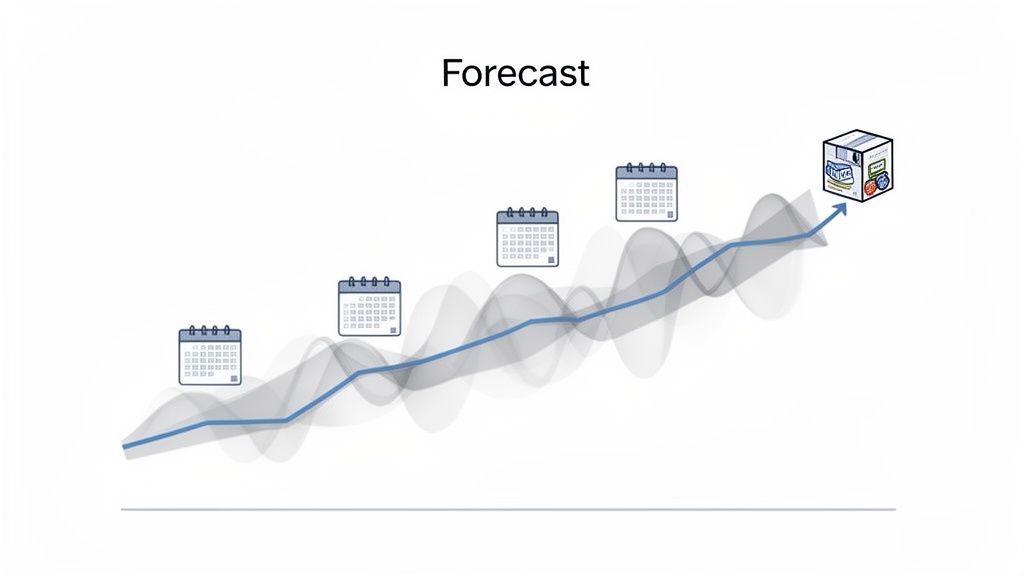
The SARIMA (Seasonal ARIMA) model extends this capability by specifically accounting for repeating seasonal cycles, making it ideal for Shopify merchants selling products with predictable yearly fluctuations, like swimwear in the summer or holiday decorations in winter. To deepen your understanding of sequential data prediction, delve into Mastering time series forecasting methods, which are foundational for many demand forecasting applications.
Machine learning models offer advanced methods for forecasting demand by automatically identifying complex, non-linear relationships in your data. Algorithms like Gradient Boosting (XGBoost, LightGBM) and neural networks can process numerous variables simultaneously, including historical sales, promotions, seasonality, and external factors like holidays or web traffic. They excel at finding hidden patterns that simpler models might miss, adapting as new data becomes available to improve prediction accuracy over time.
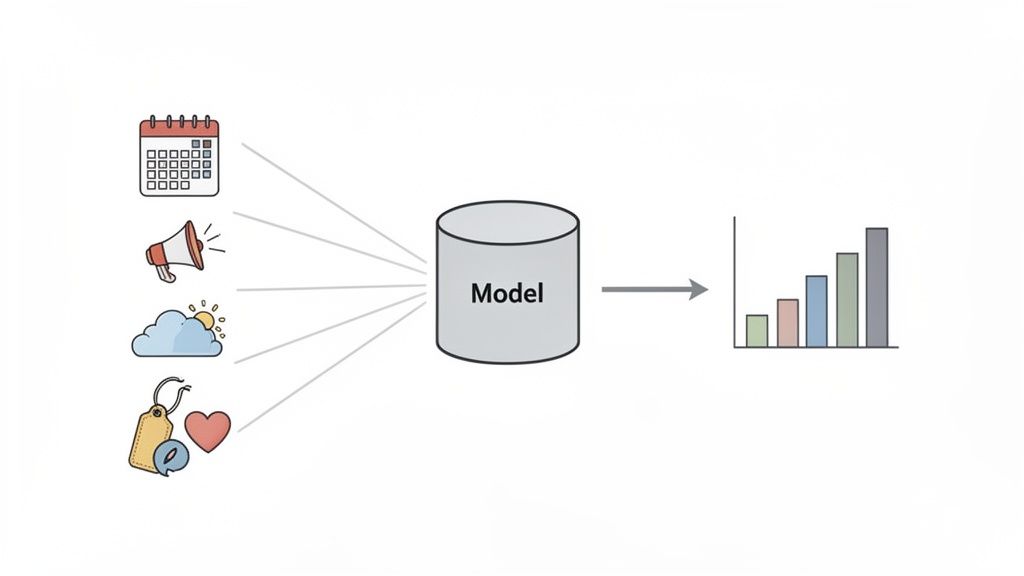
This approach is particularly powerful for complex inventories where demand is influenced by many interacting drivers. For example, Alibaba uses neural networks to forecast demand across millions of products during massive sales events like Singles' Day. Many modern forecasting apps for Shopify are built on ML backends, giving merchants access to this technology without needing a data science team. You can explore how these technologies are packaged in user-friendly tools with this guide to demand forecasting software.
Exponential smoothing is another powerful quantitative technique among the various methods for forecasting demand. It predicts future values by assigning exponentially decreasing weights to past observations. This means more recent data points are given greater significance, while the influence of older data gradually diminishes. This approach is highly effective for capturing underlying patterns without the complexity of models like ARIMA.
The method has several variants. Simple Exponential Smoothing (SES) is best for data without a trend or seasonality. Double Exponential Smoothing (Holt's method) incorporates a trend component, and Triple Exponential Smoothing (Holt-Winters) adds a seasonal component. This flexibility makes it an intuitive and computationally efficient choice, particularly for short-to-medium-term forecasts for retailers like beverage companies forecasting seasonal summer demand.
Causal forecasting, also known as regression analysis, is a powerful quantitative technique that links demand to its external and internal drivers. Instead of relying solely on past sales data, this method identifies and quantifies the relationships between demand and influential variables like marketing spend, price changes, competitor activity, or even weather patterns. It answers the question, "How will demand change if we increase our ad budget by 20% or run a 15% off promotion?"
This approach is essential for businesses whose sales are heavily influenced by specific actions and market conditions. For example, a sunscreen brand can use regression to model how temperature and UV index forecasts impact sales, while a fashion retailer can predict the demand lift generated by an upcoming email campaign. It is one of the most effective methods for forecasting demand when you need to understand the why behind sales fluctuations, not just the what.
Judgmental and qualitative forecasting relies on human expertise, intuition, and subjective opinions to predict future demand. This method is crucial when historical data is unavailable, unreliable, or insufficient for quantitative models, such as during new product launches or periods of market disruption. Techniques include expert opinion panels, sales team input, and the structured Delphi method, where experts provide anonymous feedback in multiple rounds to reach a consensus.
These methods for forecasting demand are essential for capturing insights that data alone cannot provide. For example, a luxury brand might use an expert panel to forecast demand for a limited-edition collection, while a new D2C startup relies on the founder’s industry knowledge before accumulating sales data. This qualitative input helps contextualize market shifts and customer sentiment that statistical models might miss.
Ensemble forecasting is a sophisticated quantitative approach that combines predictions from several different models to produce a single, more accurate forecast. Instead of relying on one method, this technique aggregates the outputs from diverse models like time series, machine learning, and causal regression. By blending their individual strengths and offsetting their weaknesses, ensemble methods consistently outperform any single model, often improving accuracy by 5-15%.
This technique is at the core of modern demand planning. For instance, Amazon uses complex ensemble methods across millions of products, and the winning entries in the prestigious M4 Forecasting Competition predominantly used ensemble approaches. For Shopify merchants, it means you don't have to bet on just one method; you can combine a simple moving average with a causal model that accounts for promotions to get a more resilient prediction.
Leading indicators are external variables that change before a business's sales do, offering an early warning system for demand shifts. Instead of relying solely on past sales, this method integrates external signals like search engine trends, social media mentions, or macroeconomic data to predict future demand. This approach helps businesses anticipate market changes rather than just reacting to them, providing a critical competitive edge.
For example, a fashion retailer could monitor Pinterest trends for a specific style to predict its popularity, while a wellness brand might track Google searches for "vitamin D" to forecast supplement sales. Integrating these external data points into forecasting models allows for a more proactive and market-aware inventory strategy. To effectively integrate market intelligence and stay competitive, exploring dedicated competitor price tracking software can be highly beneficial for forecasting.
Inventory-based forecasting uses sell-through analysis, a measure of inventory velocity, to predict future sales. Instead of focusing on what customers might want (demand), this method analyzes the rate at which products are actually being purchased from available stock. By calculating the ratio of units sold to units received over a specific period, merchants can identify which products are moving quickly, which are lagging, and which are dead stock.
This approach is one of the most practical methods for forecasting demand because it provides direct feedback on merchandising and pricing strategies. For example, a fashion retailer can use a 60% sell-through rate within eight weeks as a trigger for markdowns, while a home goods store can use it to balance inventory between trending seasonal items and evergreen classics. The core insight comes from translating sales velocity into future inventory needs, ensuring capital isn't tied up in slow-moving goods.
Demand sensing is a modern, short-term approach among methods for forecasting demand that uses real-time data to create highly accurate micro-forecasts. Instead of relying solely on historical sales aggregates, it incorporates daily point-of-sale (POS) data, current inventory levels, and external signals like social media trends or local weather. This allows businesses to adapt almost instantly to actual market behavior, making it perfect for managing fast-moving products.
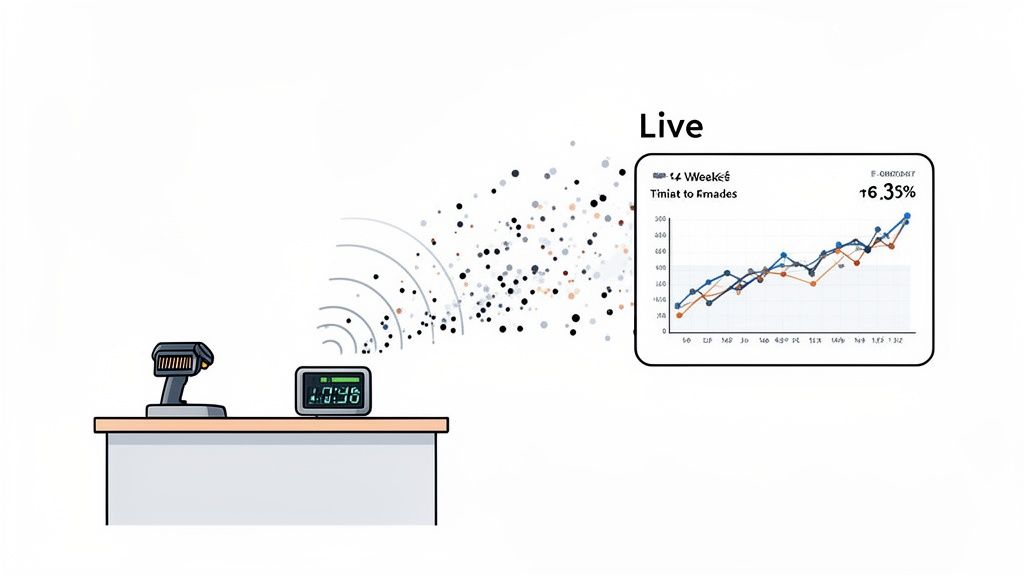
Retail giants like Zara use demand sensing to align their entire supply chain, from design to store replenishment, within rapid cycles. Similarly, Amazon adjusts its warehouse fulfillment strategies hourly based on incoming order patterns. This method excels at reducing the "bullwhip effect," where small changes in consumer demand create larger and larger distortions up the supply chain. For a deeper dive into modern supply chain analytics, Lokad offers powerful tools for quantitative supply chain optimization.
Statistical anomaly detection is not a direct forecasting method but a critical preparatory step that protects your models from distortion. This process uses techniques like control charts, z-score analysis, or isolation forests to identify data points that deviate significantly from expected norms. By spotting and managing these outliers, you prevent one-off events, like a viral social media post or a data entry error, from skewing your entire forecast and leading to poor inventory decisions.
This approach is vital for maintaining the integrity of your historical data, which is the foundation of all quantitative methods for forecasting demand. For example, a Shopify store might see a sudden, massive sales spike after an influencer mention. Without anomaly detection, a forecasting model might misinterpret this as a new, permanent trend, causing you to overstock inventory. Isolating this event allows the model to learn from regular patterns while letting you analyze the outlier separately to understand its cause.
| Method | Implementation complexity | Resource requirements | Expected outcomes | Ideal use cases | Key advantages |
|---|---|---|---|---|---|
| Time Series Forecasting (ARIMA/SARIMA) | Low–Moderate | Low (historical sales only) | Reliable trend & seasonal forecasts with confidence intervals | Established SKUs with clear seasonality | Fast, interpretable, minimal external data |
| Machine Learning (Gradient Boosting & Neural Networks) | High | High (large data, compute, ML expertise) | High accuracy for complex, multi-factor patterns | Large SKU catalogs; multi-variable demand drivers | Captures non-linear relationships; scalable |
| Exponential Smoothing (SES/Holt/Holt‑Winters) | Low | Low (limited data, minimal tuning) | Responsive short-to-medium term forecasts | Stable/trending products and short horizons (1–8 weeks) | Simple, fast, interpretable, low compute |
| Causal/Regression Forecasting | Moderate–High | Moderate (external causal data, domain expertise) | Quantified driver impacts; scenario analysis | Promotion- or price-sensitive products; ROI analysis | Actionable insights; interpretable coefficients |
| Judgmental & Qualitative Forecasting | Low–Moderate | Moderate (expert time, workshops) | Contextual forecasts when data is sparse or disrupted | New-product launches, disrupted markets, strategic scenarios | Captures tacit knowledge; flexible and adaptive |
| Ensemble Forecasting (Combined Methods) | High | High (multiple models, orchestration) | Improved accuracy and robustness vs single models | Heterogeneous portfolios; mission‑critical accuracy needs | Reduces model risk; leverages complementary strengths |
| Leading Indicators & External Data Integration | Moderate–High | Moderate (data sourcing & integration) | Early warning signals; extended lead time predictions | Trend-driven categories with digital signals | Early detection of shifts; proactive planning |
| Inventory-Based Forecasting (Sell‑Through Analysis) | Low–Moderate | Low (inventory + sales data) | Velocity-based projections; identify slow/fast movers | Inventory optimization, markdown/clearance planning | Direct measure of sell velocity; practical for action |
| Demand Sensing (Real‑Time Micro‑Forecasting) | High | High (real‑time feeds, infrastructure) | Very accurate near-term (1–4 weeks) forecasts | Fast-moving SKUs, omni‑channel retail, rapid replenishment | Rapid responsiveness; reduces safety stock |
| Statistical Anomaly Detection & Outlier Management | Moderate | Moderate (detection algorithms, monitoring) | Cleaner training data; alerts for spikes/drops | Viral spikes, data errors, promotion handling | Prevents model skew; flags events for investigation |
Navigating the world of demand forecasting can feel like learning a new language. From the statistical rigor of ARIMA models to the adaptive power of machine learning, we've explored a wide spectrum of tools. The central lesson is clear: no single method is a universal solution. Instead, the goal is to build a versatile and dynamic forecasting toolkit tailored to the specific needs of your e-commerce business.
Choosing the right approach is a strategic decision, not just a technical one. For a Shopify store with years of stable sales data for a core product, a Time Series or Exponential Smoothing model offers a solid, reliable foundation. But what about that new product launch influenced by TikTok trends? That’s where Qualitative and Judgmental methods, backed by real-time Demand Sensing, become essential for navigating uncertainty.
The most effective demand forecasting systems are not static; they are layered and responsive. Your strategy should evolve as your business grows and your data matures.
Mastering these methods for forecasting demand directly translates into tangible business outcomes. It means less capital tied up in slow-moving inventory, fewer lost sales from stockouts, and more efficient allocation of marketing spend. It’s the critical link between analyzing past performance and proactively shaping future profitability. By moving beyond a one-size-fits-all approach, you can build a system that not only predicts demand but also provides the confidence to make smarter, faster decisions across your entire operation.
Ready to stop guessing and start building a truly data-driven inventory strategy? Tociny.ai automates the complex process of selecting, blending, and managing these advanced methods for forecasting demand for every single SKU in your catalog. See how our AI-powered platform can deliver precise, actionable forecasts by joining our private beta at Tociny.ai today.
Tociny is in private beta — we’re onboarding a few select stores right now.
Book a short call to get early access and exclusive insights.