In the crowded world of D2C and Shopify, simply having great products isn't enough. The real competitive edge lies in how you present them. Effective category management, the strategic process of grouping and managing products, is the invisible architecture behind a successful e-commerce store. It transforms a random assortment of SKUs into a curated, intuitive shopping experience that guides customers, boosts average order value, and turns browsers into loyal buyers.
Many brands, however, still rely on guesswork. This approach often leads to bloated inventories, missed sales opportunities, and a confusing customer journey. A disorganized digital shelf can overwhelm shoppers, causing them to abandon their carts and seek out competitors with a clearer, more logical presentation. The difference between a thriving online store and one that struggles to convert is often found in the deliberate, data-driven organization of its product catalog.
This article cuts through the noise. We are breaking down 10 proven category management best practices, tailored specifically for the dynamic e-commerce landscape. You won't find vague theories here. Instead, you'll get a comprehensive playbook designed to help you make smarter merchandising decisions.
Inside, you will discover:
- Actionable steps to implement each practice immediately.
- Key performance indicators (KPIs) to track your success.
- Practical checklists to keep your strategy on course.
- Concrete examples of how these principles apply to real-world stores.
From defining a clear role for each category to optimizing your pricing and promotions, these insights will help you turn your product catalog into a powerful engine for sustainable growth. Let's dive into the strategies that will refine your operations and elevate your customer experience.
1. Category Role Definition: Assigning a Strategic Job to Every Product Group
The foundation of any strong category management strategy is recognizing that not all product groups serve the same purpose. Instead of applying a one-size-fits-all approach, the first and most critical best practice is to assign each category a specific strategic role. This process transforms your product catalog from a simple list into a coordinated team, where each category has a defined job contributing to your overall business goals.
By classifying categories, you can tailor marketing, inventory, and merchandising tactics with precision, moving from reactive sales to proactive, strategic growth. This clarity prevents you from overinvesting in low-impact categories or under-resourcing your primary customer magnets.
Common Category Roles for D2C Brands
- Destination: These are your signature categories. They are the primary reason customers seek out your brand and are crucial for attracting new traffic and defining your market position. Think of a D2C coffee brand’s unique "Single-Origin Espresso Blends."
- Routine/Core: These are the reliable, frequently purchased items that build customer loyalty and create a stable revenue base. For a Shopify apparel store, this might be their line of "Basic Organic Cotton T-Shirts."
- Seasonal/Occasional: These categories drive traffic and sales during specific times or events. They create urgency and are excellent for promotional campaigns, like a home goods store’s "Holiday Decor" collection.
- Convenience: These are often impulse buys or add-on items that increase average order value (AOV). They complement your core offerings, such as a skincare brand selling "Exfoliating Mitts" alongside their cleansers.
How to Implement Category Roles
- Analyze Your Data: Use sales velocity, profit margins, and customer purchase frequency to form initial hypotheses. Platforms like Tociny.ai can help identify which products are driving loyalty (Routine) versus those attracting one-time, high-value purchases (Destination).
- Gather Cross-Functional Input: Hold a workshop with stakeholders from marketing, sales, and supply chain. Marketing knows what drives traffic, while supply chain understands inventory costs and complexities.
- Define and Document: Create a clear document outlining each category's role, its primary KPIs (e.g., Destination = new customer acquisition, Convenience = units per transaction), and the core strategy for it.
- Review and Adapt: The market is not static. Re-evaluate your category roles quarterly or at least annually to ensure they still align with customer behavior and business objectives. A former Convenience item might evolve into a Routine purchase as customer habits change.
2. Assortment Optimization: Curating the Perfect Product Mix for Your Customers
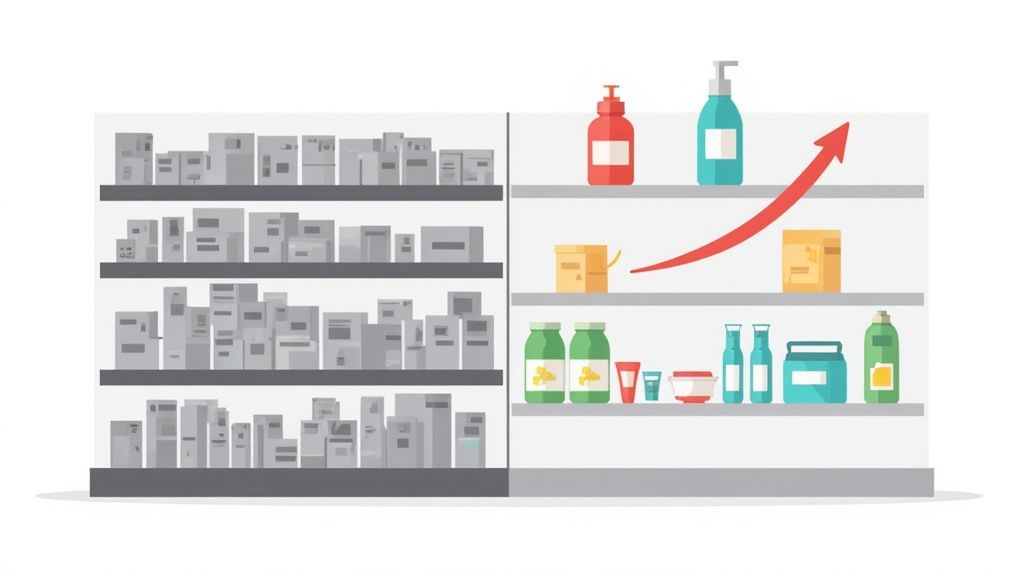
Once you have defined the strategic role of each category, the next critical step is to optimize the assortment within it. Assortment optimization is the art and science of selecting the right mix of products to offer, ensuring that your selection maximizes sales and customer satisfaction without overwhelming shoppers or creating inventory bloat. It answers the fundamental question: "What specific products should we carry to win in this category?"
This practice involves a disciplined analysis of what to add, what to keep, and what to remove. A poorly optimized assortment leads to decision fatigue for customers and ties up capital in slow-moving stock, while a well-curated one makes shopping intuitive, enhances brand perception, and drives profitability.
Key Principles of D2C Assortment Planning
- Breadth vs. Depth: This is the core trade-off. Breadth refers to the number of different product types you offer (e.g., a skincare brand offering cleansers, serums, and moisturizers). Depth refers to the variety within a single type (e.g., offering five different kinds of serums for various skin types). The right balance depends on your category’s role. Destination categories often require more depth to establish authority.
- SKU Rationalization: This is the process of identifying and discontinuing underperforming products (“dogs”). This frees up resources, simplifies the customer journey, and allows you to focus marketing spend on your winners. Procter & Gamble famously boosted profits by cutting nearly 100 of its brands to focus on its top performers.
- Product Cannibalization: This occurs when a new product’s sales come at the expense of an existing one. A key goal of assortment optimization is to introduce new items that attract new spending, not just shift it from another product in your catalog.
How to Implement Assortment Optimization
- Conduct an 80/20 Analysis: Apply the Pareto principle to your sales data. Identify the 20% of your SKUs that are generating 80% of your revenue or profit. This immediately highlights your core performers and potential candidates for removal.
- Analyze SKU Productivity: Go beyond just sales. Use metrics like gross margin return on inventory (GMROI) and sales per square foot (for physical retail) or conversion rate per product page (for D2C). An inventory analytics platform can automate this, scoring SKUs on their true contribution.
- Establish Clear Add/Drop Criteria: Create a formal process for introducing and discontinuing products. Define the performance hurdles a new product must clear in its first 90 days and the red flags (e.g., low margin, high return rate) that trigger a delisting review for an existing one.
- Forecast Accurately: Use historical data and market trends to predict demand for new and existing products. Accurate forecasting is crucial for deciding how much depth to invest in for a particular item. You can explore a variety of demand forecast methods on Tociny.ai to find the right approach for your business.
3. Pricing Strategy and Optimization: Aligning Price with Category Value
Effective category management goes beyond product selection; it demands a sophisticated pricing strategy that aligns with each category’s role and market position. Instead of applying a uniform markup across your catalog, this best practice involves developing nuanced, value-based pricing that considers consumer sensitivity, competitive pressures, and profit goals at a granular level. This approach turns pricing from a simple calculation into a powerful lever for influencing demand, maximizing margins, and reinforcing your brand’s perceived value.
By tailoring your pricing architecture, you can use your Destination categories to signal premium quality while leveraging Convenience items to boost basket size without deterring customers. This strategic flexibility is a cornerstone of modern category management best practices, ensuring you capture the maximum value from every transaction.

Common Pricing Architectures for D2C Brands
- Value-Based Pricing: This strategy is ideal for Destination categories where your product offers unique benefits. Pricing is based on the perceived value to the customer, not just the cost of goods. A D2C brand selling high-performance, sustainable outerwear can command a premium price that reflects its innovation and eco-friendly mission.
- Competitive Pricing: Used for Routine/Core categories in saturated markets. Prices are set in line with or slightly below key competitors to maintain market share and encourage repeat purchases. A Shopify store selling phone cases would continuously monitor competitor prices for its core models.
- Promotional/Dynamic Pricing: Best suited for Seasonal or short-lifecycle products. This involves planned markdowns, bundles, and time-sensitive offers to create urgency and clear inventory. A candy company, for example, would use this for its Valentine's Day collection, adjusting prices as the date approaches.
- Cost-Plus Pricing: While often too simplistic, this can be effective for Convenience or low-consideration add-on items. You simply add a standard markup to the product's cost, ensuring profitability on impulse buys that don't require deep strategic analysis.
How to Implement Category-Level Pricing
- Analyze Price Elasticity: Use historical sales data to understand how demand for products in each category changes with price adjustments. Tools like Tociny.ai can help forecast the impact of price changes on sales volume and revenue, revealing which products are highly sensitive.
- Conduct Competitor Benchmarking: Regularly monitor competitor pricing, especially for your Routine and Destination categories. Use this data not to copy but to strategically position your own offerings.
- Define Margin Targets by Category: Set clear profit margin goals for each category based on its strategic role. Your Destination category might have a 60% margin target, while a competitive Routine category might be set at 35%.
- Test and Iterate: Implement A/B tests for price changes on a small segment of your audience before a full rollout. Measure the impact on conversion rates, average order value, and overall gross margin to validate your strategy.
4. Promotion Planning and Execution: Driving Sales Without Eroding Value
Effective category management isn't just about what you sell; it's about how you sell it. Promotions are powerful levers for growth, but without strategic planning at the category level, they can quickly erode margins and devalue your brand. This best practice involves designing promotional activities that align with each category’s specific role, ensuring every discount, bundle, or offer serves a deliberate business objective.
Instead of reactive, store-wide sales, category-led promotions are surgical. A "Destination" category might get a "Gift with Purchase" to enhance its premium feel, while a "Seasonal" category uses a time-sensitive discount to clear excess stock before it becomes obsolete. This approach turns promotions from a cost center into a strategic tool for managing inventory, acquiring customers, and boosting profitability.

Common Promotional Mechanics by Category
- Destination: Use value-add promotions like "Gift with Purchase" (GWP) or exclusive access to new products. This reinforces the category's premium status without discounting core items. A luxury candle brand might offer a free wick trimmer with their best-selling scent.
- Routine/Core: Focus on loyalty and increasing purchase frequency with "Buy More, Save More" tiers or subscription discounts. For a pet food brand, this could be a 15% discount for subscribing to auto-shipments of their core kibble.
- Seasonal/Occasional: Employ time-sensitive discounts (e.g., "40% Off Holiday Decor - This Week Only!") to create urgency and clear inventory efficiently. This is the classic Black Friday/Cyber Monday strategy for electronics or fashion.
- Convenience: Encourage impulse buys with "Bundle and Save" offers that pair these items with core products. A coffee company could offer a discounted bundle of their "Espresso Blend" (Routine) and a new "Frothing Wand" (Convenience).
How to Implement Strategic Promotions
- Define Clear Objectives: Before launching any promotion, define its primary goal. Is it to increase AOV, clear aging stock, acquire new customers, or drive repeat purchases?
- Create a Promotional Calendar: Plan your key promotions quarterly. Align them with seasonal demand, product launches, and overall business goals. This prevents promotional overlap and ensures coordination with your supply chain.
- Measure Promotional Lift and ROI: Track every promotion's performance. Go beyond revenue and analyze metrics like margin impact, incremental sales (sales you wouldn't have made otherwise), and customer acquisition cost.
- Use Data to Personalize Offers: Leverage customer segmentation to tailor promotions. Platforms like Tociny.ai can identify high-value customer segments who may respond better to an exclusive early-access offer than a simple percentage-off discount.
5. Shelf Space and Planogram Management: Maximizing Visibility and Sales
While "shelf space" is traditionally a brick-and-mortar concept, its digital equivalent is just as critical for D2C brands. This practice involves strategically organizing how products are displayed on your website, from category pages to search results, to guide the customer journey and maximize sales. A well-designed digital planogram ensures your most important products get prime visibility, balancing profitability with an intuitive shopping experience.
This strategic placement prevents your high-potential SKUs from getting lost in a sea of products and helps customers discover items that meet their needs quickly. It translates the logic of physical retail, where eye-level is buy-level, to the digital world, where "above the fold" placement and top search rankings drive conversions.
Digital Planogram Strategies for D2C Brands
- Category Page Layout: This is your primary digital shelf. It involves deciding the order in which products appear. Do you lead with best-sellers, new arrivals, high-margin items, or a curated collection? The layout should reflect the category's strategic role.
- Hero Product Placement: Just as a physical store uses end-caps, your homepage and key landing pages should feature "hero" products from your Destination or Seasonal categories to immediately capture customer attention and communicate your brand's core value.
- Cross-Sell and Up-Sell Placement: This involves strategically placing Convenience or complementary items on product detail pages (PDPs) or at checkout. For example, a D2C camera store placing a "Frequently Bought Together" bundle with a camera, lens, and memory card.
- Search Result Prioritization: Optimizing your site search to push specific SKUs to the top of results for relevant keywords. This ensures customers looking for a general term like "running shoe" see your highest-converting or most profitable model first.
How to Implement Digital Planograms
- Define Your Metrics: Use data to guide placement. Key metrics include sales velocity, conversion rate per product view, profit margin, and customer lifetime value associated with first purchase. Platforms like Tociny.ai can help you identify which products are your true growth drivers.
- Map Out Key Pages: Create a visual map or spreadsheet for your most important pages: homepage, collection pages, and key landing pages. Define the "slots" for products and assign rules for what populates them.
- Implement and Test: Use your e-commerce platform's features (like Shopify's collection sorting) or third-party apps to execute your plan. A/B test different layouts to see what drives higher AOV and conversion rates. For example, test a "Best Sellers" sort order against a "New Arrivals" order on a key category page.
- Refine Based on Performance: Your digital shelf is not static. Regularly review performance data and adjust your planograms. If a SKU isn't performing in a top spot, it may be time to swap it out or investigate underlying issues. This process often connects to a broader SKU rationalization strategy to ensure your digital shelf space is always optimized. Learn more about how to declutter your product catalog effectively on tociny.ai.
6. Private Label Development and Management: Building Brand Equity and Margin
A powerful yet often overlooked component of advanced category management best practices is the strategic development of a private label. This involves creating and managing your own branded products within a category to boost profit margins, differentiate your store from competitors, and cultivate deeper customer loyalty. Instead of solely relying on third-party brands, you take control of the product from creation to sale.
By introducing an in-house brand, you can fill gaps in the market, offer better value, or provide a premium alternative unavailable elsewhere. This strategy transforms you from a simple reseller into a unique destination brand, giving customers a compelling reason to shop exclusively with you.
Common Private Label Tiers for D2C Brands
- Value Tier: Offers a no-frills, cost-effective alternative to national brands, capturing price-sensitive customers. Think of a pet supply store launching its own line of "Simple Nutrition" dog food.
- Core/Standard Tier: Designed to be comparable in quality to leading brands but at a more competitive price point. A Shopify electronics store might create "Innovate Essentials" cables and chargers.
- Premium Tier: A high-quality, exclusive line that offers superior features, ingredients, or design. This builds brand prestige and commands higher margins, such as a beauty retailer’s "Aura Botanics Reserve" skincare line.
- Niche/Specialty Tier: Targets a specific customer need not met by mainstream brands, like a coffee store’s "Single-Origin Micro-Lot" collection sourced exclusively for their customers.
How to Implement Private Label Development
- Identify Opportunities with Data: Analyze category sales and margin data to find high-volume, low-margin products that are ripe for a private label alternative. Use tools like Tociny.ai to spot categories with high customer loyalty but where brand-name products are compressing your profits.
- Define Your Value Proposition: Clearly determine what your private label will offer. Is it a lower price, better quality, unique features, or sustainable sourcing? This will guide your product development and marketing.
- Source and Vet Suppliers: Partner with reliable manufacturers who can meet your quality standards. Request samples, conduct quality control audits, and establish clear production agreements. Don’t compromise on quality to save a few cents; your brand reputation is at stake.
- Launch and Position Strategically: Invest in professional packaging and branding that reflects your chosen tier. Position the private label to complement, not cannibalize, your top-selling national brands. Use it to fill a specific price or quality gap in your assortment.
7. Supplier and Vendor Management: Building Strategic Partnerships for Success
Effective category management extends beyond your digital storefront; it is deeply rooted in the strength and strategic alignment of your supplier relationships. Simply treating vendors as transactional entities is a missed opportunity. Instead, the best practice is to manage them as strategic partners, ensuring product availability, consistent quality, cost efficiency, and even innovation for each category.
This collaborative approach transforms your supply chain from a potential bottleneck into a competitive advantage. By actively managing vendor performance and fostering partnerships, you can reduce stockouts, negotiate better terms, and gain early access to new products, directly influencing the health and profitability of your categories.
Common Approaches to Supplier Management
- Supplier Segmentation: Not all suppliers are created equal. Segment them based on their strategic importance. A supplier for a Destination category (e.g., your exclusive jewelry designer) requires a deep, collaborative partnership, while a supplier for a Convenience category (e.g., packaging materials) might be managed more on cost and reliability.
- Performance Tracking: Use scorecards to monitor key metrics like on-time delivery, order fill rates, quality control pass rates, and cost variance. This data-driven approach removes emotion from performance conversations.
- Collaborative Planning: Involve key suppliers in your demand forecasting. Sharing sales data and promotional calendars helps them plan production, reducing lead times and minimizing the risk of stockouts for your Routine best-sellers.
- Joint Innovation: Work with strategic partners to co-develop new products or exclusive variants. This is crucial for keeping Destination and Seasonal categories fresh and exciting, as seen in Apple’s deep collaborations with its component suppliers.
How to Implement Strategic Vendor Management
- Segment Your Supplier Base: Classify suppliers into tiers (e.g., Strategic, Collaborative, Transactional) based on their impact on your business, spend, and innovation potential.
- Establish Clear SLAs: Define Service Level Agreements (SLAs) with your key suppliers. Document expectations for lead times, order accuracy, communication protocols, and quality standards.
- Conduct Regular Business Reviews (QBRs): Meet with your strategic and collaborative partners quarterly. Review performance scorecards, discuss upcoming demand forecasts, and brainstorm growth opportunities.
- Align Incentives and Costs: Use your data to optimize purchasing. For instance, understanding your Economic Order Quantity can help you place orders that benefit both your inventory costs and your supplier's production efficiency. Learn more about how to calculate your ideal order size on tociny.ai. Platforms like Tociny.ai can provide the demand forecasts needed to make these calculations accurate.
8. Market and Consumer Insights: Grounding Your Strategy in Data
A category strategy built without deep market and consumer understanding is essentially a guess. Effective category management best practices demand a systematic approach to collecting, analyzing, and applying data about your market, competitors, and, most importantly, your customers. This practice moves your decision-making from being product-centric to customer-centric, ensuring your assortment, pricing, and promotions resonate with real-world needs and trends.
By grounding your strategy in solid insights, you can anticipate shifts in demand, identify unmet needs, and pinpoint competitive vulnerabilities. This proactive approach allows you to optimize categories not just for today's sales, but for future market relevance and sustained growth.
Key Areas for Insight Gathering
- Market Sizing and Trends: Understanding the overall size of your market and its growth trajectory. Are you in a growing, shrinking, or stable category? Services like Nielsen and Mintel provide comprehensive reports on market dynamics.
- Consumer Behavior and Segmentation: Moving beyond simple demographics to understand why customers buy. This includes analyzing shopping missions, lifestyle factors, and product usage patterns to create meaningful customer segments.
- Competitive Intelligence: Systematically tracking competitors’ assortments, pricing, promotional calendars, and new product launches. This helps identify gaps in the market and informs your own strategic positioning.
- Social Listening and Trend Spotting: Monitoring social media, forums, and review sites to catch emerging trends and understand consumer sentiment in real-time. This is often where the earliest signals of a new "Destination" category appear.
How to Implement Insight-Driven Decisions
- Integrate Multiple Data Sources: Combine internal sales data with external sources. Use your Shopify analytics alongside Google Trends, industry reports, and competitor site monitoring to build a complete picture.
- Develop Consumer Personas: Create detailed profiles of your key customer segments. What are their pain points, goals, and shopping triggers? Use these personas to evaluate every decision, from product sourcing to marketing copy.
- Establish a Feedback Loop: Actively solicit customer feedback through surveys, reviews, and social media engagement. Use this qualitative data to add context to your quantitative sales numbers.
- Share Insights Across Teams: Create a centralized dashboard or regular report to share key findings with marketing, product development, and operations. When everyone understands the "why" behind the strategy, execution becomes more aligned and effective.
9. Cross-Category and Occasion-Based Strategy: Building Cohesive Shopping Missions
Effective category management goes beyond optimizing individual silos; it involves understanding how categories interact. A cross-category and occasion-based strategy shifts the focus from selling products to selling solutions for a specific consumer need or "shopping mission." This approach recognizes that customers rarely buy in a vacuum. Instead, they purchase items together for a particular purpose, like "movie night at home" or "newborn baby essentials."
By organizing and merchandising products based on these occasions, you create a more intuitive and valuable shopping experience. This not only increases the average order value (AOV) through natural bundling but also strengthens customer loyalty by demonstrating a deep understanding of their lifestyle and needs.
Common Occasion-Based Strategies for D2C Brands
- Complementary Use: Grouping products that are used together. For a D2C kitchenware brand, this means merchandising high-quality knives alongside premium cutting boards, not just in their respective categories.
- Lifestyle Bundling: Creating collections based on a customer persona or activity. A fitness apparel brand might create a "Yoga Starter Kit" bundle that includes a mat, leggings, a top, and a water bottle.
- Gifting Occasions: Curating products for specific events like Mother's Day, Valentine's Day, or birthdays. A beauty brand could create a "Self-Care Sunday" gift set that combines a face mask, bath bomb, and body lotion.
- 'Shop the Look': Common in fashion, this strategy allows customers to purchase an entire outfit (top, pants, accessories) from a single product page, moving beyond simple cross-sells.
How to Implement an Occasion-Based Strategy
- Analyze Basket Data: The first step is to uncover true product affinities. Use your sales data or a platform like Tociny.ai to perform a market basket analysis, identifying which items are most frequently purchased together. This data-driven approach reveals real customer behavior, not just assumptions.
- Define Key Occasions: Based on your basket analysis and customer research, identify 3-5 core shopping missions your customers have. This could be "hosting a party," "weekly meal prep," or "setting up a home office."
- Build Cross-Category Narratives: Develop marketing campaigns and on-site merchandising that tell a story around each occasion. Create dedicated landing pages or collections like "Your Complete Grilling Kit," and use email and social media to promote these solutions.
- Test and Monitor: Launch your occasion-based bundles or collections and closely monitor performance. Track KPIs like AOV, conversion rate for the bundle, and sales lift in the associated categories. Be mindful of potential cannibalization and adjust your strategy if a bundle is simply stealing sales from individual items without increasing overall revenue.
10. Performance Metrics and Analytics: Creating a Data-Driven Feedback Loop
A strategy without measurement is just a guess. The tenth essential practice is establishing comprehensive performance metrics and analytics to track the success of your category plans. This involves creating dashboards and defining Key Performance Indicators (KPIs) that connect directly to each category's strategic role, providing a clear, data-driven view of what’s working and what isn’t.
This feedback loop transforms category management from a static, annual exercise into a dynamic, continuous improvement cycle. By monitoring the right metrics, you can quickly identify underperforming products, spot emerging trends, and make agile adjustments to your assortment, pricing, and promotion strategies to maximize profitability and market share.
Key Metrics for D2C Category Dashboards
- Sales & Profitability Metrics: Track Gross Margin Return on Inventory (GMROI), category-specific revenue, and net profit. This helps you understand not just what’s selling, but what is actually making money.
- Customer Metrics: Monitor Customer Lifetime Value (CLV) by category, purchase frequency, and new vs. returning customer rates. This reveals which categories are driving loyalty versus acquisition.
- Inventory & Operational Metrics: Keep an eye on Inventory Turnover, Stock-to-Sales Ratio, and Sell-Through Rate. These operational KPIs are crucial for maintaining healthy cash flow and avoiding costly overstocks.
- Market Metrics: For larger brands, tracking category market share or Share of Voice (SOV) provides crucial context on competitive performance and growth opportunities.
How to Implement Performance Analytics
- Link KPIs to Category Roles: Assign 5-8 core KPIs to each category based on its job. A "Destination" category's primary KPI might be new customer acquisition, while a "Convenience" category is measured by units per transaction.
- Build an Automated Dashboard: Use tools like Shopify’s native analytics, Google Data Studio, or more advanced platforms to create a centralized, automated dashboard. This eliminates manual reporting and provides real-time insights.
- Establish Benchmarks: Performance data is more meaningful with context. Compare your KPIs against historical performance, industry averages, or internal goals to understand if your results are strong, average, or lagging.
- Schedule Regular Reviews: Set up weekly or bi-weekly meetings with your team to review the category dashboard. Use these sessions to diagnose issues, celebrate wins, and make data-backed decisions for the upcoming period, ensuring your category management best practices are consistently refined.
10-Point Comparison: Category Management Best Practices
| Item |
Implementation complexity |
Resource requirements |
Expected outcomes |
Ideal use cases |
Key advantages |
| Category Role Definition |
Medium — framework design and periodic review |
Moderate — analytics + cross‑functional alignment |
Clear prioritization and focused category strategies |
Portfolio planning; merchandising strategy |
Targeted resource allocation; aligned marketing and supply chain |
| Assortment Optimization |
High — SKU analysis and testing cycles |
High — POS data, analytics, SKU management |
Higher turnover, improved profitability, optimized working capital |
SKU rationalization; format-specific assortments |
Reduced carrying costs; better assortment relevance |
| Pricing Strategy and Optimization |
High — elasticity modeling and price architecture |
High — pricing tools, competitive data, analysts |
Improved margins and competitive positioning |
Competitive or margin-sensitive categories; promotions |
Maximized profitability; smarter promotional decisions |
| Promotion Planning and Execution |
Medium‑High — calendar planning and coordination |
High — marketing, supply chain, tracking tools |
Incremental sales, inventory clearance, measurable lift |
Seasonal peaks, product launches, clearance events |
Drives short‑term sales; measurable ROI and trial |
| Shelf Space and Planogram Management |
Medium — planogram design and compliance |
Moderate — planogram software, store execution |
Increased sales per linear foot; better shopper navigation |
Brick‑and‑mortar, dense SKU categories |
Improves visibility and shelf productivity |
| Private Label Development and Management |
High — product development and quality control |
High — sourcing, R&D, marketing investment |
Higher margins, differentiation, increased loyalty |
Retailers seeking margin growth and exclusivity |
Margin uplift; direct control over specifications |
| Supplier and Vendor Management |
Medium — relationship and contract management |
Moderate‑High — supplier programs, data sharing |
Better availability, cost efficiencies, innovation |
Categories dependent on strategic suppliers |
Reduces costs; fosters collaborative innovation |
| Market and Consumer Insights |
Medium — research and analysis workflows |
Moderate‑High — research tools, panels, analysts |
Evidence‑based decisions; early trend detection |
New product development; strategy validation |
Deeper consumer understanding; reduced strategic risk |
| Cross‑Category and Occasion‑Based Strategy |
High — cross‑category analysis and coordination |
Moderate‑High — basket data, marketing, merchandising |
Increased basket size; improved shopper convenience |
Bundling, occasion‑driven merchandising |
Drives cross‑sell; aligns offering to shopping missions |
| Performance Metrics and Analytics |
Medium — KPI selection and dashboarding |
Moderate‑High — BI tools, data pipelines, analysts |
Faster issue detection; informed continuous improvement |
Ongoing category management and executive reporting |
Enables accountability; supports data‑driven decisions |
From Theory to Action: Building Your Category Management Flywheel
We've explored ten foundational category management best practices, from defining category roles and optimizing assortments to leveraging deep market insights and tracking performance metrics. Each practice represents a critical lever you can pull to drive growth, enhance customer loyalty, and boost profitability within your e-commerce store. It's easy to look at this comprehensive list and feel overwhelmed, but the goal isn't to implement everything at once. The real power lies in creating a continuous, self-reinforcing cycle of improvement.
Mastering these strategies is about shifting from a reactive operational mindset to a proactive, strategic one. Instead of just managing products, you are curating experiences. Instead of just setting prices, you are shaping perceived value. This distinction is what separates stagnant brands from those that achieve sustainable, long-term success.
The journey starts not with a complete overhaul, but with a single, focused step. By treating these best practices as a strategic toolkit, you can select the right tool for your most pressing challenge and begin building momentum.
Key Takeaways and Your Strategic Starting Point
The core message threaded through all ten practices is the indispensable role of data. Gut feelings and historical assumptions are no longer enough in the competitive D2C landscape. Success hinges on your ability to translate raw data into strategic action.
Here’s a summary of the most important takeaways:
- Strategy Before Tactics: Defining a clear role for each category (e.g., Destination, Routine, Convenience) provides the strategic North Star that guides all subsequent decisions on assortment, pricing, and promotion.
- Customer-Centricity is Non-Negotiable: Your assortment, pricing, and promotional strategies must be built around a deep understanding of your target customer's needs, behaviors, and price sensitivity.
- Integration is Power: These practices are not isolated silos. Your supplier relationships directly impact your pricing power and assortment flexibility. Your promotional plans must align with your inventory forecasts. A holistic approach amplifies the impact of each individual effort.
- Technology is Your Accelerator: Modern tools are essential for cutting through the noise. Leveraging inventory analytics and forecasting platforms transforms complex datasets into the clear, actionable insights needed to implement these category management best practices effectively and at scale.
Your Actionable Next Steps
To move from theory to execution, avoid the temptation to tackle everything simultaneously. Instead, build a flywheel by focusing your initial energy where it will generate the most momentum.
- Conduct a Quick Audit: Choose one high-impact category. It could be your bestseller, one with declining margins, or a new category you want to grow. Review its performance against the ten practices discussed. Where are the most obvious gaps? Is the assortment bloated? Are promotions cannibalizing sales? Is supplier performance dragging down profitability?
- Select Your "First-Mover" Practice: Based on your audit, pick one or two practices to focus on for the next 90 days. For instance, if you have excess stock, prioritize Assortment Optimization. If customer acquisition is a challenge, focus on Promotion Planning and Execution.
- Define a "Mini-Project" with Clear KPIs: Turn your chosen practice into a small, manageable project.
- Example Project: "Optimize the 'Premium Skincare' category assortment."
- KPIs: Reduce SKU count by 15%, increase category margin by 5%, and improve the stock-to-sales ratio by 20% within 90 days.
- Measure, Learn, and Iterate: At the end of the 90-day cycle, analyze your results. What worked? What didn’t? Apply these learnings and select your next focus area. This iterative process is the engine of your category management flywheel.
By consistently applying this cycle-audit, focus, execute, and learn-you transform these category management best practices from a static checklist into a dynamic system for growth. Each successful optimization generates more data and deeper insights, which in turn fuels smarter, more profitable decisions for the next cycle. This is how you build a resilient, customer-focused brand that not only competes but leads in its market.
Ready to turn your sales data into your most powerful strategic asset? Tociny.ai provides the advanced inventory analytics and demand forecasting needed to implement these category management best practices with precision. Stop guessing and start making data-driven decisions by visiting Tociny.ai to see how you can unlock profitable growth today.