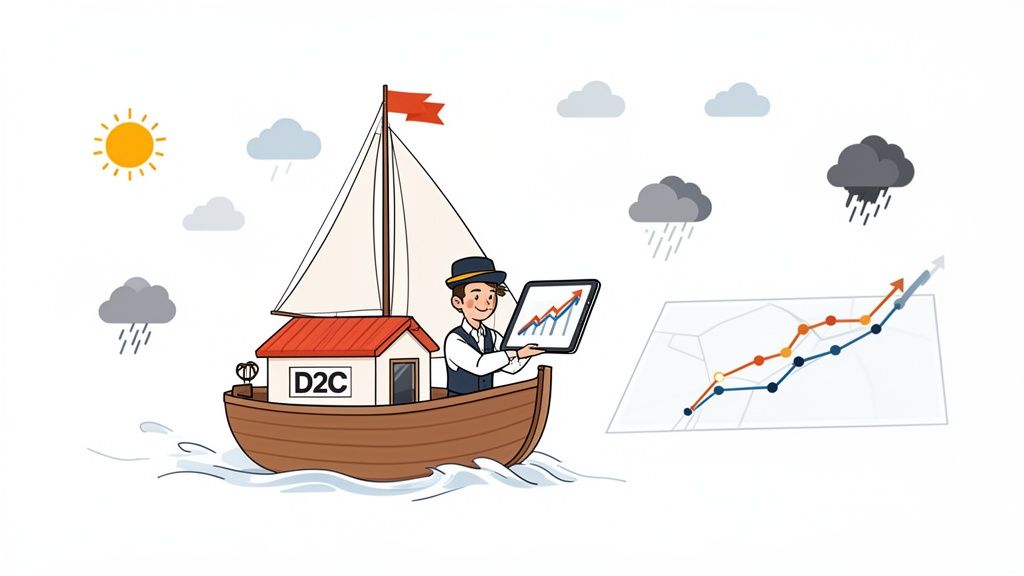
Picture this: you're trying to sail a ship across the ocean, but you have no weather forecast. You could sail right into a nasty storm or, just as bad, miss the perfect winds that would get you to your destination faster. For a Shopify brand, demand and forecasting is that vital weather report. It helps you navigate the choppy waters of ecommerce.
Let’s be clear: forecasting isn't about gazing into a crystal ball. It’s a smart, strategic process that uses your past sales data and current market signals to get a solid handle on what your customers will want to buy in the future.
When you get this right, you dodge the two icebergs that sink far too many D2C brands: costly overstock and frustrating stockouts.
Overstocking is a cash-flow killer. It traps your money in products collecting dust on a shelf instead of funding your next marketing campaign or product launch. On the flip side, stockouts are a loyalty killer. They send eager customers straight to your competitors and leave a bad taste in their mouths. Nailing the balance is the heart of smart inventory management.
Getting forecasting right—or wrong—has a direct impact on your bottom line. It's not just a small operational detail; it's a major driver of profitability. Here’s a quick look at the direct business impact of guessing versus knowing.
| Problem Area | Impact of Guesswork (Poor Forecasting) | Benefit of Accuracy (Good Forecasting) |
|---|---|---|
| Profitability | Deep discounts to clear dead stock, eroding margins. | More full-price sales, protecting and boosting profits. |
| Cash Flow | Capital is trapped in slow-moving inventory. | More cash is free for marketing, R&D, and growth. |
| Customer Loyalty | Frustrating stockouts drive customers to competitors. | Best-sellers are always available, building trust and repeat business. |
| Warehouse Costs | Higher storage and handling fees for excess products. | Optimized storage space and lower carrying costs. |
Ultimately, moving from guesswork to data-driven accuracy transforms your inventory from a source of constant headaches into a powerful strategic advantage.
The global retail market is exploding, projected to grow from $27.26 trillion to an incredible $36.91 trillion by 2030. That's a compound annual growth rate of about 6.25% every single year. For Shopify merchants in competitive niches like fashion, wellness, or electronics, this growth means one thing: the stakes are higher than ever.
More opportunity also means more competition. Brands that can accurately predict what customers will buy—and when—are the ones that will win. This foresight creates a ripple effect across your entire business:
Accurate demand forecasting is the bridge between your historical sales data and your future profitability. It transforms inventory from a reactive headache into a proactive strategic asset.
This whole process is a key part of a bigger strategy called demand planning. If you want to zoom out and see the full picture, we break it down in our guide on what is demand planning.
The good news? Modern AI tools like Tociny.ai are making this D2C superpower accessible to every ambitious brand, turning mountains of complex data into clear, actionable insights for smarter inventory decisions.
To get a real grip on future sales, you need the right tool for the job. Think of demand forecasting methods like a mechanic's toolbox—each one is built for a specific task. You wouldn’t use a socket wrench to change a tire, and you definitely shouldn't use the same forecasting method for a brand-new product launch as you would for a long-time bestseller.
Ultimately, your choice boils down to a simple question: do you have enough reliable sales history to work with? The answer splits your options into two main camps: qualitative and quantitative forecasting. Each gives you a different lens for seeing future demand, and knowing the difference is the first step toward building an inventory plan that doesn't break.
What do you do when you’re launching a new product line or testing a new market? With no sales history to lean on, you have to become a bit of a detective, gathering clues from the world around you. That’s the heart of qualitative forecasting.
This approach hinges on human judgment and expertise instead of pure statistical models. It’s more of an art than a science, piecing together external insights to build a reasonable estimate of what demand might look like.
Common qualitative techniques include: * Market Research: Getting out there and surveying potential customers to see if they’re interested, how they shop, and what problems they need solved. * Expert Opinions: Tapping into the knowledge of industry veterans, your own sales team, or consultants who have a gut feel for the market. This is often done through a structured process called the Delphi method. * Competitor Analysis: Seeing how similar products from your competitors are doing. This can give you a solid benchmark for your own potential sales volume.
Qualitative forecasting is your best friend for any new venture, but because it’s so subjective, think of it as a starting point. The moment sales start rolling in, you can begin mixing these insights with cold, hard data.
Once your product has been on the market for a while, it leaves a trail of evidence: your sales history. Quantitative forecasting uses this historical data to find patterns and project them into the future. Here, you're trading your detective hat for a statistician's visor.
This approach works on the assumption that what happened in the past—like seasonal spikes or steady growth—will likely happen again. It's an incredibly powerful way to make objective, data-driven predictions for products with an established track record.
One of the most common quantitative methods is time-series analysis. This technique looks at sales data collected over regular intervals (daily, weekly, monthly) to pull out trends, seasonality, and other recurring patterns. For example, a D2C apparel brand can use time-series analysis to predict how many winter coats to order by looking at sales data from the last few winters.
If you want to go deeper into the different statistical models and find the perfect fit for your store, we've broken down the most common demand forecast methods right here.
While traditional methods are great, they often work in isolation. Qualitative insights can miss subtle data patterns, and quantitative models can be completely thrown off by sudden market shifts that don’t appear in your historical data. This is where AI and machine learning really change the game.
Think of AI as a master detective that combines all the clues. It crunches your historical sales numbers (quantitative) while also scanning external signals like market trends, competitor promotions, and even social media buzz (qualitative). By weaving all this information together, AI models spot complex connections that humans and simple spreadsheets would almost certainly miss. Many modern brands now rely on the best predictive analytics software to tie all these threads together and get a clearer picture.
This modern approach isn’t just about looking backward. It creates adaptive forecasts that actually learn and adjust in real-time as new data comes in, giving you a much more accurate and resilient view of what’s coming.
Deciding on a forecasting approach isn't a one-size-fits-all situation. The right method depends on your product's lifecycle, the data you have available, and your business goals. A new brand just getting started has very different needs than an established store with years of sales history.
The table below breaks down the most common techniques to help you see where your business fits.
| Forecasting Method | Best For | Pros | Cons |
|---|---|---|---|
| Qualitative | New products, new markets, or when historical data is unavailable. | Great for innovation and long-term strategic planning. Taps into expert knowledge. | Highly subjective and can be biased. Less accurate for short-term inventory decisions. |
| Time-Series Analysis | Established products with stable demand patterns and clear seasonality. | Objective and data-driven. Relatively simple to implement for predictable products. | Can't account for sudden market changes. Relies heavily on clean, historical data. |
| AI / Machine Learning | Both new and established products, especially in dynamic or unpredictable markets. | Highly accurate and adaptive. Processes vast amounts of data to find hidden patterns. | Requires specialized tools and expertise. Can feel like a "black box" if not understood. |
Ultimately, many successful brands use a hybrid approach. They might start with qualitative insights for a new launch, transition to time-series analysis as sales history builds, and eventually integrate AI to refine their forecasts and stay ahead of the curve.
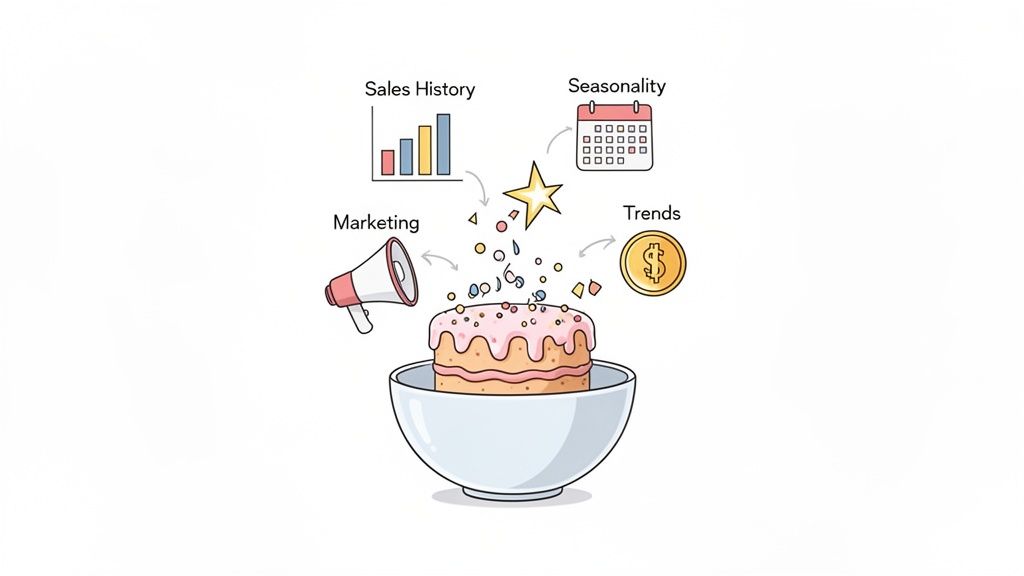
A good forecast is a lot like a good cake. You can't just throw flour in a bowl and expect it to turn out right. While your historical sales data is the flour—the absolute foundation—relying on it alone will leave you with a flat, bland prediction.
To bake up a rich, reliable forecast that actually mirrors reality, you have to blend in other essential ingredients. These other data signals are the eggs, sugar, and spices that give your demand and forecasting model its structure, flavor, and depth.
Your past sales are your most valuable forecasting asset, no question. But they only tell you what happened, not why it happened or what’s about to change.
A simple spreadsheet that just copies last year’s numbers forward is going to miss the mark. It can’t see the big competitor that just launched, nor can it anticipate a sudden shift in what your customers are spending their money on. This is exactly why layering in more data signals isn't just a nice-to-have; it's a must.
Building a truly robust prediction means mixing in a variety of internal and external data. Let's break down the most critical ingredients you need to get right.
Seasonality: This is the most obvious one for most D2C brands. It’s the predictable rhythm of your business—the holiday rush for a gift shop or the summer spike for a swimwear brand. It’s the baseline beat of your sales year.
Marketing and Promotions: Your own actions create demand. That planned 20% off sale, a new influencer partnership, or a bigger ad budget will all cause sales spikes. Your historical data alone can't predict the impact of these future events.
Emerging Market Trends: Consumer tastes can pivot on a dime. One viral TikTok video or a new home decor style trending on Pinterest can create a massive, sudden wave of demand for a product you thought was a slow-mover. If you're not watching for these signals, you'll be completely blindsided.
Economic Factors: The bigger picture matters. Things like inflation, consumer confidence, and employment trends directly impact how much disposable income your customers have. These factors tell you whether shoppers are in a mood to splurge or save.
A truly effective demand and forecasting model doesn't just look at what you sold; it understands the entire context surrounding those sales. It connects your internal actions with external market forces to create a holistic and adaptive prediction.
Let's say you run a Shopify store selling high-end, sustainable home goods. A basic forecast would just look at last year's sales. A smarter, multi-signal forecast, however, would add more layers: * It would track housing market trends, knowing that more home sales often lead to more spending on decor. * It would monitor social media mentions of sustainable materials, catching a new trend before it goes mainstream. * It would factor in your upcoming Earth Day promotion, anticipating a sales lift for that specific week.
This is precisely where spreadsheets fall apart and AI-powered tools shine. An AI platform is built to chew on all these different, complex inputs at once, spotting connections a human might easily miss. This ability to synthesize information is what turns a simple forecast from a backward-looking report into a strategic advantage.
The current economic climate makes this more crucial than ever. For instance, US online holiday sales in 2025 are predicted to grow by just 2.1%—a real slowdown from past years. This points to more cautious consumers who are prioritizing value over impulse buys, making every inventory decision critical. You can explore the full 2025 retail sales forecast to get a better handle on these changing behaviors.
So, how do you know if your demand forecasting is actually working? A forecast is only as good as its results, which means you need a simple way to grade its performance. Otherwise, you're just making educated guesses and hoping for the best.
Think of it like a game of darts. Your forecasts are the darts, and the bullseye is your actual sales numbers. The goal is to get as close as possible, as often as possible. We can measure this in a few key ways.
You don't need a PhD in statistics to figure out if your forecast is hitting the mark. For Shopify merchants, one of the most practical metrics is Mean Absolute Percent Error (MAPE). Put simply, MAPE tells you the average percentage difference between what you predicted you'd sell and what you actually sold.
For instance, if you forecasted 100 units of a particular SKU and only sold 90, your error for that product is 10%. MAPE just averages that percentage error across all your products for a specific period. The lower your MAPE, the more accurate your forecast—and the closer your darts are landing to the bullseye.
It's also crucial to understand the difference between accuracy and precision.
You absolutely need both. An accurate but imprecise forecast is just luck. A precise but inaccurate one is consistently wrong. The sweet spot is being both accurate and precise, hitting that bullseye over and over again.
Even the sharpest merchants can fall into common traps that completely derail their forecasting accuracy. Spotting these pitfalls is the first step toward avoiding them.
Relying solely on past sales data is like driving while looking only in the rearview mirror. It tells you where you've been, but it won't show you the sharp turn or roadblock just ahead.
Here are the most common mistakes we see and how to sidestep them:
1. Ignoring Market Shifts and External Factors Basing everything on last year's sales leaves a massive blind spot. Consumer behavior isn't static; it's constantly in flux. A recent McKinsey study found that a staggering 79% of global consumers are now trading down to cheaper goods or holding out for deals. This trend is particularly sharp in apparel, where 47% of US shoppers now wait for sales. If you ignore a shift like that, you're setting yourself up for a warehouse full of overstocked, full-priced items nobody wants. You can explore the full insights on consumer behavior from McKinsey to see more.
2. Failing to Account for Promotions Did you run a killer Black Friday sale last year? If you don't specifically flag that promotional lift, your forecasting model will assume that massive sales spike is just business as usual. It will then incorrectly predict another huge November next year, even if you have no plans for a similar sale.
3. Getting Trapped in Spreadsheet Chaos Spreadsheets are fine when you're just starting out, but they become a serious liability as you scale. They are notoriously prone to human error, can't handle multiple data signals at once, and demand hours of tedious manual updates. This "spreadsheet chaos" makes it impossible to build a reliable or scalable forecasting process.
Knowing the theory is one thing, but turning that knowledge into confident, money-making inventory decisions is where the real growth kicks in. Let's move from the concepts to a practical workflow and see how a modern Shopify brand can nail its demand and forecasting strategy—no data science degree required.
This is exactly where platforms like Tociny.ai come in. Instead of wrestling with messy spreadsheets or confusing statistical models, you get clear, actionable insights that directly answer your most critical questions: What should I order? When? And how much?
Picture a fast-growing fashion brand gearing up for a new season. In the past, they might have placed orders based on last year’s sales numbers and a big dose of gut instinct. The all-too-common result? They sell out of size Medium in the first week but are left with racks of XS and XL items at the end of the season, forcing them into deep, profit-killing discounts.
With an AI-driven tool, that process looks completely different. Tociny.ai’s adaptive forecasting engine doesn't just glance at last year's sales. It digs into recent sales velocity, spots emerging trends for specific styles, and even accounts for the brand's own marketing calendar. The platform might recommend a much heavier buy on that one blazer that's blowing up on social media, while suggesting a more cautious order for the niche-colored pants.
This simple shift moves the brand’s strategy from being reactive (discounting what didn't sell) to proactive (ordering what will sell).
Another classic headache is the unexpected sales spike. Think about a wellness brand whose best-selling supplement suddenly gets a shoutout from a major health influencer. Without warning, daily sales triple. A static, spreadsheet-based forecast would be completely blindsided, leading to a frustrating and costly stockout that could drag on for weeks.
Tociny.ai is built for this kind of volatility. Its stock level predictions and real-time sales forecast would immediately pick up on the surge in demand. The platform would then recalibrate its forecast and automatically trigger a reorder recommendation, alerting the inventory manager that they need to get a new purchase order out the door way sooner than planned. That agility means the brand can actually capitalize on the momentum instead of letting down a wave of new customers.
The goal of modern forecasting isn't just to be less wrong; it's to become faster and smarter in your response to change. An adaptive system turns market surprises into strategic opportunities.
You can learn more about how Tociny.ai helps you anticipate these changes with our guide to AI-powered sales forecasting. By understanding the real drivers of demand, you can make smarter decisions that protect both your revenue and your hard-earned customer relationships.
This visual shows the most common ways forecasting can go wrong, from bad data at the start to flawed models and, finally, just ignoring what the market is telling you.

As the infographic makes clear, these errors compound. A small data issue can easily snowball into a major forecasting disaster down the line.
So, what does this actually look like day-to-day? An effective workflow isn't about spending hours in spreadsheets; it's about making data-backed decisions quickly and getting on with your day.
Check the Dashboard: Start with a bird's-eye view of your inventory health. The dashboard should instantly show you what’s flying off the shelves, what’s gathering dust, and which products are at risk of stocking out soon.
Analyze Key Forecasts: Dive into the sales forecast for your most important products. See the predicted demand for the next few weeks or months and understand the patterns behind it—whether it’s seasonality or just a recent bump in sales.
Act on Recommendations: This is where the magic happens. The system translates the forecast into concrete actions. It will recommend the exact quantities to order for each SKU, helping you keep the right amount of stock without tying up too much cash.
Place Purchase Orders: Armed with this data, you can create and send purchase orders to your suppliers with total confidence, knowing the quantities are based on a reliable prediction of future demand, not a wild guess.
This straightforward, repeatable process takes the anxiety and endless manual work out of inventory management. It transforms a complex analytical chore into a streamlined, operational habit.
We’ve seen just how critical accurate demand and forecasting has become. It’s no longer a complex luxury reserved for enterprise giants with massive analytics teams. Today, it’s an essential, accessible strategy for any ambitious D2C brand ready to scale smarter, not just bigger.
If there's one core takeaway from all this, it’s the need to shift from reactive to proactive inventory management.
Running a modern ecommerce brand means breaking the old, painful cycle of ordering more only when you’re already out of stock. In today’s market, the brands that win are the ones that can anticipate what customers want before they even know they want it. They adapt to market shifts on the fly, turning potential disruptions into profitable opportunities.
This isn't just about plugging in a new tool; it’s a fundamental change in how you think about your business. The brands leading the pack have stopped viewing inventory as a costly liability—a source of risk and tied-up cash. Instead, they see it as their greatest strategic asset.
The future of ecommerce belongs to brands that use intelligent forecasting to transform their inventory from a passive cost center into an active, strategic advantage.
When you nail this, your capital finally starts working for you. It’s funding new product lines and marketing campaigns instead of collecting dust in a warehouse. It means your customers are consistently delighted because their favorite products are always in stock. It’s a powerful shift that sends positive ripples across your entire business, from your cash flow to your brand’s reputation.
To truly make your inventory planning adaptive, it's essential to pair smart forecasting with robust operational habits. You can get a great breakdown of these in this guide to 10 Inventory Management Best Practices for 2025. Combining a strong forecast with solid day-to-day practices is the recipe for sustainable growth.
Ultimately, mastering demand and forecasting gives you control. It empowers you to navigate uncertainty with confidence, ensuring you have the right products, in the right place, at the right time. By embracing this data-driven, adaptive model, you’re not just managing stock—you’re building a more profitable and predictable future for your brand.
When you're digging into demand forecasting, a few questions always pop up. We hear them from Shopify merchants all the time, so we’ve put together some straightforward answers to help you run a smarter, more profitable store.
This really depends on how fast your products move. If you're in a fast-paced niche like fashion or consumer electronics where trends shift on a dime, you should probably be looking at your forecast weekly, or at least every two weeks. For products with more stable sales, a monthly check-in can work just fine.
But here’s the thing: the best approach is to have a forecast that’s always updating. Modern AI platforms like Tociny.ai don’t just sit around waiting for you to run a report. They’re constantly crunching new sales data as it comes in. This means you get real-time insights without lifting a finger, ensuring every decision is based on what’s happening right now.
Absolutely, you just need to start with a different playbook. Since you don't have any sales history, you’ll lean on qualitative forecasting methods first.
Think of yourself as a market detective. Your job is to: * Analyze similar products: Look at what's already out there. This gives you a rough baseline for what kind of sales volume to expect. * Survey potential customers: Get a feel for genuine interest and whether people would actually buy it. * Talk to the experts: Pick the brains of your sales team or other industry veterans. They often have a great gut feeling for what will sell.
Once you launch, that's when the magic happens. After just a few weeks of real sales data, you can plug that info into a quantitative or AI-driven model. The system will take that initial data and start building a much more accurate picture of future demand.
It’s not just useful—it's critical. In fact, forecasting is most valuable when your sales feel chaotic. While no forecast is a crystal ball, a good system is designed to find the hidden logic behind all that unpredictability.
An advanced forecasting tool can figure out if your sales swings are driven by seasonality, a recent marketing campaign, or bigger market trends. It finds the signal in the noise.
An AI-powered tool can untangle this complexity in a way a spreadsheet never could. It helps you find that sweet spot for your inventory—enough to act as a buffer against surprises, but not so much that you’re tying up cash in a warehouse full of overstock.
The breaking point is usually when your spreadsheet starts costing you more than it saves. If you're spending hours every week wrestling with data or, worse, constantly running out of your best-sellers despite all that planning, it’s time for a change.
Honestly, if you’re managing more than just a handful of SKUs, a dedicated tool will pay for itself almost immediately. You'll get back your time and stop losing sales to easily preventable stockouts.
Ready to stop guessing and start making data-driven inventory decisions? Tociny.ai replaces spreadsheet chaos with clear, actionable forecasts. Get early access and see how our AI can help you grow.
Tociny is in private beta — we’re onboarding a few select stores right now.
Book a short call to get early access and exclusive insights.