So, what exactly is demand planning?
At its core, demand planning is the process of looking into the future, predicting what your customers are going to want, and then making sure your entire operation—from inventory to production to your supply chain—is ready to meet that demand. It’s how you shift from just guessing what to order to actually knowing what your customers will buy. The goal is simple: avoid those two nightmare scenarios for any e-commerce brand: costly overstock and frustrating stockouts.
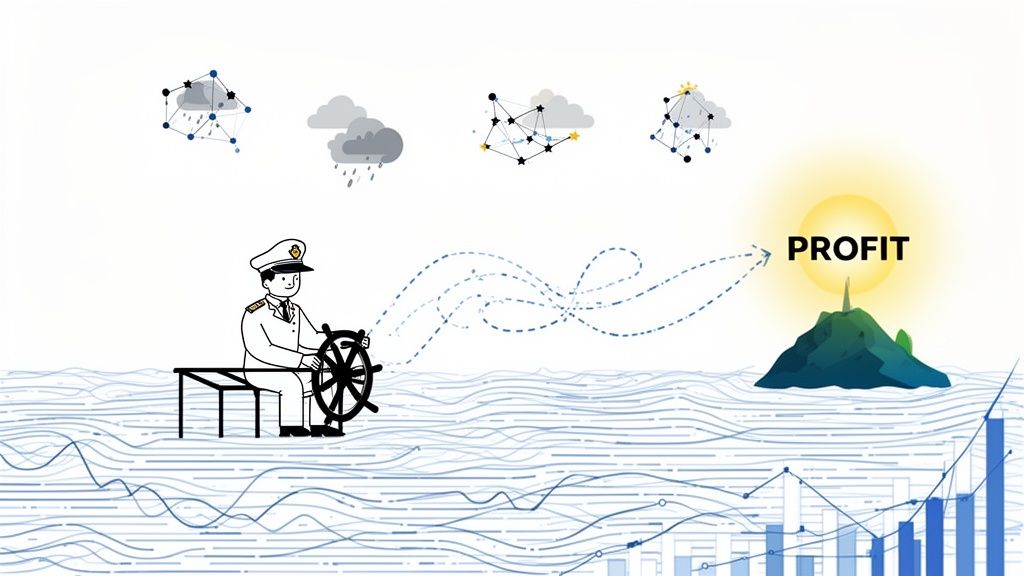
Imagine you’re the captain of a ship, and your destination is consistent profitability and happy, loyal customers. The market is the ocean—sometimes it’s calm, but more often than not, it's turbulent. You've got unexpected storms like supply chain delays, sudden viral trends, and fickle customer tastes.
Good demand planning is your ship's navigation system. It uses weather forecasts (data analysis) and star charts (your sales history) to plot the most efficient and safest route forward.
Without it, you’re essentially sailing blind. You're just reacting to the chaos around you. You might stock up on winter coats right before an unseasonably warm spell, leaving you with a shipwreck of unsold inventory. Or you might completely underestimate the demand for a new summer product, leading to stockouts that send your hard-won customers sailing right over to your competitors.
Demand planning transforms your business from a reactive state—constantly putting out fires—to a proactive one, where you anticipate market shifts and prepare for them. It’s the engine for sustainable growth.
So, how does this work in practice? Let's compare the two approaches side-by-side.
| Aspect | Proactive Demand Planning | Reactive Ordering |
|---|---|---|
| Inventory Levels | Optimized stock levels, minimizing carrying costs and stockouts. | Prone to overstocking or stockouts, tying up cash and losing sales. |
| Cash Flow | Healthier cash flow as capital isn't tied up in excess inventory. | Volatile cash flow due to emergency purchases and unsold goods. |
| Customer Satisfaction | High. Customers find what they want in stock, leading to loyalty. | Low. Frustrated customers face "out of stock" notices and go elsewhere. |
| Operational Efficiency | Smooth, predictable operations with fewer last-minute scrambles. | Chaotic. Constant fire-fighting, expedited shipping, and supply chain stress. |
| Profit Margins | Protected. Reduced need for markdowns and lost sales from stockouts. | Eroded by clearance sales, high shipping costs, and missed revenue. |
| Growth Potential | Scalable. Systems are in place to support growth and new product launches. | Limited. Growth is often stalled by inventory and cash flow problems. |
The difference is stark. One approach builds a resilient, profitable business, while the other leaves you constantly at the mercy of the market's whims.
At its heart, demand planning brings three critical business functions together so they work in harmony. If you neglect any one of these, the whole system can start to break down.
In today’s e-commerce world, just relying on your gut or a messy spreadsheet isn't going to cut it anymore. The complexity of modern markets—with their lightning-fast trends and sky-high customer expectations—demands better tools. We're seeing this play out in the rapid adoption of dedicated software.
The global market for demand planning solutions was valued at USD 5.21 billion in 2024 and is projected to explode to USD 15.63 billion by 2034. You can find more details on this growth in a report from Zion Market Research.
This trend highlights a clear truth: businesses are investing serious money in technologies that give them a competitive edge through smarter planning. For D2C brands, mastering demand planning is no longer just a good idea—it’s absolutely essential for survival and growth.

Forecasting is where the magic really happens in demand planning. It’s the point where you stop making educated guesses and start making calculated predictions about what your customers are going to buy next. This is how you turn raw sales data into actionable intelligence that informs every single inventory and supply chain decision you make.
Think of forecasting like choosing the right tool for the job. Some tools are simple and straightforward, looking only at what just happened. Others are incredibly powerful, capable of analyzing thousands of variables at once. Let's break down the different methods, from the basics to the most advanced.
Quantitative methods are all about the numbers—specifically, your historical sales data. They use mathematical models to spot patterns and project those trends into the future. These methods are fantastic for products that have a relatively stable sales history.
While these traditional methods give you a solid baseline, they operate on one big assumption: that the future will look a lot like the past.
But what do you do when you have no historical data, like when you’re launching a brand-new product? This is where qualitative forecasting shines. Instead of crunching past numbers, this approach leans on human expertise and what’s happening in the market.
Qualitative methods are about capturing what the numbers can't tell you—market buzz, gut feelings from industry veterans, and direct feedback from your customers. They add a layer of real-world context that raw data often misses.
A couple of common qualitative techniques include:
These methods are invaluable, especially for new ventures, but they can be subjective. They work best when used to enrich and inform data-driven approaches, not replace them entirely. You can explore how all these methods fit together in our complete guide to demand forecast methods.
The real breakthrough in modern demand planning is artificial intelligence. While traditional models might look at a few variables, AI can process thousands of data points at the same time, uncovering complex connections that are simply invisible to the human eye.
An AI model isn't just looking at last year's sales. It can simultaneously factor in things like:
If you want to go deeper into the technology behind this, you can explore various data analysis tools for forecasting and scenario planning. This leap in capability takes you from a static, backward-looking forecast to a dynamic one that adapts on the fly. It delivers a level of accuracy that older systems just can't compete with, empowering D2C brands to make smarter inventory buys, reduce risk, and jump on growth opportunities.
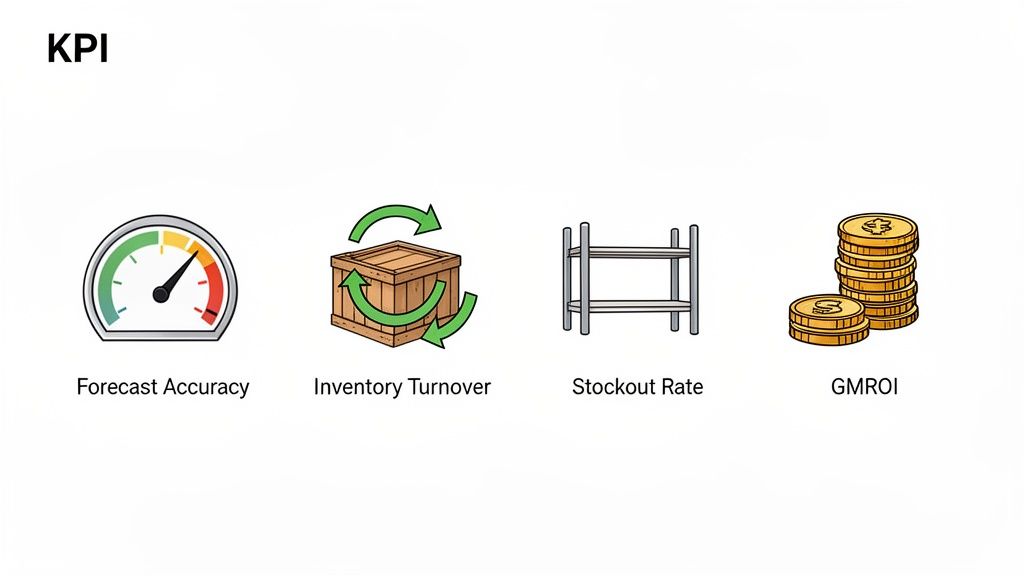
Let's be real: demand planning isn't a "set it and forget it" kind of deal. If you want to get better, you have to measure your performance. That's where Key Performance Indicators (KPIs) come in. Think of them as the dashboard for your business, turning all your planning efforts into clear signals that show what's working and what’s crying out for attention.
By keeping a close eye on the right metrics, you can sharpen your strategies, make smarter decisions backed by actual data, and see a direct line from your planning to your profitability.
So, let's break down the essential KPIs every e-commerce brand should have on their radar.
This is the big one. Forecast accuracy is the cornerstone of demand planning, measuring the gap between what you thought you’d sell and what you actually sold. Nailing this means you're cutting down on waste while capturing every possible sale.
The math is straightforward: 1 - ( |Actual Sales - Forecasted Sales| / Actual Sales ). That percentage tells you how close you were to the mark. Tracking this consistently shows you how reliable your forecasting is and where you might need to make some tweaks. For a deeper dive, check out our guide on how to improve your demand forecast accuracy.
Imagine your inventory is like produce at a grocery store. The faster it moves off the shelf, the healthier your business. Inventory turnover measures how many times you sell through and replace your entire stock in a given period, usually a year.
A high turnover rate is a great sign—it points to efficient management and strong sales. A low rate, on the other hand, is a red flag. It means your cash is tied up in products that are just sitting there, racking up storage fees.
The formula is simply: Cost of Goods Sold (COGS) / Average Inventory. This number gives you a crystal-clear picture of your operational efficiency.
Nothing kills the mood for a customer like seeing "out of stock." For your brand, it's a pure lost opportunity. The stockout rate tells you how often an item is unavailable right when a customer is ready to buy.
High stockout rates don't just cost you a single sale; they frustrate customers and can do real damage to your brand's reputation over time.
Tracking your stockout rate helps you find the weak spots in your safety stock levels and reorder points. It's about protecting your revenue and, just as importantly, your customer loyalty.
Calculate it with: (Number of Stockouts / Total Orders) x 100. Your goal is to keep this number as close to zero as possible. Of course, this relies on good data, so learning some practical ways to track a Shopify store's sales volume is a great first step.
Finally, there's Gross Margin Return on Investment (GMROI). This metric answers the most important question: for every dollar you put into inventory, how much profit are you getting back? It’s the ultimate measure of how profitable your inventory really is.
A GMROI over 1 means you're making money. The higher the number, the smarter your inventory decisions are. You can figure it out with this formula: Gross Margin / Average Inventory Cost.
Getting a handle on these KPIs isn't just busywork—it has a massive impact. Companies that adopt modern demand planning systems often see a 20-30% reduction in inventory costs and can boost their forecast accuracy by up to 65%. It's simple: what gets measured gets managed.
Knowing the theory is one thing, but putting demand planning into practice is where the magic happens. The good news? You don't need some complex, enterprise-level system to get started. What you really need is a repeatable, logical process that turns raw data into smart inventory decisions.
I've designed this framework specifically for growing e-commerce brands. It breaks the entire cycle down into clear, actionable steps, transforming demand planning from a dreaded task into a manageable workflow that builds momentum.
Every solid demand plan starts with clean, reliable data. Before you can predict the future, you have to get an honest picture of the past. This first step is all about pulling together the right information from across your business.
Think of it like a chef prepping for a big service. You need to gather all your ingredients (data points) and make sure they're fresh and ready to go (clean and accurate).
Your key data sources will be:
This is where many brands get stuck, manually wrestling with spreadsheets. It’s a huge bottleneck. Modern tools offer a massive advantage here. An AI platform like Tociny.ai, for example, syncs directly with your sales channels to automatically collect and organize this data, freeing you up to focus on analysis, not data entry.
With your data organized, it's time to create an initial, numbers-driven forecast. This is your objective starting point—a prediction based purely on historical patterns, stripped of any gut feelings or biases. This is where you'll apply the quantitative forecasting methods we talked about earlier.
For instance, you might use a moving average to smooth out recent sales noise or apply seasonal indexing to account for predictable peaks like Black Friday. The goal here isn’t perfection; it’s to establish a solid baseline that you can build on.
Your statistical forecast is like the scientific control in an experiment. It’s the data-driven anchor for your entire process, giving you an unbiased estimate before you layer on human intelligence.
This is another area where AI really shines. Instead of you trying to guess which forecasting model is best, an AI system can test multiple algorithms against your data and pick the one that produces the most accurate baseline for each individual product.
Your baseline forecast knows what has happened, but it has no idea what you plan to make happen. This is where you enrich the data with expertise from across your business, adding context that numbers alone will always miss.
Get your key people in a room to review the baseline forecast.
This collaborative input is what elevates a simple prediction into a truly strategic demand plan. It bridges the gap between statistical probability and what's actually happening on the ground.
Once you've gathered all that qualitative feedback, it's time to adjust the baseline and create a single, unified demand plan. This is your "consensus forecast"—the one version of the truth that every department agrees to and commits to.
This step is absolutely critical for breaking down silos. When marketing, operations, and finance all sign off on the same plan, everyone is pulling in the same direction. Marketing knows how many units they need to help sell, and operations knows how many units they need to have ready.
Once finalized, this plan becomes the blueprint for your purchasing and inventory strategy. It drives your reorder points and order quantities, helping you decide exactly how much of each product to buy and when. This also informs your safety stock levels. To nail this part, you'll need to understand how to calculate safety stock to protect your business from surprise demand surges or supplier delays.
Demand planning isn't a one-and-done deal. It's a continuous cycle of planning, executing, and improving. The final step is to constantly track your performance against the plan and use those insights to make your next forecast even sharper.
This is where an AI-powered dashboard gives you a clear, at-a-glance view of your sales performance against your forecast. Tools like this make it incredibly easy to spot when things are veering off track, allowing you to react quickly and make smart adjustments.
Set aside time each week or month to review your key demand planning KPIs.
By consistently answering these questions, you create a powerful feedback loop. Each cycle makes your team smarter and your planning more precise, which ultimately drives efficiency and profit across your entire operation.
Getting demand planning right is a massive competitive advantage, but it's surprisingly easy to get wrong. A few common mistakes can quietly sabotage even the best intentions, leading to frustrating stockouts, cash flow problems, and unhappy customers.
Knowing what these pitfalls are is the first step. Let's break down the most common ones we see.
The biggest mistake? Relying only on historical sales data. It’s like trying to drive a car by looking exclusively in the rearview mirror. Yes, your past performance gives you a baseline, but it tells you nothing about the road ahead—market shifts, a competitor's surprise sale, or the impact of that big marketing campaign you're about to launch.
Another classic blunder is letting your teams operate in silos. This is when marketing, sales, and operations all make their own plans without talking to each other, creating a disconnect that sends ripples across the entire business.
Imagine your marketing team is gearing up for a huge influencer campaign. They’re projecting a massive lift in sales for a specific product. But if they don't loop in the inventory and supply chain folks, the outcome is painfully predictable: a sudden, massive stockout. All that marketing buzz goes to waste, and potential customers are left empty-handed.
So, how do you break down those walls?
This flowchart shows exactly why that collaboration is so critical. Data flows in, a forecast is generated, but it doesn't become a solid plan until the teams reach a consensus.

Successful planning isn't an isolated task for one department; it’s a team sport.
Failing to look outside your own four walls is another recipe for disaster. Customer tastes change, new trends pop up on TikTok, and economic shifts can alter buying habits almost overnight. A rigid plan that ignores these external signals will always be one step behind.
Just as problematic is clinging to outdated tools. Look, spreadsheets were a fine place to start, but they just can't keep up with the complexity of modern e-commerce. They’re magnets for manual errors, make collaboration a nightmare, and simply don't have the horsepower to analyze the thousands of variables that influence customer demand today.
Key Takeaway: Static, siloed planning with old-school tools is a purely reactive strategy. A dynamic, collaborative approach using modern technology is proactive—it lets you anticipate change instead of just reacting to it.
The shift toward more intelligent systems isn't just a trend; it's a necessity. Recent reports show that 91% of companies now see AI-powered insights as critical for growth. On top of that, 77% of business leaders say demand planning tools are a top priority for 2025.
You can dig into the research on why demand planning is a top priority for modern businesses. By simply sidestepping these common mistakes, you can turn your demand planning from a source of constant stress into a powerful engine for growth.
Think of effective demand planning less like a one-time project and more like a strategic discipline. It's what separates the thriving e-commerce brands from the ones that are always just trying to keep their heads above water. This guide has given you a roadmap for understanding why it matters, how to forecast, what KPIs to track, and a practical process to put it all into action.
Ultimately, your ability to accurately see what customers want before they want it is your single greatest advantage in a crowded market. If there's one thing to take away, it's this: the era of reactive, manual planning is over. Your gut feelings and clunky spreadsheets just can't keep up anymore.
The future of e-commerce belongs to brands that operate proactively. This isn't just about reacting to last month's sales data; it's about anticipating market shifts, seeing the ripple effects of a new marketing campaign, and understanding customer behavior before it happens. Making this shift is a real commitment.
Embracing data-driven, AI-powered tools transforms demand planning from a constant operational headache into your most powerful engine for growth, profit, and real customer loyalty.
At the end of the day, smart planning is about building a resilient business. It’s what allows you to navigate uncertainty with confidence, making sure you have the right products, in the right place, at the right time. When you bring intelligent tools and a forward-looking mindset into your operations, you’re not just setting your brand up to survive—you're positioning it to lead. That's how you build a future-proof business that can scale profitably and keep your customers coming back for more.
Even with a solid game plan, you're bound to have some questions as you get into the weeds of demand planning. Let's tackle a few of the most common ones we hear from e-commerce brands just like yours.
It’s incredibly common to hear these terms used interchangeably, but they’re not the same thing at all. Getting the distinction right is the first step toward building a smooth operational rhythm.
Think of demand forecasting as one specific, vital ingredient in a larger recipe. It’s the focused, data-heavy task of predicting future sales. You dig into your historical data, look at market trends, and come up with a number—your best estimate of what customers are going to buy.
Demand planning, on the other hand, is the entire recipe. It's the big-picture strategy that takes that forecast and uses it to make smart, coordinated business decisions. This is where you decide how much inventory to order, schedule production, align your marketing campaigns, and manage your cash flow.
In short, forecasting predicts the future; planning prepares your entire business for it.
In the fast-moving world of e-commerce, setting an annual plan and forgetting about it is a recipe for disaster. Customer tastes and market conditions just change too quickly. Agility is the name of the game here.
For most D2C brands, a monthly planning cycle hits the sweet spot. It gives you a consistent rhythm for making major updates and strategic adjustments. This should be backed up by weekly check-ins where you review performance against your plan and make smaller tweaks. This hybrid approach keeps you strategic without letting sudden shifts in the market catch you off guard.
The goal isn’t to create a perfect plan you follow no matter what. It’s to build a living document that adapts to reality, making sure your decisions are always based on the most current information you have.
Absolutely. In fact, starting with spreadsheets is a perfectly normal—and practical—first step for a new business. They’re accessible, they don’t cost anything to get started, and they’re great for getting a basic handle on your numbers when your product catalog is still small.
But brands outgrow them. Fast. As your business scales, those trusty spreadsheets quickly become a major liability.
While spreadsheets serve a purpose early on, any brand that's serious about efficient growth will eventually hit a wall. AI-powered tools are the logical next step, built from the ground up to handle the complexity that spreadsheets were never designed for.
The magic of artificial intelligence in demand planning lies in its ability to see patterns and connections that are completely invisible to the human eye. A traditional forecast might just look at last year's sales for the same period. An AI model, however, can analyze thousands of data points at once.
It can figure out how variables like your marketing spend, a competitor's big sale, an upcoming holiday, and even Google search trends all interact with each other to influence your sales. This multi-layered analysis produces forecasts that are dramatically more accurate and reliable.
By processing this immense complexity, AI helps you graduate from making educated guesses to making truly data-driven decisions. The result? Less risk of overstocking and fewer missed sales opportunities.
Ready to stop guessing and start planning with confidence? Tociny.ai uses AI to provide clear sales forecasts and actionable inventory recommendations, turning complex data into your most powerful tool for profitable growth. Discover how Tociny.ai can future-proof your Shopify store.
Tociny is in private beta — we’re onboarding a few select stores right now.
Book a short call to get early access and exclusive insights.