
Think of an inventory system as the command center for your entire e-commerce operation. It’s the combination of processes and technology you use to track every single product from the moment you order it from a supplier to the second it lands on a customer's doorstep. It gives you a crystal-clear, real-time picture of what you have, where it is, and how fast it’s moving.
Ever tried navigating a big city without a map or GPS? You might get there eventually, but you'll probably hit a dozen dead ends, waste a ton of gas, and end up completely stressed out. That’s exactly what running an e-commerce store feels like without a proper inventory system. It's not just a product database—it's the central nervous system of your retail business.
A modern system links every part of your operation. It connects the dots between a supplier's shipment and the package leaving your warehouse. It's the unseen force that prevents the two cardinal sins of retail: frustrating stockouts and cash-draining overstock. When a customer hits a product page only to see "Out of Stock," you don't just lose that one sale; you risk losing that customer for good.
On the flip side, tying up too much money in products that just sit on the shelf suffocates your cash flow, stopping you from investing in things that actually grow your business.
The best inventory systems do more than just count things. They turn raw data into a powerful strategic advantage, giving you the clarity to make smarter, more confident business decisions. When you truly understand how your inventory behaves, you can:
This is why businesses are pouring serious money into this area. The global market for inventory optimization tools is expected to hit a massive USD 12.42 billion by 2032, with e-commerce leading the charge. This isn't just a trend; it's a fundamental shift in thinking. Top brands no longer see inventory as a liability to be managed, but as a core asset to be optimized for maximum value. You can dive deeper into the numbers in this inventory optimization market report.
An effective inventory system is your bridge between supply and demand. It ensures that the promises you make on your product pages are promises you can keep in your warehouse, building the trust that underpins a successful brand.
Ultimately, mastering your inventory is about gaining control and confidence. It lets you move from constantly putting out fires—like scrambling to fill an unexpected wave of orders—to proactively planning for what’s next. This foundational control is what allows you to scale sustainably, ensuring your operations can actually handle the success your brand deserves.
Before we dive deeper, here's a quick look at the core concepts we'll be covering and why they matter for your store's success.
| Concept | Why It's Important for Your Business |
|---|---|
| Periodic vs. Perpetual Systems | Determines how frequently you update your stock counts, impacting accuracy and workload. |
| Spreadsheet vs. IMS vs. ERP | The tools of the trade, ranging from basic manual tracking to fully integrated business management. |
| Core Features | The must-have functions like real-time tracking, forecasting, and reporting that power smart decisions. |
| Key Performance Indicators (KPIs) | The metrics that tell you if your strategy is working, like inventory turnover and sell-through rate. |
| Integration & Implementation | How to connect your inventory system to your Shopify store and other essential tools seamlessly. |
This table serves as a roadmap for what's ahead. Understanding these elements is the first step toward building an inventory strategy that not only keeps your business running smoothly but actively fuels its growth.
Picking the right way to track your products is one of the most critical decisions you'll make for your e-commerce business. The methods and tools you choose will directly ripple through your efficiency, accuracy, and ultimately, your ability to grow.
At a high level, inventory management breaks down into two core philosophies that dictate how and when you count your stock.
Think of a periodic inventory system like a traditional, once-a-year physical check-up. You shut everything down, do a full manual count of every single item on your shelves, and then update your books. It's a simpler approach that doesn't demand much tech, which is why it's a common starting point for tiny businesses with just a handful of SKUs. The big problem? In between those counts, you’re flying blind and relying on guesswork that gets outdated fast.
On the flip side, a perpetual inventory system is like a continuous heart-rate monitor for your stock. It tracks your inventory levels in real-time, automatically updating quantities every time a product is sold, received, or moved. This gives you a live, accurate view of what you have at any given moment—something that’s absolutely essential for preventing stockouts and making smart purchasing decisions in a fast-moving online store.
While a periodic system seems less complicated to set up, it creates huge information gaps. For any growing e-commerce brand, not knowing your exact stock levels can lead to disaster, like overselling during a flash sale or completely missing the reorder point for a bestseller.
Perpetual systems, powered by tools like barcode scanners and integrated software, get rid of all that guesswork. They are the backbone of modern retail, giving you the hard data you need for accurate forecasting, smooth order fulfillment, and a customer experience that doesn't end in frustration. In fact, this real-time approach is a must for more advanced strategies. You can learn more about how it works with models like Just-in-Time inventory management.
This constant, automated flow is what keeps your online store's availability perfectly synced with what’s actually in your warehouse, preventing those costly—and embarrassing—errors.

Once you’ve settled on a perpetual system (which is really the only way to go for a serious e-commerce store), you need to pick the right tool for the job. Your choice will come down to your business size, complexity, and budget.
Here’s the breakdown:
Choosing your tool is about matching its power to your needs. A spreadsheet is like a basic calculator, an IMS is a specialized diagnostic tool, and an ERP is a full-blown operating room. You wouldn't use a calculator for surgery, and you shouldn't use a spreadsheet to run a growing e-commerce brand. This table breaks down the key differences to help you decide.
| System Type | Best For | Key Advantages | Common Drawbacks |
|---|---|---|---|
| Spreadsheets | Startups, hobbyists, or businesses with <20 SKUs | No cost to start, highly flexible | Prone to human error, no real-time data, not scalable |
| Inventory Management Software (IMS) | Growing small to medium-sized e-commerce businesses | Automation, real-time tracking, e-commerce integration | Monthly subscription cost, requires setup and training |
| Enterprise Resource Planning (ERP) | Large enterprises with complex, multi-channel operations | All-in-one system, deep business-wide insights | High cost, complex implementation, can be overkill for SMEs |
The right system provides clarity and control. You can’t fix a problem if you don’t know what’s causing it, and an effective system will immediately highlight whether you’re dealing with stockouts (too little) or overstock (too much).
What's shocking is how many businesses are still stuck in the past. Despite the obvious risks of manual entry, a startling 63% of supply chain managers still use spreadsheets, which means they're missing out on the accuracy and automation that modern inventory systems deliver.
It's also worth thinking about how your physical storage impacts your system choice. Flexible solutions like Warehouse Self Storage can adapt as your stock levels change, which is another piece of the puzzle you’ll need to manage effectively.
So, what separates a simple digital stock list from a true business growth engine? It all comes down to a core set of features that transform basic tracking into an intelligent, automated operation. The best inventory systems don't just count what you have; they give you clarity, automate the grunt work, and offer up insights that lead to much smarter decisions. These aren't just nice-to-haves—they're essential for any e-commerce brand that's serious about scaling.
Moving beyond a spreadsheet means grabbing hold of tools that actively manage your stock, not just record it.

The absolute bedrock of any modern system is real-time inventory tracking. Think about it: a customer buys your last blue t-shirt on Shopify. A real-time system instantly updates your stock levels across all your channels, stopping you from selling an item you no longer have. It’s the single best way to avoid the dreaded oversell and the customer frustration that comes with it.
And the engine that powers this accuracy? Barcode scanning. This simple tech drastically cuts down on human error when you’re receiving stock, picking orders, or doing a stock take. Instead of fumbling with SKU numbers, your team just scans a label. The data is captured instantly and, more importantly, correctly. This duo gives you a perpetually accurate picture of what’s on your shelves.
The entire retail industry is sprinting in this direction. A recent analysis predicts that by 2025, a whopping 77% of retailers will be using real-time visibility tools like IoT sensors to perfect their stock monitoring.
Do you lie awake at night worried about running out of your best-sellers? Automated reordering is the answer. You simply set a minimum stock level—or "reorder point"—for each product. The second your inventory dips below that threshold, the system automatically generates a purchase order or pings you to restock. Just like that, a reactive scramble becomes a proactive, calm process.
And for businesses juggling inventory in multiple places—say, a main warehouse, a physical store, and a 3PL partner—multi-location management is a complete non-negotiable. This feature pulls all your inventory data into one central dashboard. From there, you can see stock levels at every location, fulfill orders from the closest warehouse, and transfer stock between sites to balance things out. It’s about having a single, unified view of your entire operation. To stay on top of it all, smart systems are always evolving, with platforms regularly introducing enhanced order management features to streamline everything that happens post-sale.
A powerful inventory system doesn't just tell you what you have; it helps you decide what you need. It moves your strategy from reactive order-taking to predictive, data-driven planning that anticipates customer demand before it even happens.
This is where the truly advanced inventory systems pull away from the pack. Instead of relying on gut feelings or basic sales history, AI-powered demand forecasting chews through complex data to predict future sales with stunning accuracy. It analyzes past sales trends, seasonality, upcoming promotions, and even external market shifts to tell you what your customers will want to buy next week, next month, or next quarter.
This predictive power completely transforms your purchasing strategy. Imagine your marketing team is gearing up for a huge campaign on a specific product. An AI forecaster can model the expected sales lift and tell you exactly how much extra stock to order, ensuring you meet the demand surge without tying up too much cash.
This capability is a massive lever for profitability. By aligning what you buy with precise predictions, you can slash both stockouts and overstock, freeing up your cash flow. The key is learning how to use an AI-powered sales forecasting tool to turn those predictions into profitable inventory decisions.
Having a slick inventory system is one thing. Knowing how to actually use its data to measure what's working—and what isn't—is what separates the businesses that thrive from those just getting by.
Think of your inventory system as a fitness tracker for your business. It doesn't just count your steps (or your products); it gives you the vital signs you need to understand your operational health. Without those insights, all that data is just noise.
The secret is focusing on the right Key Performance Indicators (KPIs). These are the specific, measurable metrics that tell you if your inventory strategy is hitting the mark. They turn abstract numbers on a dashboard into intelligence you can use to directly improve your cash flow and profitability. Learning to read these signals is how you spot trouble early and start making smart, data-driven decisions.
To get a clear picture of your inventory's health, you need to monitor a few crucial metrics. These KPIs work together, painting a detailed portrait of your stock management's efficiency and profitability. Don't get intimidated by formulas; the concepts are straightforward and incredibly powerful once you grasp them.
Let's break down the three most important ones every Shopify merchant should have on their radar.
These metrics aren't just for dusty annual reports; they are your real-time early warning system.
A low inventory turnover rate is a flashing red light signaling you're likely overstocked. It’s your data telling you, "Hey, you have too much money sitting on this shelf, and it's not moving fast enough."
Knowing the numbers is only half the battle. The real magic happens when you use them to make better decisions. Let's walk through a practical example for your store.
Imagine you run an online apparel shop. Your inventory system flags that the "Winter Wonderland Sweater" has a painfully low sell-through rate halfway through the season. This single piece of data is your call to action. Instead of letting it gather dust until next year, you can immediately run a flash sale or bundle it with a popular scarf to get that stock moving.
This proactive approach, triggered by a simple KPI, accomplishes two critical things: it frees up the cash that was trapped in those unsold sweaters, and it makes room for new, more profitable products. Without tracking that metric, the sweater might have sat there for months, quietly draining your resources. By turning data into decisive action, you protect your cash flow and keep your product catalog fresh and exciting. That’s the real power of modern inventory systems.
Alright, so you’ve picked out a new inventory system. That’s a huge step forward, but let's be honest—the actual transition can feel a little intimidating. The secret to success isn't just about the software you chose; it's all in the game plan. If you break the process down into clear, manageable steps, you can turn a potentially chaotic overhaul into a smooth, confident leap forward for your business.
Think of it like moving into a new, bigger house. You wouldn't just toss all your boxes in the middle of the living room and hope for the best, right? Of course not. You'd sort through your old stuff, label everything clearly, get the utilities turned on, and then unpack methodically, one room at a time. The exact same logic applies when you're implementing a new inventory system.
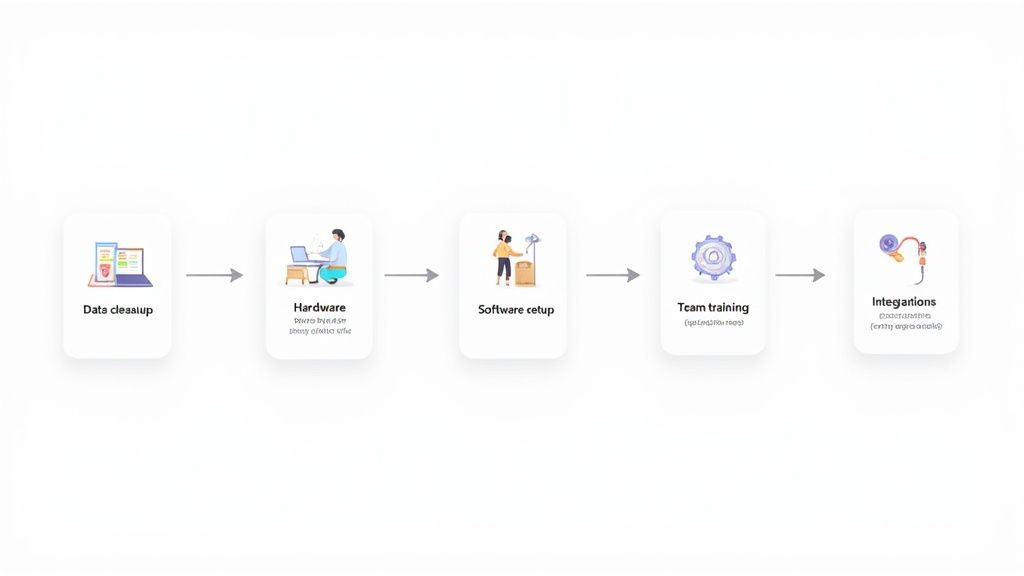
A new system is only as good as the information you feed it. Before you even think about migrating, you have to get your existing inventory data squeaky clean. This is the "decluttering" phase. Standardize your SKU naming conventions, double-check all your supplier details, and—most importantly—do a full physical stock count to get a perfectly accurate baseline.
Dumping messy data into a shiny new system is one of the biggest mistakes you can make. It’s like starting a marathon with your shoes tied together. Inaccurate counts from day one will create a ripple effect of errors, causing overselling, phantom stock, and endless headaches. Take the time to get this right. It’s non-negotiable.
With your data prepped and ready, it’s time to get your tools in place. This means getting both the physical gear and the digital setup dialed in.
Hardware Setup:
Software Configuration: Once the hardware is humming, you'll dive into your inventory management software. This is where you set up user accounts (with the right permissions, of course), define all your warehouse locations (bins, shelves, etc.), and establish the reorder points for your products. You're basically teaching the software how your warehouse operates.
The goal of implementation isn't just to install software; it's to build a reliable, repeatable workflow that eliminates manual guesswork and empowers your team with accurate, real-time information.
A new system means a new way of working, so getting your team on board is absolutely critical. Don’t just show them which buttons to click—explain why the new process is better and how it makes their jobs easier. Walk them through the core day-to-day tasks: receiving a shipment, picking an order, performing a cycle count.
Give everyone a chance to practice in a test environment before you go live. This lets them build confidence and make mistakes that don't affect real customers. A team that truly understands the "why" behind the system is far more likely to embrace it and use it correctly.
Now for the final, and most powerful, step: connecting your inventory system to the rest of your tech stack. This is where you unlock massive efficiency gains and automate the tedious stuff.
For any Shopify merchant, the most vital connection is with your Shopify store. This ensures that every time a sale comes through, your inventory levels are updated instantly and automatically. No more manual adjustments. The next essential link is your accounting software, like QuickBooks, which automates financial entries and keeps your books perfectly aligned with your physical stock movements.
If you want to see what these powerful, connected setups look like in the wild, check out this guide to inventory management system examples. By linking these platforms, you create a single source of truth for your entire operation, wiping out manual data entry and drastically reducing the risk of costly mistakes.
Even the most sophisticated inventory system will fail if it’s built on a foundation of bad habits. Investing in great software is only half the battle. The real trick to protecting your profits and keeping customers happy is avoiding the common, costly mistakes that trip up so many businesses.
These errors often start small, but they have a nasty habit of snowballing into major operational headaches.
Think of your inventory system as the brain of your operation. If you feed it bad information—like inaccurate data—it’s going to make bad decisions. No matter how smart the software is, garbage in always means garbage out. Simple mistakes in your day-to-day process can undermine the entire system, leading to frustrating stockouts, cash-draining overstock, and a line of unhappy customers.
One of the most frequent—and damaging—mistakes is manual data entry error. It could be a simple typo when receiving a shipment or misclassifying a new product, but the ripple effects are huge. A single wrong digit can throw your entire stock count off, creating a situation where your website confidently sells a product you don’t actually have.
Imagine the chaos during a holiday rush. A business thinks it has 100 units of its top-selling gadget, but due to a receiving error, it only has 10. The system happily oversells by 90 units, forcing the team to cancel orders, issue refunds, and manage a flood of angry customer emails. That single error doesn't just cost sales; it torches your brand's reputation.
This is exactly where modern inventory systems shine. By using barcode scanners for receiving and picking, you take human error out of the equation and ensure your data is accurate from the moment a product walks in the door.
A common misconception is that inventory management is just about counting things. In reality, it’s about maintaining data integrity. Your inventory data must be a perfect mirror of your physical warehouse—anything less leads to flawed decisions.
Relying solely on your software without ever physically verifying what’s on your shelves is a recipe for disaster. Theft, damage, and supplier mis-shipments create discrepancies that your system, on its own, will never know about. Skipping regular audits is like driving your car without ever checking the tire pressure; you won’t notice a problem until you’re on the side of the road with a blowout.
Instead of dreading a massive, once-a-year physical count that shuts down your whole operation, try implementing cycle counting. This just means counting small, manageable sections of your inventory on a daily or weekly basis. It's far less disruptive and helps you catch—and correct—discrepancies almost as soon as they happen, keeping your data clean all year round.
Finally, a critical strategic mistake is picking a system that solves today’s problems but can't handle tomorrow’s growth. A startup might get by with a simple spreadsheet, but what happens when you add new products, expand to new sales channels, or open a second warehouse? That basic tool quickly becomes a bottleneck.
Selecting a scalable solution from the get-go saves you from a painful and expensive migration down the road. You need a system that can grow with you, seamlessly handling more complexity without holding your business back.
We get it—diving into inventory systems can bring up a lot of questions. Here are a few of the most common ones we hear, along with some straightforward answers to clear things up.
The breaking point usually arrives when your spreadsheet starts costing you more than it saves. If you're spending hours every week just updating counts, constantly running out of your best-sellers, or struggling to juggle stock between Shopify and another sales channel, you're already there.
The biggest red flag? When inventory mistakes lead directly to lost sales or unhappy customers. At that point, your spreadsheet isn't a tool anymore—it's a bottleneck holding your business back.
It all comes down to real-time accuracy. Think of a perpetual system as a live dashboard for your stock. Every time you make a sale or receive new products, the numbers update instantly. You always have an accurate, up-to-the-minute view of what's on your shelves.
A periodic system, on the other hand, is like taking a snapshot in time. You only know what you have when you do a full manual count, maybe once a month. This means your data is almost always out of date, which is a recipe for surprise stockouts and bad purchasing decisions. For any serious e-commerce store, a perpetual system is the only way to go.
The core value of a perpetual inventory system is trust. It gives you reliable, real-time data so you can make confident decisions about purchasing, marketing, and sales without constantly worrying about overselling.
A good inventory system acts as your early-warning signal for supply chain chaos. By giving you a live look at your stock levels, sales velocity, and supplier lead times, it helps you spot problems and react before they become emergencies.
For example, if a supplier’s shipment is running late, you can immediately see which products are at risk of selling out and make a plan. The best inventory systems even help you game out different scenarios, letting you find backup suppliers or tweak your reorder points to stay ahead of the curve. In fact, some studies show that AI-driven management can slash logistics costs by up to 20% by helping you make exactly these kinds of smart, proactive decisions.
Ready to stop guessing and start making data-driven inventory decisions? Tociny.ai offers an AI-powered analytics platform that gives Shopify merchants clear visibility into sales trends and stock levels, helping you reduce overstock and prevent stockouts. Plan your inventory with confidence by exploring our solution at https://tociny.ai.
Tociny is in private beta — we’re onboarding a few select stores right now.
Book a short call to get early access and exclusive insights.