
Just-In-Time (JIT) inventory is a strategy where you get goods from suppliers only as you need them to fill customer orders. The whole point is to keep the amount of stock sitting in your warehouse to an absolute minimum. This on-demand approach is a complete flip from traditional models that preach keeping tons of inventory on hand "just in case."
Picture a top-tier chef running a kitchen for a fancy tasting menu. Instead of a huge, overflowing pantry where ingredients could go bad, this chef has fresh, high-quality items delivered exactly when they're needed for each dish. This guarantees peak freshness, slashes waste, and cuts down on the money tied up in food that's just sitting there. That’s the core of what just in time inventory is—a lean, efficient system designed to pull resources through the supply chain based on what customers are actually buying, not what you think they might buy.
This way of thinking isn't some new fad; it has deep roots in manufacturing. The idea really took off with Toyota Motor Corporation back in the 1970s, becoming a cornerstone of their legendary Toyota Production System (TPS). By getting parts only when they were needed on the assembly line, Toyota cut its storage costs dramatically, stamped out waste, and built an incredibly responsive production cycle. You can dig deeper into the origins of JIT and its impact over at netsuite.com.
For an e-commerce or D2C brand, this means a customer's order is the starting gun for the entire fulfillment race. That single click triggers a request to your suppliers for either raw materials or finished goods, which then show up "just in time" to be packed and shipped out. The goals are simple but powerful:
To truly grasp the JIT philosophy, it helps to break down its foundational concepts. The table below outlines the core principles that make this system tick and what they mean for an e-commerce business trying to stay lean and agile.
| Principle | Description | Goal for E-commerce |
|---|---|---|
| Pull System | Production is triggered by actual customer demand, not by forecasts or schedules. | Fulfill orders as they come in, preventing the buildup of unsold goods. |
| Waste Elimination (Muda) | Identify and remove any activity that doesn't add value, such as overproduction or excess inventory. | Reduce carrying costs, minimize the risk of dead stock, and streamline operations. |
| Continuous Flow (Takt Time) | Match the pace of production directly to the rate of customer sales. | Create a smooth, predictable fulfillment process without bottlenecks or delays. |
| Supplier Partnerships | Develop strong, reliable relationships with suppliers for frequent, small-batch deliveries. | Ensure a consistent and timely supply of goods to meet real-time demand. |
| Zero Defects | Strive for perfect quality from suppliers to eliminate the need for buffer stock for faulty items. | Reduce returns and ensure customer satisfaction with every order shipped. |
These principles work together to create a system that's not just about cutting costs, but about building a more responsive, efficient, and resilient business from the ground up.
This 'pull' system, driven by real customer purchases, fundamentally shifts the inventory mindset from "just in case" to "just in time." It forces a discipline that prioritizes agility and strong supplier partnerships over the perceived safety of large stockpiles.
Ultimately, JIT is about creating a seamless, demand-driven flow from your supplier all the way to your customer's doorstep. Instead of pushing products into the market based on a guess, you pull inventory through your operations in direct response to what your customers are buying right now. For modern, agile brands, that's a game-changer.
The Just-in-Time inventory model runs on a single, powerful idea: it's a pull system. This completely flips the traditional retail model on its head. Instead of a brand pushing products it thinks will sell into the market, a customer's actual purchase pulls the necessary goods through the supply chain.
Think of it like this. A typical e-commerce store is like a big-box retailer, stocking its shelves high based on a forecast of what shoppers might buy. A JIT brand, on the other hand, is like a farm-to-table restaurant. The chef doesn't order a crate of fresh fish "just in case"—they order it the moment a customer requests the catch of the day.
This simple shift means a customer's click on "Buy Now" is the starting gun for your entire operation. That one action kicks off a perfectly timed sequence of events designed to get the product made and shipped with almost zero waste.
For this delicate dance to work, three core elements have to be in lockstep. If one of them falters, the whole system can grind to a halt, leading to delays and frustrated customers.
Rock-Solid Supplier Relationships: Your suppliers aren't just vendors; they are mission-critical partners. The relationship has to be built on a foundation of trust and lightning-fast communication. They need to be ready to handle frequent, small-batch orders without a single hiccup.
Instant Communication and Data Flow: Information needs to move at the speed of the sale. The moment an order hits your Shopify store, that data must instantly fire off to your warehouse, production team, and suppliers. There's no room for manual entry or delays.
Accurate Demand Forecasting: This might sound counterintuitive. If JIT is reactive, why forecast? While you're reacting to individual sales, you still need a strong grasp of your overall sales velocity. This allows your suppliers to be prepared for your needs, even if they aren't shipping you products just yet. It’s about anticipating the pace, not the exact order.
JIT isn’t about having no plan. It’s about having an incredibly flexible plan that activates the second a customer makes a purchase. The goal is to align your entire supply chain with real-time customer demand, not predictive guesses.
This visualization breaks down the streamlined flow of a JIT system, from the moment a customer clicks "buy" to the final shipment.
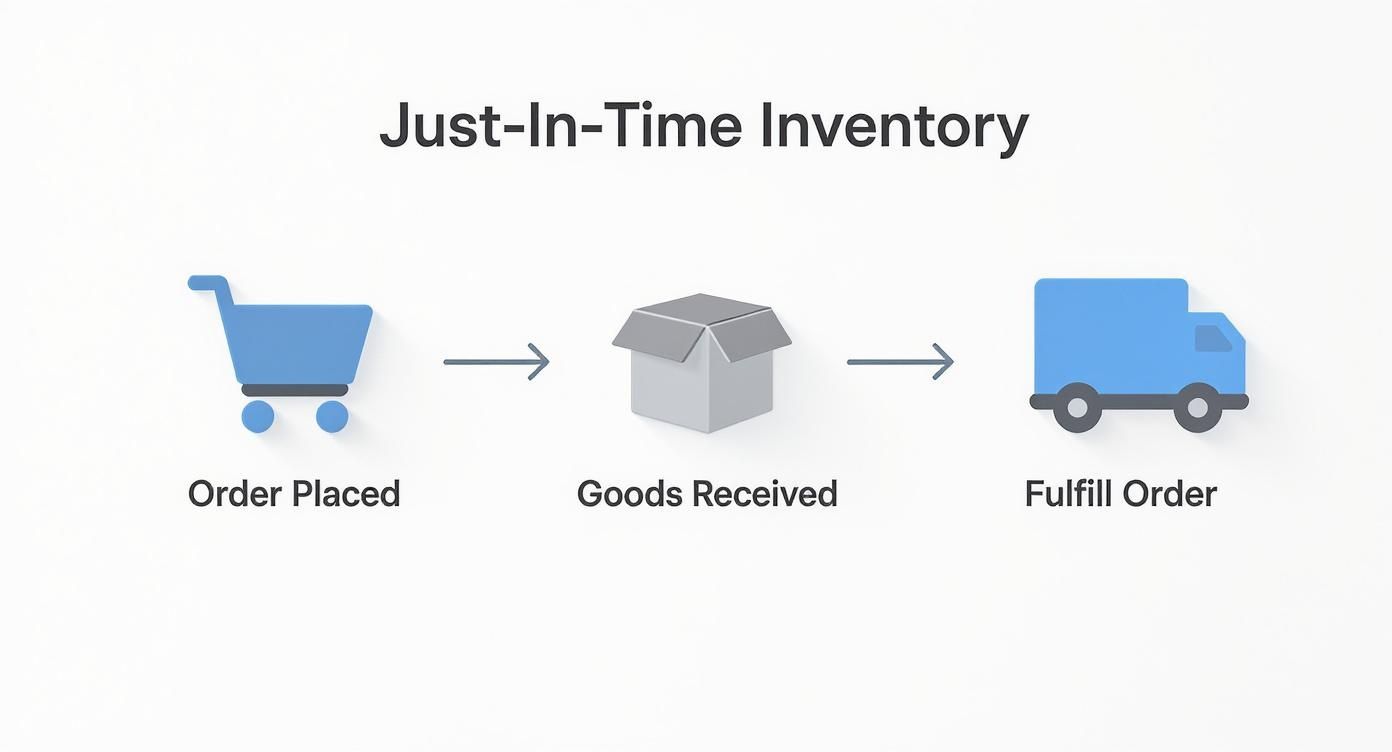
As the diagram shows, the JIT model cuts out the traditional "warehousing" phase where finished goods sit on shelves. Instead, receiving goods is directly tied to fulfilling an existing order.
Let's walk through how this works for a direct-to-consumer brand, "Artisan Tees," selling custom-printed t-shirts on Shopify.
Imagine a customer orders a large, black t-shirt with a specific graphic. Here’s the JIT process in action:
With this model, Artisan Tees completely avoids the huge upfront cost and risk of stocking thousands of shirts in every size, color, and design. Their cash isn't locked up in inventory that might never sell. This ultra-lean approach requires incredible coordination and a deep understanding of sales patterns. Mastering different demand forecast methods is absolutely essential to pull this off without frustrating customers with stockouts or delays.
Adopting a Just-In-Time inventory strategy can bring incredible efficiency, but make no mistake—it's a high-wire act. This isn't some one-size-fits-all solution you can just plug into your business. It's a fundamental trade-off, pitting ultimate leanness against operational resilience.
Before you even think about going down the JIT path, it's critical to understand both sides of the coin.

On one hand, the potential rewards are massive. On the other, the margin for error is razor-thin. Let's break down exactly what you stand to gain and what vulnerabilities you absolutely must prepare for.
The primary appeal of JIT is its powerful, direct impact on your bottom line and your ability to pivot quickly. By systematically eliminating excess stock, you unlock benefits that ripple across your entire operation.
Dramatically Lower Holding Costs: This is the big one. When you aren't stockpiling products, you slash all the costs that come with it—warehouse space, insurance, labor to manage stock, and even utilities. Less inventory sitting on shelves means less overhead, period.
Improved Cash Flow: Every piece of inventory is just cash tied up on a shelf, unable to do anything for you. A JIT model frees up that capital, letting you reinvest it into marketing, product development, or other areas that actually grow your business. For small and growing D2C brands, this liquidity can be a total game-changer.
Reduced Waste and Obsolescence: Trends change in a flash. Products get updated, and seasonal items expire. By ordering only what you need, you sidestep the massive risk of getting stuck with dead stock that you have to sell at a steep discount or write off completely.
Higher Quality Control: When you work with smaller, more frequent batches, it’s far easier to spot defects. If a supplier sends a faulty component, you catch the problem after receiving a small order, not after you’ve already bought thousands of units. This leads to better products and fewer painful returns.
While the benefits sound great, the JIT model operates with virtually no safety net. This makes it extremely fragile and susceptible to disruptions that a traditional inventory system could easily absorb.
The single biggest drawback is the extreme sensitivity to supply chain interruptions. A single delayed shipment—whether it's due to bad weather, a traffic jam, or a port closure—can bring your entire fulfillment process to a screeching halt. With no buffer stock, you have nothing to sell, leading directly to lost sales and angry customers.
This high-stakes dependency extends to your suppliers' performance. A JIT system demands near-perfection from everyone involved. Your suppliers have to consistently deliver the right quantity of high-quality goods exactly on schedule. One mistake on their end has an immediate and direct impact on your ability to serve your customers.
The core vulnerability of JIT was laid bare for the world to see during the global supply chain shocks of the COVID-19 pandemic. Businesses running ultra-lean systems discovered they lacked the resilience to handle sudden supplier shutdowns or shipping delays, resulting in widespread shortages.
This event forced many companies to reconsider their strategies, balancing JIT's efficiency with more cautious approaches. The pandemic highlighted how a pure JIT model can falter in unpredictable scenarios, as detailed in research exploring balancing JIT and 'just-in-case' strategies.
Another huge risk is the inability to handle unexpected demand surges. If one of your products suddenly goes viral or a marketing campaign blows past all expectations, a JIT system simply can't respond fast enough. Without a stockpile to draw from, you'll face stockouts, leaving potential revenue on the table and disappointing a wave of new customers.
This is exactly why many businesses adopt a hybrid approach, using JIT for their predictable best-sellers while keeping a buffer for more volatile items. You can learn how to calculate safety stock in our inventory guide to protect against this very risk.
Ultimately, choosing JIT is a calculated decision. It demands a stable market, rock-solid supplier partnerships, and a deep, data-driven understanding of your demand patterns.
So, you’ve set up your Just-In-Time system. Now for the million-dollar question: is it actually working?
Moving from theory to practice means you have to track the right data. Success with a JIT model isn't just about feeling leaner—it’s about seeing measurable improvements in your efficiency and financial health. Generic metrics won’t do the job; you need to hone in on the key performance indicators (KPIs) that reveal the true health of your on-demand inventory system.
Think of these KPIs as your dashboard. They signal when your system is running smoothly and flash warning lights when you're getting too close to the edge. They help you answer the big questions: Are you moving products fast enough? Are your customers still happy? Are your suppliers holding up their end of the deal? Without this data, you’re just flying blind.
To get a clear picture of your JIT performance, start with these three essential metrics. Together, they give you a balanced view of efficiency, customer satisfaction, and supplier reliability—the three pillars of any successful JIT operation.
Inventory Turnover Rate: This is the quintessential JIT metric. It tells you how many times you sell and replace your entire inventory over a set period. A high turnover rate is the name of the game in JIT, showing that products are flying off the shelves and your cash isn't tied up in stock that’s just sitting there.
Order Fill Rate: Sometimes called the perfect order rate, this KPI tracks the percentage of customer orders you can ship completely and on time, with no hiccups. It's a direct line to your customer satisfaction levels.
Supplier Lead Time: This one’s simple: how long does it take to get your stuff? It tracks the total time from the moment you place an order with a supplier until the goods are in your hands. In a JIT world, consistency and speed are everything.
Just tracking these numbers isn't enough. The real magic happens when you interpret them and take action. For instance, a sky-high inventory turnover is fantastic, but if your order fill rate starts to drop, that’s a blaring alarm. It means your system is too aggressive, and you're leaving money on the table through lost sales.
A successful JIT system is a delicate balancing act. It’s not just about cranking your inventory turnover as high as it can go; it’s about sustaining that efficiency while consistently delivering an amazing customer experience. Your metrics are the tools that help you find and maintain that perfect equilibrium.
When it's done right, the impact of JIT is massive. When Nike rolled out JIT, they managed to cut lead times by a whopping 40% and boosted productivity by 20%. In another case, Motorola’s focus on real-time visibility—a core part of JIT—helped them slash their inventory needs by 20%. These examples show how dialing in your operations can lead to some serious financial and operational wins. You can dig into more data in research that analyzes JIT's impact across industries.
By keeping a close watch on these core KPIs, you can continuously fine-tune your processes, build stronger supplier relationships, and make sure your quest for efficiency never comes at the cost of the customer satisfaction that fuels your brand's growth.
Making the jump to a Just-In-Time model isn't just about changing your ordering schedule; it's a fundamental operational shift. Getting it right for a Shopify or D2C brand means serious planning, rock-solid partnerships, and the right tech. The payoff is incredible efficiency and healthier cash flow, but cutting corners will lead straight to stockouts and unhappy customers.
The process doesn't start with placing smaller orders. It starts with a hard, honest look at your business. A successful JIT system is built on predictability and trust, so you need a clear roadmap before you start tearing up your current supply chain.
Before you get caught up in the potential savings, you have to figure out if JIT is even a realistic strategy for your brand. This initial gut check is the most important step. Not every business is built for this lean approach.
Start with your sales data. Are your products flying off the shelves with a steady, predictable rhythm? JIT works beautifully with consistency. It's a terrible fit for brands chasing viral trends or dealing with wild, unpredictable seasonal spikes.
Next, take a close look at your suppliers. Can you count on them? Are they equipped to handle frequent, smaller orders with tight, consistent lead times and zero quality issues? Your JIT system is only as strong as its weakest link, and a shaky supplier is a recipe for disaster.
Forget the old transactional way of dealing with suppliers. For JIT to work, you need a true partnership. This goes way beyond just sending purchase orders; it's about deep integration and constant, clear communication. Your success is now completely intertwined with their performance.
The best way to solidify this is with detailed Service-Level Agreements (SLAs). These aren't just formalities; they are the rulebook for your relationship. Get specific on:
This level of collaboration turns your suppliers from simple vendors into a genuine extension of your own operations team.
A proactive, communicative partnership is the engine of a JIT system. Without it, you’re not implementing a lean strategy; you’re simply operating without a safety net and hoping for the best.
You can't run a modern JIT system on spreadsheets and gut feelings. The whole model hinges on real-time data and razor-sharp forecasting to make the split-second decisions required. Your Shopify store needs a powerful tech stack to back it up.
An inventory analytics platform is non-negotiable. Tools like Tociny.ai give you the deep visibility needed to track sales velocity, spot trends, and generate the precise demand forecasts that tell your suppliers exactly what you need, right when you need it. For more ideas, check out some of the top inventory management techniques for Shopify that pair well with JIT.
Whatever you do, don't go all-in at once. The smartest approach is to launch a small, controlled pilot program. This lets you test the waters, work out the kinks, and refine your process without putting your entire business on the line.
Pick a single product line to be your guinea pig—ideally, one with stable demand and a supplier you already trust. Run the JIT model for just this line for a month or two. This trial run is where you'll uncover the real-world bottlenecks, communication gaps, and other surprises you didn't plan for.
Use this time to gather data and get honest feedback from your team and your supplier. Once you've ironed everything out and have a proven, repeatable workflow, you can confidently start expanding the JIT model to the rest of your catalog.
Look, a pure Just-In-Time inventory strategy isn't the magic bullet for every brand, and that's okay. While the dream of ultimate efficiency is tempting, its rigidity can be a huge liability. If you deal with unpredictable demand or suppliers who take their sweet time, going 100% JIT is asking for trouble.
The good news? Inventory management isn't an all-or-nothing game. You don't have to choose between being dangerously lean or drowning in excess stock.
The smartest e-commerce brands I've seen ditch the one-size-fits-all approach. They craft custom strategies, blending the best parts of JIT with more cautious, practical methods. It's all about building a system that fits your specific risk tolerance, market, and what your customers have come to expect.
One of the simplest and most effective ways to add a little cushion is with safety stock. Think of it as a small, strategic insurance policy against the inevitable bumps in the supply chain road. Instead of aiming for zero excess inventory, you intentionally keep a calculated buffer of your most important or fastest-selling products.
This creates a hybrid model that many call "JIT with a buffer." You're still running lean on most of your catalog, but you've got a small reserve of the essentials ready to go.
By mixing JIT’s efficiency with the security of a safety stock, you build a system that can absorb minor shocks. A small shipping delay or a random spike in sales won't immediately lead to a stockout and a wave of unhappy customers.
This simple tweak protects your revenue and reputation when things don't go perfectly according to plan. It’s a smart compromise that acknowledges a core truth of e-commerce: perfect predictability is a myth.
Another powerful tool to pair with JIT is the reorder point (ROP). This isn't just a random number; it's a specific inventory level that, once hit, automatically triggers a new purchase order. It’s calculated based on real data: your supplier's lead time and your daily sales velocity.
When used together, safety stock and reorder points add a much-needed layer of resilience to a JIT foundation. You get to enjoy most of the cost-saving perks of a lean system while still having a crucial cushion against the chaos of the market.
This hybrid approach gets it right. While the goal is always efficiency, the top priority is—and always should be—making sure you have what your customers want, when they want it. It's about being lean where you can, and prepared where you must.
Even after breaking down the mechanics, pros, and cons, a few key questions always pop up when brands start seriously considering a Just-In-Time model. This is a huge operational shift, after all, so it’s completely normal to have some lingering uncertainties. We’ve pulled together the most common ones to give you clear, direct answers.
Think of this as the final check-in before deciding if this lean approach really fits your business. Getting these details right can be the difference between a smooth transition and a series of frustrating operational headaches. Let's clear up any remaining confusion.
Honestly, no. The reality is, what is just in time inventory works best under a specific set of conditions. It's a fantastic match for businesses with fairly predictable, stable demand. Brands that specialize in made-to-order or customizable products—think personalized t-shirts or configurable furniture—are perfect candidates because production is triggered by an actual customer order.
But, if your business thrives on viral trends or sells highly seasonal items with massive, unpredictable demand spikes, a pure JIT model is playing with fire. A sudden surge in orders can completely overwhelm your supply chain, leaving you with stockouts right when your product is taking off.
This is a really common point of confusion, but the distinction is crucial. It all comes down to who physically handles the product before it gets to the customer.
JIT gives you far more control over the final product quality and the customer’s unboxing experience, while dropshipping offloads the entire fulfillment burden.
The core difference lies in operational control. JIT is about optimizing your fulfillment process, whereas dropshipping is about outsourcing it entirely.
Without a doubt, the single biggest hurdle is building deep, unwavering trust and seamless communication with your suppliers. This cannot be overstated. A traditional supplier relationship is often just transactional, focused on price. A JIT relationship has to be a true, integrated partnership.
Any delay, quality slip, or communication breakdown from a supplier will immediately and directly impact your ability to fulfill orders. There's no buffer stock to absorb their mistakes. This dependency makes their reliability, consistency, and transparency absolutely essential to your success. Building that level of trust and operational sync is the hardest—and most important—part of making JIT work.
Ready to stop guessing and start planning? Tociny.ai replaces complex spreadsheets with clear, AI-driven inventory analytics. Get actionable recommendations to reduce overstock, prevent stockouts, and grow your Shopify store with confidence. Get early access to Tociny.ai today.
Tociny is in private beta — we’re onboarding a few select stores right now.
Book a short call to get early access and exclusive insights.