That mountain of extra stock sitting in your warehouse isn’t just taking up space—it's actively tying up your cash and putting a ceiling on your brand's growth. Sure, the storage fees are the obvious line item, but the real financial damage from overstock is happening just below the surface, quietly eating into your profits every single day.
Think about it. Every dollar frozen in those unsold goods is a dollar you can't pump into a new marketing campaign, invest in product development, or use for any other growth opportunity. This is the opportunity cost of overstocking, and it’s a silent killer of a brand’s momentum.
The financial hit goes way beyond what you pay for warehouse shelves. Let’s get into the real drain on your resources.
You have to look at the full picture to understand the damage. Overstock introduces a whole range of costs that aren't always obvious at first glance:
These factors all pile up, turning what seems like a simple inventory issue into a critical business challenge. For a full breakdown of these expenses, you can dive deeper into how to calculate inventory carrying cost and see just how much it's really costing you.
It's a massive, industry-wide problem. Inventory distortion—which covers both overstock and out-of-stocks—is still responsible for losses equal to 6.5% of worldwide retail sales. That's a number roughly the size of South Korea's entire GDP.
Getting a handle on your stock levels isn't just good practice anymore; it's a matter of survival and growth. Once you understand the true, all-in cost of holding too much product, you can justify the investment in better systems and strategies. It completely reframes the issue from a simple storage problem to a core financial imperative for any modern D2C brand.
Before you start slashing prices or whipping up clearance bundles, you need to play detective. The first, most crucial step in dealing with excess inventory is figuring out exactly what’s wrong and why. Rushing into a solution without a proper diagnosis is like treating a symptom without knowing the illness—it almost never works long-term.
This diagnostic phase is all about using the data you already have to reveal what's really happening on your shelves. Think of it as a much-needed health check-up for your stock. The goal is to clearly identify which products are thriving and which are just collecting dust.
This isn't just about clutter. Excess inventory directly torpedoes your cash flow, introduces the risk of stock becoming completely worthless (obsolescence), and ties up capital that could be used for real growth opportunities.
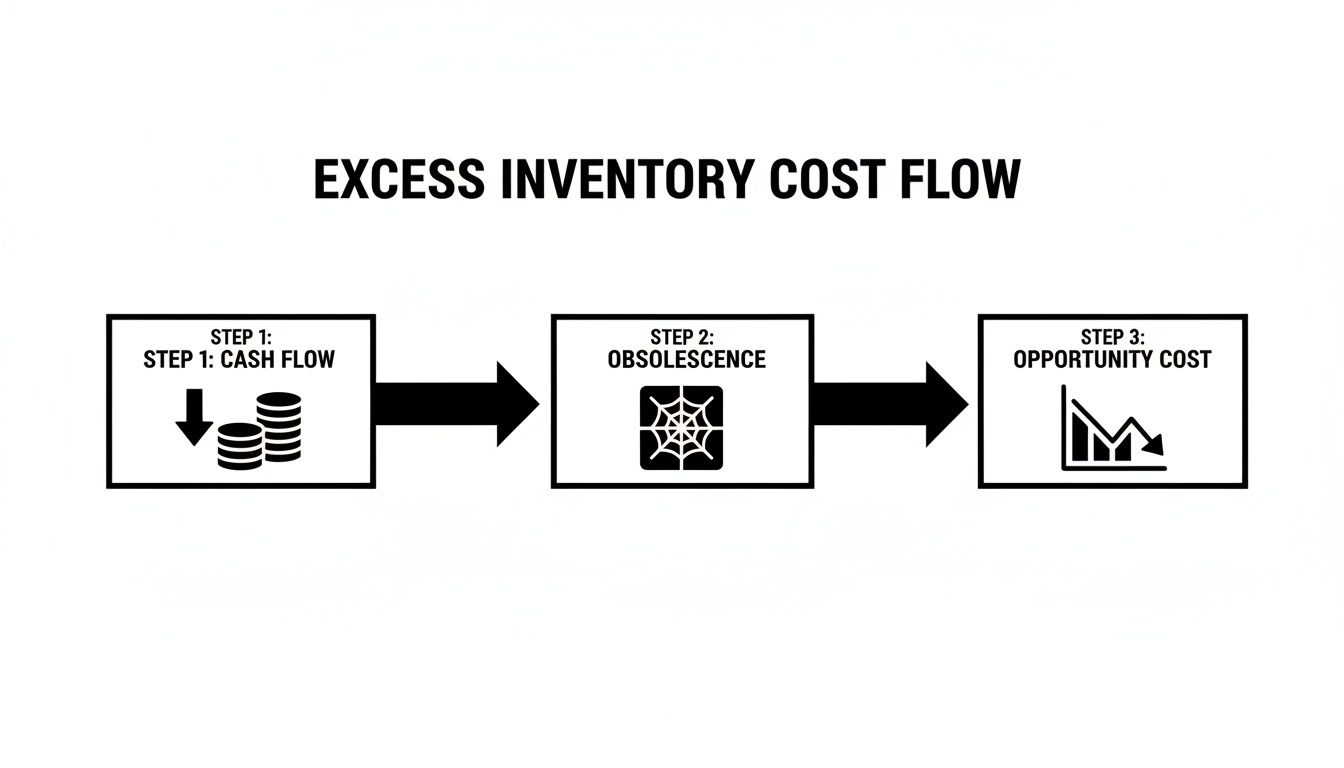
Every unsold unit sitting in your warehouse is an active liability, quietly draining your business's financial health.
A fantastic starting point for any inventory health check is the ABC analysis. This classic method applies the Pareto Principle (the 80/20 rule) to your inventory, segmenting products based on their value to your business. It’s simple, but incredibly powerful.
Here’s the breakdown:
This simple exercise immediately shines a spotlight on where your attention is most needed. If you’re overstocked on your 'A' items, that's a five-alarm fire. On the flip side, having too many 'C' items is a slow, silent drain on your cash and warehouse space.
With your products neatly segmented, it’s time to dig into the key performance indicators (KPIs) that tell you the real story. Two of the most important metrics here are inventory turnover rate and days of supply.
Inventory turnover tells you how many times you sell and replace your stock over a given period. A slow turnover rate on a high-value 'A' item is a massive red flag. Days of supply is even more direct—it tells you how long your current stock will last at your recent sales velocity.
For a more granular look at this, our guide on how to identify slow-moving inventory is a great resource for pinpointing problem SKUs quickly.
A global benchmark report found the median stock turn rate is just 3.9, revealing a huge gap between top-performing brands and the average small business. The same data shows that rigorous monthly reviews can slash stockouts by 18%. It's a clear signal that paying close attention pays off.
To build a solid foundation for these practices, it helps to understand the principles of essential inventory management for small businesses. By combining a solid ABC analysis with these core health metrics, you move from guessing to knowing. You’ll have a clear, data-backed picture of your inventory's condition, which is the only way to make smart, effective decisions.
Before diving into the specific tactics, let's quickly compare the kinds of actions you can take. Some fixes are immediate and tactical, while others are more strategic and foundational.
This table gives you a snapshot of the different levers you can pull, separating the quick fixes from the more involved, long-term process improvements.
| Strategy Type | Actionable Tactic | Typical Impact | Effort Level |
|---|---|---|---|
| Quick Wins | Flash sales, targeted discounts | Immediate sales lift, clears aging stock | Low to Medium |
| Quick Wins | Product bundling, BOGO offers | Increased AOV, moves slow items with bestsellers | Medium |
| Quick Wins | Return to vendor (RTV) agreements | Frees up capital and space (if available) | Medium |
| Long-Term | Refine forecasting models | Improved demand accuracy, less over-ordering | High |
| Long-Term | Optimize reorder points & safety stock | Reduced carrying costs, better stock availability | High |
| Long-Term | Assortment rationalization | Eliminates chronic underperformers, simplifies ops | Medium to High |
Understanding this distinction is key. Quick wins are great for immediate relief, but the long-term strategies are what will keep you from ending up in the same situation six months from now. A truly effective plan uses a mix of both.
Once you’ve pinpointed which products are collecting dust, it’s time to take action. The goal isn't just to get rid of stock, but to do it smartly. You want to recoup as much cash as you can without cheapening your brand's reputation. This means moving beyond a simple, site-wide "50% Off" banner.

Let's break down a few effective strategies that clear the shelves while protecting your brand and generating cash.
One of my favorite ways to move slow-moving inventory is to pair it with a bestseller. This tactic, known as product bundling, works wonders because it increases the perceived value of the purchase while helping you sell items that just wouldn’t move on their own.
Imagine a skincare brand with a serum that's getting a little too close to its expiration date. Instead of slashing the price and making it look undesirable, they could bundle it with their top-selling moisturizer for a small, attractive discount. The customer feels like they're getting a great deal on a set, and the brand moves aging stock profitably.
Bundling is more than just a clearance tactic; it's a way to boost your average order value (AOV). By packaging a slow-mover with a popular product, you not only solve an inventory problem but also increase the total cart size for each transaction.
Learning how to make a bundle on Shopify is a seriously powerful skill. It allows you to create these compelling offers right in your store, turning a potential loss into a profitable sale. Another solid approach is to offer a slow-moving item as a low-cost upsell at checkout. When a customer is already committed to buying, adding a small, high-value item is often an easy yes for them.
Instead of shouting a sale from the rooftops for everyone to hear, try creating exclusive flash sales for your most loyal customers. This approach makes your subscribers feel valued and creates a powerful sense of urgency without devaluing your products in the public eye.
An email-exclusive, 24-hour sale on select overstocked items can drive a massive spike in revenue. And because the offer is private, it doesn’t train your general audience to just sit around and wait for discounts.
Here are a few ways I’ve seen this work well:
By focusing on these targeted promotions, you can seriously improve your inventory turnover without resorting to deep, brand-damaging discounts. For a deeper dive, check out our guide on how to improve inventory turnover for more sustainable practices: https://tociny.ai/blog/how-to-improve-inventory-turnover
Sometimes, you just need to move a large volume of stock—and fast. This is where you face a big choice: manage the clearance yourself or sell it off to a third-party liquidator.
The right choice really depends on your situation. If your brand reputation is paramount and the stock levels are manageable, keep it in-house. But if you're facing a critical cash flow or space crisis, a liquidator can be a necessary, if painful, last resort.
Clearing out existing overstock feels good—it’s an immediate cash-flow boost. But the real victory comes from preventing it from piling up in the first place. If you want to achieve long-term inventory health, you have to shift from a reactive, fire-fighting mindset to a proactive, forward-looking one. That means getting away from the static spreadsheets and gut-feel decisions that so often lead to over-ordering.
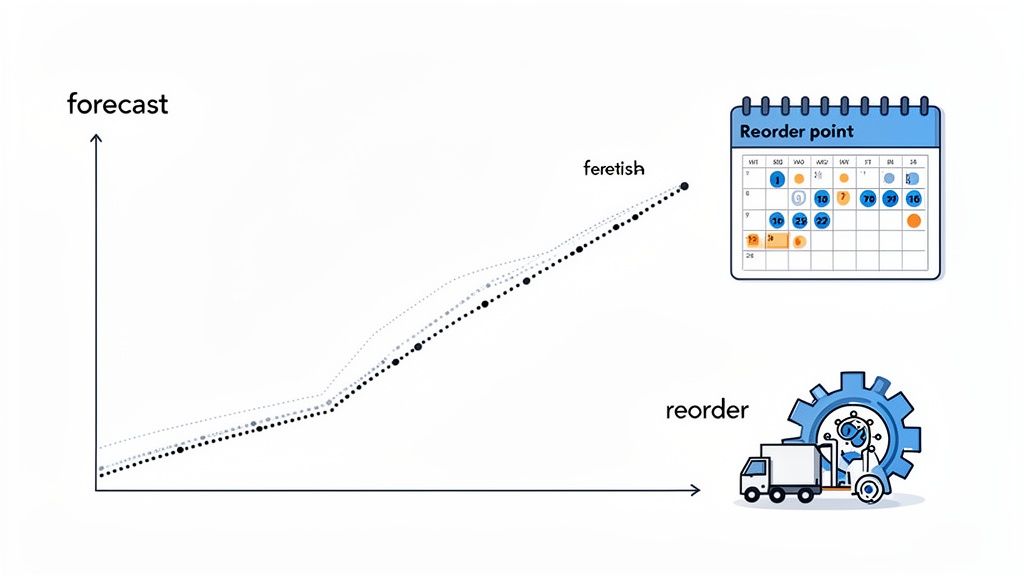
At its core, this proactive approach is all about building a smarter, more dynamic forecasting and reordering process. You’re creating a system that actually anticipates demand instead of just reacting to what you sold last month.
So many brands set a reorder point—the stock level that triggers a new PO—and then just forget about it. This is a one-way ticket to excess inventory. A static reorder point for a seasonal product, for instance, makes absolutely no sense. Your system needs to be dynamic enough to handle the real world.
Your reorder points should always be based on two critical, moving factors: * Lead Time: How long does it actually take for new stock to land after you place an order with a supplier? * Sales Velocity: How quickly are you really selling the product right now, not six months ago?
In the same way, safety stock—that extra inventory you keep to avoid stockouts—can't be a random guess. It's a calculated buffer meant to protect you from a sudden spike in demand or a supplier delay. Set it too high, and you're creating your own overstock problem. Too low, and you're leaving sales on the table.
The goal is to constantly tweak these levels based on current performance data and how reliable your suppliers are, not on last year's dusty numbers.
A proactive approach means your inventory policies are fluid, not fixed. They should adapt to changes in your business and the broader market, allowing you to stay nimble and protect your cash flow.
This lesson hit home for a lot of businesses as global supply chains went haywire. Many built up huge risk buffers to survive, but the savviest operators are now strategically trimming them as conditions stabilize. As retailers backed off from aggressive front-loading, US supply chains saw a 5.8% year-over-year drop in bill-of-lading volumes one September—a clear signal of a shift toward leaner operations. You can dig into these supply chain dynamics and see how top brands are adapting in this S&P Global report.
Forecasting can feel like staring into a crystal ball, but it doesn’t have to be pure guesswork. Good demand forecasting is rooted in data, blending what’s happened in the past with signals about what’s coming next. When you look beyond simple sales history, you can paint a much more accurate picture of the future.
Start by layering in these key data points:
Sure, you can try to juggle all these variables in a spreadsheet, but it’s a massive time sink and riddled with potential for error. This is where modern tools completely change the game. AI-driven platforms like Tociny.ai can automate this complex analysis, turning your raw sales data into predictive insights that help you order the right amount of stock at exactly the right time.
Solid inventory management goes way beyond just reordering what you're low on. It's really about curating your entire product catalog to make you the most money possible. Sometimes, the single best way to slash excess inventory is to simply stop selling the products that cause the problem in the first place.
This whole process is called SKU rationalization. It's all about making the tough, data-driven calls on what products truly deserve a spot in your store.
It’s so easy to get attached to certain products, especially if they were part of your original launch. But nostalgia doesn't pay the warehouse rent. A regular, systematic review forces you to look at your assortment with a cold, hard eye, making sure every single product is pulling its weight.
First things first, you need a clear way to evaluate each product. Don't just look at one number; you need the full picture to separate the winners from the "shelf warmers" that are quietly sucking up cash and space.
Here’s a practical way to score your products:
Think about a specialty coffee roaster who does this. They might find that 80% of their profit comes from just five of their twenty different blends. The other fifteen? They're just adding complexity to operations, marketing, and warehousing. That's a huge, flashing sign to simplify their lineup and pour their energy into what's actually working.
Once you've run the numbers, you'll have a list of underperformers. Now for the hard part—actually pulling the plug. This isn't about admitting failure. It's about smart resource allocation.
SKU rationalization is a strategic act of pruning. By cutting the low-performing branches, you allow the core of your business—the profitable, in-demand products—to grow stronger and healthier.
Phasing out a product gracefully is the name of the game. You can use the clearance tactics we've already talked about, like bundling them with bestsellers or running a "Last Chance to Buy" campaign for your email list. This helps you liquidate the last of the stock without taking a massive loss.
By doing this kind of assortment review regularly—say, every quarter or twice a year—you stop chronic overstock from ever becoming a major headache. It’s a core discipline that turns your product catalog from a sprawling, messy collection into a finely-tuned, profit-generating machine. And that strategic focus is absolutely critical if you want to learn how to reduce excess inventory for good.
Even with a killer plan, you’re bound to have questions once you start digging into your inventory data. Let's tackle some of the most common ones I hear from D2C owners and inventory managers who are getting serious about optimizing their stock.
Consistency is everything here. You've got to bake this into your routine to catch overstock before it becomes a real financial drag.
For your fast-moving products, you need to be looking at them every single month. No exceptions. For the slower, more stable items in your catalog, a quarterly deep dive is usually enough to stay on top of things.
The trick is to make this a non-negotiable part of your operational rhythm. Seriously, put a recurring event on your calendar right now. This regular check-in is your best defense against nasty surprises and cash flow crunches down the road.
This is the classic "it depends" question, but I'll give you a straight answer. The ideal inventory turnover ratio is completely different depending on your industry. A fast-fashion brand might be gunning for a ratio over 10, while a high-end furniture business could be perfectly healthy sitting at a 2 or 3.
For most D2C e-commerce brands, a solid, achievable target is somewhere between 4 and 6.
Look, don't get hung up on some universal benchmark. The real goal is to track your own ratio over time and push for steady, incremental improvement. If that number is trending up, you know your inventory health is getting better. That's what matters.
Yes, it absolutely can—if you get sloppy with it. If you’re constantly running site-wide sales, you're just training customers to wait for a discount. That's a race to the bottom that devalues your brand.
But you still need to move that aging stock. The secret is to do it strategically, without looking desperate.
Ditch the endless "20% OFF!" banners on your homepage and try these smarter tactics instead:
These moves help you get that cash back in the bank while protecting the brand equity you’ve worked so hard to build.
Ready to stop guessing and start making data-driven inventory decisions? Tociny.ai replaces complex spreadsheets with clear, AI-powered recommendations to help you reduce overstock and forecast demand with confidence. Join our private beta for exclusive early access at https://tociny.ai.
Tociny is in private beta — we’re onboarding a few select stores right now.
Book a short call to get early access and exclusive insights.