
At its core, inventory replenishment is the whole process of restocking your products to keep up with customer demand. For any direct-to-consumer (D2C) brand, it boils down to a simple, powerful mantra: have the right product, in the right quantity, at the right time. Nail this, and you’re on your way to maximizing sales and keeping your customers happy.

Imagine you’re a barista managing coffee beans for the morning rush. If you have too few, you’ll lose sales to caffeine-deprived customers who simply won't wait around. Order too many, and those expensive beans go stale, wasting money and precious shelf space. That delicate balance is the daily challenge every Shopify store and D2C brand owner faces.
Smart replenishment isn't just about reordering stuff. It’s about transforming a routine logistical task into a powerful engine for growth. It’s the operational backbone that directly props up your profitability, builds customer loyalty, and keeps your business healthy.
Get it right, and you dodge the two biggest profit killers in ecommerce: stockouts and overstock.
The financial stakes here are massive. Retailers lose a jaw-dropping $1.73 trillion every single year because of stockouts and overstocks. This "inventory distortion" accounts for about 6.5% of all global retail sales, pointing to a huge opportunity for brands that can finally get a handle on their replenishment cycle. You can explore the full supply chain planning report on Netstock.com.
Sloppy inventory management isn't just a number on a spreadsheet; it hits your brand in very real ways:
Replenishment is more than an operational task; it's a financial strategy. The goal isn't just to have stock, but to have a lean, efficient inventory that turns over quickly and profitably.
For a long time, many brands treated replenishment as a reactive chore. They'd place a new order only when a shelf looked empty or a spreadsheet dipped into the red. That manual, "gut-feel" approach is riddled with human error and is far too slow for the breakneck pace of modern ecommerce.
The brands that win today have shifted from reactive to proactive. By understanding the core principles and using modern tools, you can start anticipating demand instead of just reacting to it. This guide will walk you through the essential methods, metrics, and workflows that will turn replenishment from a constant headache into your brand’s biggest competitive advantage.
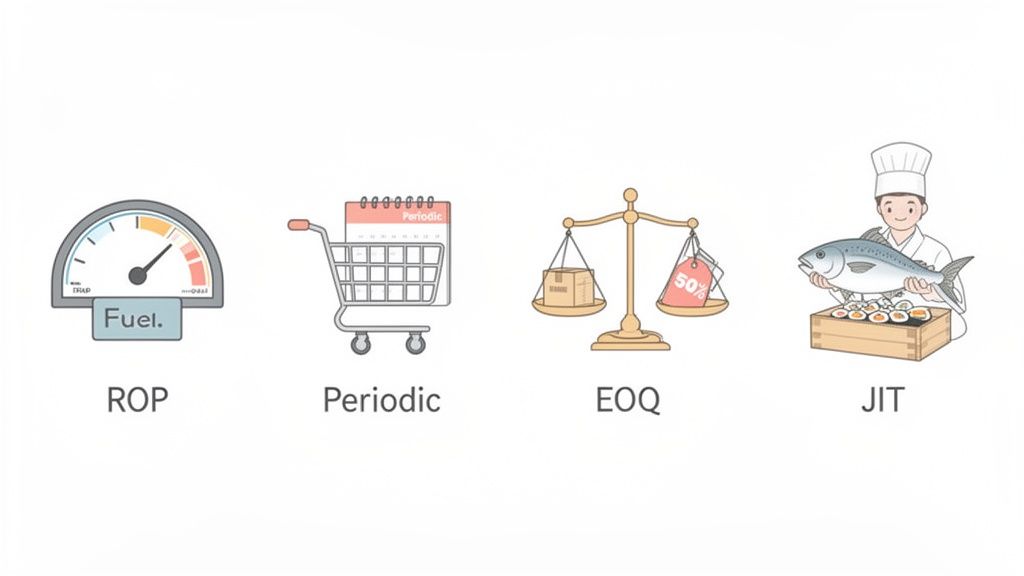
Alright, we've established why replenishment matters. Now, let's pull back the curtain on the most common strategies you can use, without any of the dense, academic jargon.
Every method is just a different way of answering two simple questions: When should I reorder, and how much should I get? Think of these as different recipes. The right one for your brand depends entirely on your products, your suppliers, and your customers.
Making this choice is a big deal. It directly impacts your cash flow, how much warehouse space you need, and how quickly you can pivot when the market throws you a curveball. We'll walk through the four core models, using some simple analogies to make them stick.
The Reorder Point (ROP) model is probably the most intuitive one out there. It works exactly like the low fuel light in your car. You don’t think about gas until that light comes on, and when it does, you know it's time to act.
With ROP, you set a minimum stock level for a product. As soon as your inventory drops to that magic number, it triggers a new order for a predetermined quantity. It’s a straightforward, "if-this-then-that" system that works beautifully for products with steady, predictable demand.
The catch? Its simplicity can be a double-edged sword. You have to monitor every single SKU individually, which can get out of hand fast if you have a large catalog. A sudden spike in sales can also burn through your stock before a new shipment arrives, leaving you with an empty shelf and unhappy customers.
The Periodic Review method is the total opposite. It operates on a fixed schedule, like your weekly grocery run. It doesn't matter if you're completely out of milk or just a little low on coffee; every Tuesday, you check your pantry and buy what you need to get back to a comfortable level.
With this strategy, you check your inventory at set intervals—daily, weekly, or monthly—and place orders for multiple items all at once. This is a great way to streamline your purchasing, especially if you get several products from the same supplier. Bundling orders can lead to better shipping rates and volume discounts.
The main downside is that you often need to carry more safety stock to avoid running out between your scheduled check-ins. Because you aren’t ordering the moment a product gets low, the risk of a stockout before your next review day is a bit higher.
Key Takeaway: The choice between Reorder Point and Periodic Review often boils down to control versus efficiency. ROP gives you tighter control over individual products, while Periodic Review makes the ordering process itself much more efficient.
The Economic Order Quantity (EOQ) model is for the numbers people. It’s a formula-based approach designed to find the financial "sweet spot" for your order sizes. It’s all about perfectly balancing two opposing forces: the cost of holding inventory and the cost of ordering it.
Sure, ordering a massive batch of your best-seller might land you a sweet per-unit discount. But the cost of storing all that product—warehouse rent, insurance, potential damage—could easily eat up those savings. On the other hand, placing tons of small orders keeps storage costs low but sends your shipping and admin fees through the roof.
EOQ gives you a formula to calculate the ideal order size that keeps your total costs as low as possible. For a deeper dive into the math and its practical uses, check out our guide on what is Economic Order Quantity.
Finally, there’s the Just-in-Time (JIT) method, the leanest and meanest of them all. Imagine a high-end sushi restaurant that gets a fresh fish delivery every single morning. They don’t have a freezer packed with tuna; they order just enough for that day's service to maximize freshness and eliminate waste.
That’s JIT in a nutshell. Inventory arrives exactly when it's needed for sale, which can slash your holding costs to almost zero. This approach requires an incredibly reliable and fast supply chain because there’s no safety stock to act as a buffer. It’s a high-risk, high-reward play that leaves zero room for supplier delays or unexpected demand.
To make it easier to see how these stack up, here’s a quick side-by-side comparison. Use this table to get a feel for which strategy might be the best fit for your brand's operational style and business needs.
| Method | Best For | Key Advantage | Main Disadvantage |
|---|---|---|---|
| Reorder Point (ROP) | Products with stable, predictable demand. | Simple to implement; minimizes safety stock. | Requires constant monitoring of every SKU. |
| Periodic Review | Brands ordering multiple items from one supplier. | Streamlines purchasing and receiving processes. | Higher risk of stockouts between reviews. |
| Economic Order Quantity (EOQ) | Businesses focused on minimizing total inventory costs. | Financially optimal; balances holding vs. ordering costs. | Relies on accurate demand and cost forecasts. |
| Just-in-Time (JIT) | Companies with highly reliable supply chains. | Drastically reduces holding costs and waste. | Very vulnerable to supply chain disruptions. |
Each of these methods provides a solid framework, but modern tools are what truly bring them to life. Understanding concepts like how hybrid BI improves inventory management can give you a serious advantage by layering real-time data and smarter analytics on top of these foundational strategies.
Picking the right replenishment method is a great start, but it's only half the battle. To really get a handle on your inventory, you need to speak its language—and that language is data. Key metrics are the vital signs of your business, turning abstract numbers into practical tools that guide every single reordering decision you make.
Think about it this way: you wouldn't drive a car without a speedometer or a fuel gauge. These metrics do the same job for your Shopify store. They give you the real-time feedback needed to navigate the market, sidestep costly mistakes, and just keep the engine running smoothly. Let's break down the essentials without getting lost in a sea of formulas.
First up is lead time. Put simply, lead time is the total time it takes from the moment you hit "send" on a purchase order to your supplier until that product is on your shelf, checked in, and ready to sell. It's the entire waiting game.
This one number is a huge deal because it dictates how far in advance you have to act. If one of your bestsellers has a 30-day lead time, you better be reordering it at least a month before you think you'll run out. Get this wrong, and you're either staring at an "out of stock" notice or you’ve tied up a bunch of cash in inventory that showed up way too early.
Next on the list is safety stock, which is basically your "just in case" inventory. It’s like the emergency stash of granola bars you keep in your bag. You don't plan on eating them, but you’re incredibly thankful they’re there when a meeting runs long or you get stuck in traffic.
That's exactly what safety stock does. It’s a buffer that shields you from two big unknowns:
Without this cushion, any little hiccup can trigger a stockout, which means lost sales and unhappy customers. Of course, figuring out the right amount is a tricky balancing act. If you need a hand with the math, you can learn how to calculate safety stock to protect your revenue without accidentally creating a mountain of overstock.
Safety stock isn’t dead inventory; it's an insurance policy. It’s a calculated investment to ensure business continuity and protect the customer experience against the unpredictable nature of supply and demand.
So, how do you know if your replenishment strategy is even working? One of the best gauges is your fill rate. This metric is your customer satisfaction scorecard, measuring the percentage of customer orders you were able to ship completely and on time, without any backorders or delays.
A high fill rate—you should be aiming for 95% or more—is a fantastic sign that your inventory levels are in sync with what your customers want. A consistently low fill rate, on the other hand, is a massive red flag. It’s telling you that you’re frequently out of stock on things people are trying to buy, and that chips away at customer loyalty and your brand's reputation.
Finally, we have Days of Inventory on Hand. This metric answers a simple but vital question: "If I stopped ordering this product today, how many days could I keep selling it before I run out?" It’s a quick snapshot of how long your current stock will last based on your recent sales pace.
This metric is brilliant for spotting problems before they blow up. A really low number is an urgent warning of a stockout risk. An unusually high number might point to a slow-moving product that’s just sitting there, tying up your capital. By keeping an eye on this, you can get a feel for the overall efficiency of your stock. It's also closely related to other key health metrics like the inventory turnover ratio, which is fundamental to understanding how quickly you're converting stock into cash.
Knowing the lingo and the metrics is one thing, but putting it all together into a repeatable workflow is where the magic really happens. For any D2C brand, a structured replenishment process is what separates the brands that are always scrambling from those that are strategically in control of their inventory.
This isn't about some overly complex software or needing a huge team. It's about creating a simple, logical cycle—a playbook for your operations. Just like a coach draws up plays, your workflow gives anyone on your team a step-by-step guide to follow. It takes the guesswork out of the equation and stops you from making those "gut-feel" decisions that lead to stocking out of a bestseller or sinking cash into a slow-mover.
The first move is always to look at what’s actually selling. Don't go by memory or what you think is popular. You need to dive right into your Shopify analytics or e-commerce platform and pull the hard numbers.
Your goal here is simple: find your winners and losers.
This initial review sets the stage for every decision you make next. It ensures you’re putting your time, energy, and money into the products that actually move the needle.
Once you know how products have been selling, the next step is to make an educated guess about how they'll sell in the future. Demand forecasting sounds intimidating, but for a growing brand, you can start with a very practical approach.
A great starting point is calculating your sales velocity—that’s just the rate you sell a specific product per day or week. For instance, if you sold 120 units of a popular skincare serum in the last 30 days, your daily sales velocity is four units. That simple number is now the baseline for your forecast.
From there, you can start to layer in more context. Got a big marketing campaign planned for next month? Is a major holiday on the horizon that always spikes sales? Thinking through these variables helps you adjust that baseline forecast up or down, giving you a much more realistic picture of future demand.
Now that you have a demand forecast and you know your supplier lead times, you can finally set a reorder point (ROP) for each of your key products. Think of this as the specific stock level that, once hit, automatically triggers a new purchase order.
Your ROP is your most important safety net. It’s calculated to make sure you have enough inventory to cover customer orders during the time it takes your supplier to deliver, plus a little extra for your safety stock buffer. Setting up low-stock alerts in your inventory system based on these ROPs is one of the single most effective ways to prevent stockouts.
A well-calculated reorder point is your early warning system. It replaces the panic of realizing a product is almost gone with a calm, automated signal that it's time to restock, giving you plenty of time to act.
When a product's inventory level hits its reorder point, it's go-time. You need to place a purchase order (PO). A crystal-clear, detailed PO is absolutely essential to avoid any miscommunication with your supplier. It should clearly spell out the SKUs, quantities, agreed-upon prices, and the expected delivery date.
But the job isn’t done when you hit "send." The final piece of the puzzle is tracking that inbound inventory. Keep the lines of communication open with your supplier to get updates on production and shipping. Knowing exactly when a delivery will arrive helps your warehouse team prepare for receiving and lets you give eager customers more accurate "back in stock" dates.
Following this structured cycle transforms replenishment from a chaotic chore into a predictable—and powerful—business process.
For years, replenishment has been a mix of historical data, gut feelings, and endless spreadsheets. While that gets you part of the way, it’s a system that’s always looking in the rearview mirror. This is where AI completely changes the game. It shifts your brand from reactive restocking to proactive, predictive inventory management.
Think of it like upgrading from a basic calculator to a powerful financial modeling computer. Instead of you manually plugging in past sales to find a reorder point, an AI system is constantly crunching huge datasets for every single one of your SKUs. It finds the hidden connections between sales history, seasonality, upcoming promotions, and even external market trends you’d never spot on your own.
This isn’t just about looking backward anymore; it's about looking forward. AI can anticipate that an unexpected heatwave will cause a spike in swimsuit sales or that a specific influencer campaign is about to send demand for one of your products through the roof.
The biggest win with AI is its ability to automate all that complex analysis. It frees your team from the soul-crushing cycle of managing inventory in spreadsheets. Instead of a manual, time-sucking task, inventory planning becomes an automated, strategic function.
This directly attacks the two oldest and most expensive problems in retail:
At its core, an automated replenishment workflow boils down to a few key stages, moving from review and forecasting to the final purchase order.
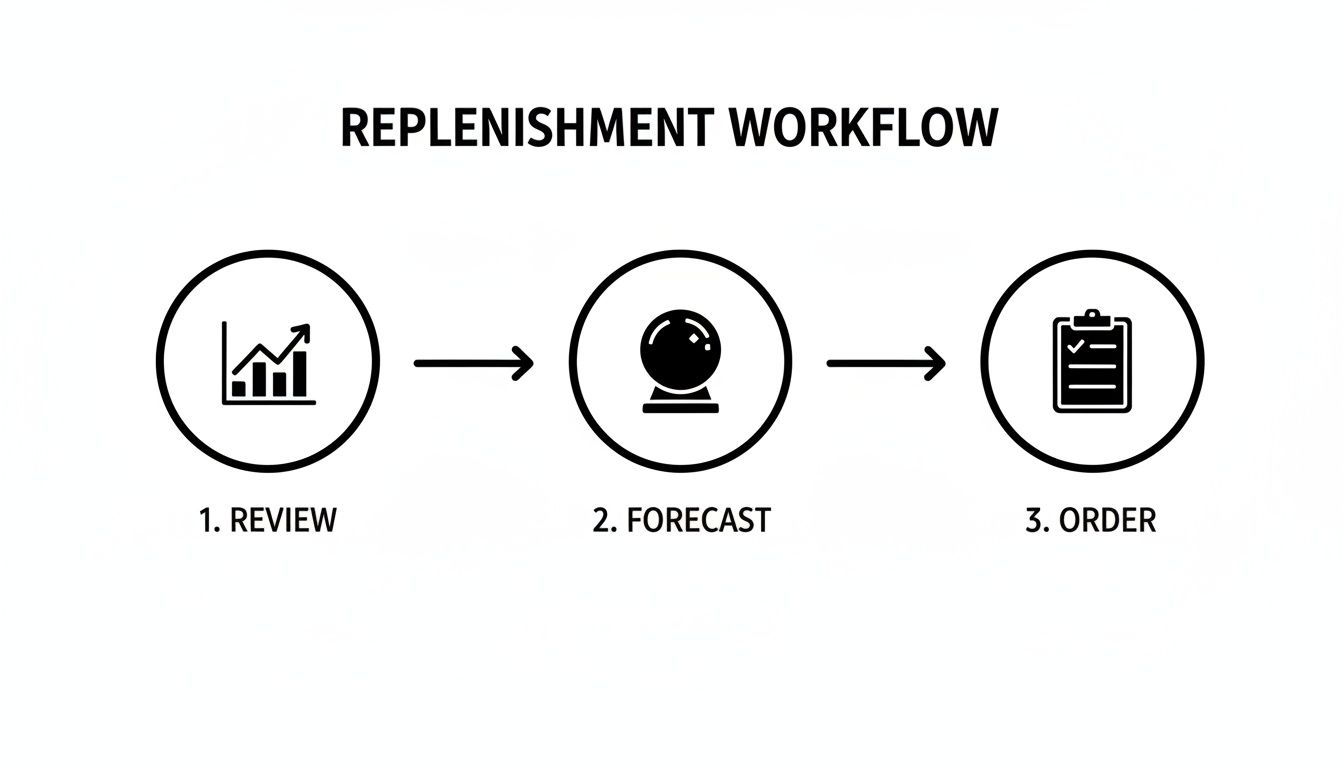
AI automates this entire flow, ensuring every step is powered by real-time data, not manual checks and best guesses.
AI systems don’t just run a one-time forecast; they constantly learn and adapt. It’s what makes them so effective in today’s unpredictable market. (We get into the technical weeds in our article on how AI demand forecasting works.)
Here are a few real-world scenarios where AI really shines:
AI transforms replenishment from a system of rules into a system of intelligence. It doesn’t just follow instructions; it provides dynamic recommendations based on a holistic view of your business and the market.
Ultimately, integrating AI into your replenishment process is about building a more resilient, efficient, and profitable business. It’s the best tool we have to tackle the billion-dollar problem of overstocks and stockouts, turning your inventory from a liability into your greatest strategic asset.
Alright, let's move from theory to the real world. Once you start implementing these strategies, you'll inevitably run into specific situations and have practical questions. It's one thing to understand the concepts, but another to apply them when you've got a supplier on the phone and purchase orders to sign.
We've pulled together some of the most common questions we hear from D2C brands. Think of this as your quick-reference guide for navigating those day-to-day inventory challenges.
For your best-sellers—your "A-category" items—you should be looking at them weekly, at a minimum. These products are the engine of your business. A stockout on one of them can kill your sales momentum and send customers straight to a competitor.
For your slower-moving "B" and "C" products, a review every two weeks or even monthly is usually fine. The real game-changer here is consistency. Of course, this is where automated tools really shine; they can watch your stock levels 24/7 and just ping you when it's time to take action, saving you a ton of manual work.
The most common—and most expensive—mistake is ordering based on gut feelings or simply repeating last year's purchase order. It's so easy to fall into the trap of thinking, "well, this sold great last fall, so let's order the same amount again." But customer tastes shift, trends die, and what worked last year might just sit on your shelves this year.
That hot product from last season could be losing steam. If you reorder a huge batch without looking at current sales data, you’re setting yourself up for a mountain of dead stock. Always, always let your recent sales velocity and data-driven forecasts guide your POs.
The golden rule of replenishment: Trust your data more than your gut. Past performance is a helpful guide, but your current sales velocity is the single best predictor of what you'll need tomorrow.
Seasonal items are a different beast altogether. You have to order everything well in advance, and you're relying heavily on historical data from previous years to get your forecast right. A crucial piece of the puzzle is factoring in much longer supplier lead times before your peak season hits—production lines get jammed and shipping lanes get congested.
You also need to plan for a "sell-through" date. The goal is to sell out just as the season is ending, so you aren't left holding a bunch of Santa-themed dog sweaters in February. This is an area where AI forecasting tools are incredibly powerful, as they can model those seasonal demand curves with surprising accuracy, helping you nail both the timing and the quantity of your order.
No, but it's a constraint you have to work with. While you obviously have to meet a supplier's Minimum Order Quantity (MOQ), it should never be the main reason you order a certain amount. Your order size should always be driven by what your sales forecast says you can realistically sell.
If a supplier's MOQ is way higher than what your data supports, ordering that much just ties up precious cash and puts you at a huge risk of overstock. In these cases, it’s often much smarter to try and negotiate a lower MOQ. If they won't budge, it might be time to find a new supplier whose terms are a better fit for your business's actual demand.
Ready to stop guessing and start forecasting with precision? Tociny.ai uses AI to provide clear sales insights and actionable recommendations, helping you eliminate stockouts and reduce overstock. Join the private beta for early access.
Tociny is in private beta — we’re onboarding a few select stores right now.
Book a short call to get early access and exclusive insights.