An app for inventory tracking is what separates the brands that scale from the ones that get stuck. It swaps out those clunky, error-prone spreadsheets for a live, automated system that puts an end to costly stockouts and profit-killing overstock. For any growing D2C brand, it’s how you turn inventory chaos into a well-oiled, data-driven machine.
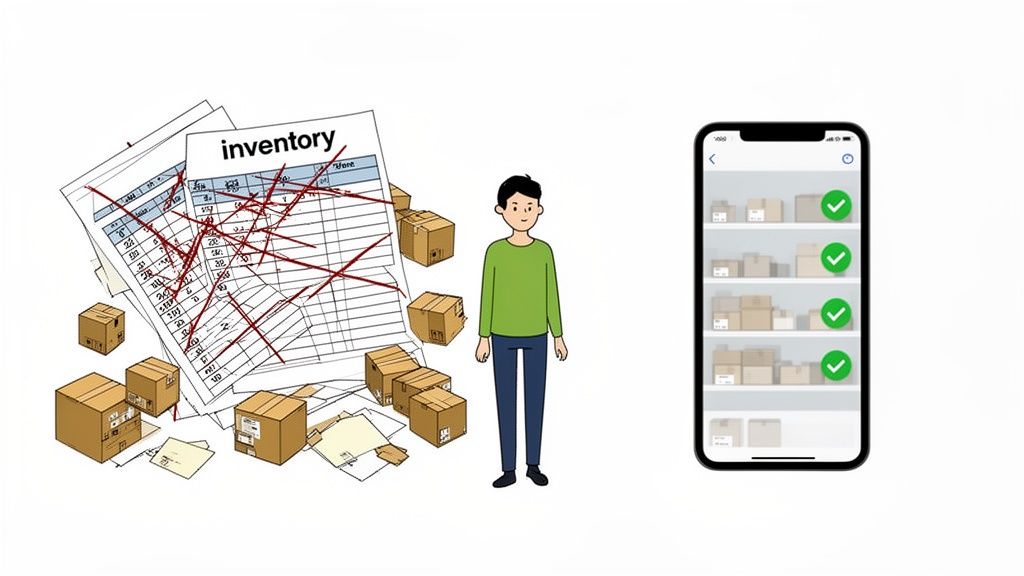
If you're still wrestling with a spreadsheet to manage your Shopify store's inventory, you know the feeling. It's a constant tightrope walk—one side is the fear of your bestseller going out of stock right before a big sale, and the other is the dread of seeing cash tied up in products collecting dust.
Every time you manually type in a number, you're rolling the dice on a costly mistake. And every hour that passes before the sheet gets updated is another blind spot in your operations.
Trying to run a modern ecommerce business this way is like navigating rush hour traffic with a folded paper map. Sure, you might get where you're going eventually, but it’s slow, frustrating, and you’re bound to hit a few dead ends. You have no idea what’s happening in real-time, and you're always one step behind the competitor who’s using a GPS.
This is exactly where a dedicated app for inventory tracking completely changes the game. Think of it as the GPS for your inventory—a smart co-pilot that feeds you the real-time data you need to make confident decisions on the fly. No more guessing games. You get a live, accurate view of every single item across all your sales channels.
As you grow, it's essential to look into more robust automated inventory management systems that move beyond simple counting and provide true operational control.
A proper inventory app doesn't just count what you have; it provides the operational intelligence to understand what you need, when you need it, and where it should be.
This shift from being reactive to proactive is what separates thriving brands from struggling ones. For any D2C business serious about scaling, an app isn't just a nice-to-have; it's the core tool for protecting your profits and building a resilient supply chain. If you're curious about just how limiting manual methods are, it's worth understanding the pitfalls of a basic inventory tracking sheet and why making the switch is so critical.
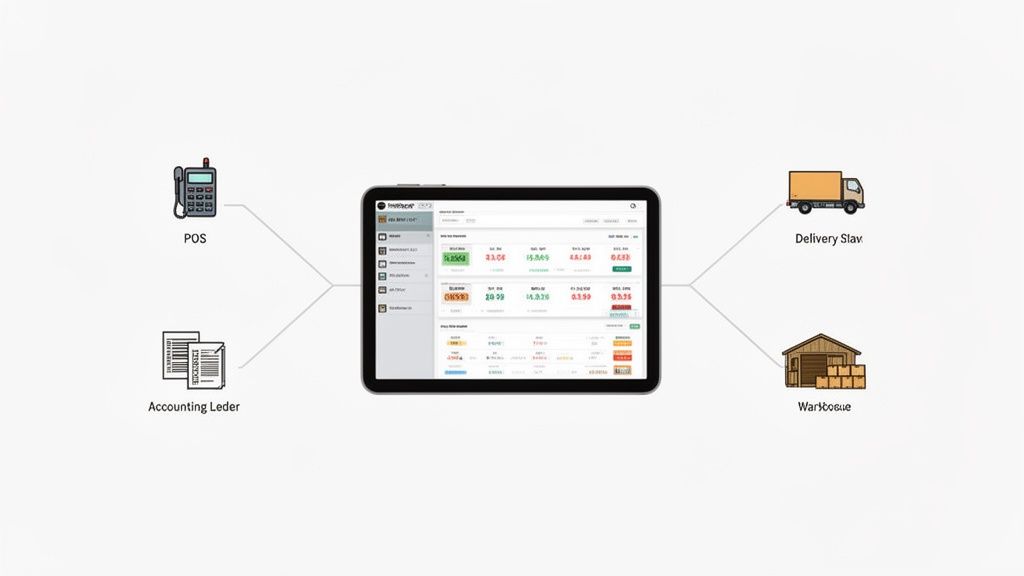
Think of a modern app for inventory tracking less like a simple calculator and more like the central nervous system for your entire D2C operation. It’s not just about counting what you have on the shelves anymore. It’s about connecting every part of your business—from sales channels to your warehouse—into one smart, cohesive system.
Instead of staring at a static spreadsheet that’s outdated the minute you create it, imagine a live dashboard that shows the real pulse of your business. Every sale, every return, every shipment is reflected instantly. This real-time view is the bedrock of good decision-making.
Without it, you’re flying blind, making calls based on old information. That's a surefire recipe for disappointing customers with stockouts or tying up cash in products that just aren't moving. A great app turns that guesswork into confidence.
The absolute baseline for any decent inventory app is real-time stock monitoring. What does that actually mean? It means the second a customer hits "buy" on your Shopify store, your inventory count for that product updates everywhere, automatically.
If you also sell at a weekend market or through a marketplace, the app syncs those sales, too. This single feature is what stops you from accidentally selling the same t-shirt twice. For brands using multiple warehouses or working with 3PLs, this isn’t just a nice-to-have; it's a must-have. You always know what you have and exactly where it is.
The best brands don’t just know which products sell well; they know which variants are driving the business. This is where SKU-level data comes in. A powerful app won't just tell you the "Classic Hoodie" is a hit. It'll show you that the "Large, Navy Blue" version is a superstar, while the "Small, Forest Green" is collecting dust.
This is where the real money is made or lost. This detail tells you what to reorder, what to put on sale, and which products might be ready for retirement.
Analyzing sales velocity for each individual SKU lets you fine-tune your product mix, making sure your cash is invested in the items that actually generate a return. It's the difference between knowing your team won the game and knowing which player scored the winning goal and how.
Your inventory app can't be an island. Its real strength is unlocked when it connects with the other tools you depend on every single day. Think of seamless integrations as the glue that holds your entire operation together, making everything run smoothly.
Your app absolutely has to play nice with your core systems, including:
When these systems are all talking to each other, you create a single source of truth. This eliminates the mind-numbing data entry that inevitably leads to human error and costly mistakes.
As your store grows, your needs will evolve. What was sufficient yesterday might become a bottleneck tomorrow. Here’s a breakdown of the core features every store needs versus the advanced capabilities that can truly set you apart.
| Feature Category | Essential Functionality (Must-Have) | Advanced Functionality (Game-Changer) |
|---|---|---|
| Stock Monitoring | Real-time, multi-channel inventory sync. | Multi-location and 3PL warehouse tracking. |
| Data & Analytics | Basic sales reports and bestseller lists. | Granular SKU-level performance, sales velocity, and profitability analysis. |
| Purchasing | Manual purchase order creation. | AI-driven reorder suggestions and automated PO generation based on sales forecasts. |
| Forecasting | Simple low-stock alerts based on fixed levels. | Predictive demand forecasting that accounts for seasonality and sales trends. |
| Integrations | Connects to Shopify and major shipping carriers. | Deep integrations with accounting, marketing, and customer service platforms. |
| Operational Tools | Barcode scanning for receiving and picking. | Kitting/bundling support and automated stock transfers between locations. |
Choosing the right app is about matching its capabilities to your current needs while ensuring it has the advanced features you'll need as you scale. Don't just solve today's problems; pick a partner that can handle tomorrow's growth.
Jumping into the Shopify App Store can feel a bit like trying to find one specific vendor in a massive, chaotic marketplace. You're surrounded by countless options, and every single one claims to be the best app for inventory tracking. It’s enough to make anyone’s head spin.
But here’s the thing: finding the right app isn’t about picking the one with the longest feature list. It’s about finding a partner that fits the unique rhythm of your business today and can keep up with where you’re headed tomorrow.
Making the right call here is a big deal. The global inventory management software market is expected to jump from USD 3.85 billion in 2025 to USD 8.94 billion by 2033, which tells you one thing loud and clear: brands are betting big on these tools. You can dig into the full research on cloud-based inventory solutions if you're curious. This trend just proves how important it is to pick a modern solution that’s built for growth.
First up, think about scalability. The app that works perfectly when you’re shipping 50 orders a month might completely fall apart when you hit 500. You have to ask the tough questions. Can this tool handle a massive sales spike on Black Friday? Does its pricing model feel like it's punishing you for growing? A great app grows with you, not against you.
Just as crucial is the user experience. If the dashboard is clunky, confusing, or just plain ugly, your team will avoid it like the plague. A great UI feels natural right out of the box. It should empower everyone, from the person packing boxes in the warehouse to the marketing manager planning a flash sale, to find what they need without a three-hour training session.
Your inventory app should simplify complexity, not add to it. If it requires a manual to perform basic tasks, it’s already slowing you down.
Finally, let's talk about two things that can absolutely make or break your experience: how the app connects to Shopify and who picks up the phone when something goes wrong.
The app needs a native, seamless integration with Shopify. Period. Anything less invites the dreaded data sync errors that lead to you accidentally selling an out-of-stock product. That’s one of the fastest ways to lose a customer’s trust.
And please, don't overlook customer support. Because issues will pop up, and when they do, you need a team that's responsive and actually knows what they're talking about. Can you hop on a live chat, or are you stuck sending an email into the void and hoping for a reply in 48 hours? Think of reliable support as your business’s safety net.
To see how all these pieces fit together in the real world, check out our guide on the best inventory management software for Shopify.
Simply tracking what you have in stock isn’t going to cut it anymore. Today, the best app for inventory tracking doesn’t just give you a rearview mirror of what you've sold; it acts more like a GPS for your business, showing you where you're headed. This is where Artificial Intelligence (AI) steps in, turning your historical data into a powerful strategic advantage.
AI-powered analytics go way beyond basic counting. Instead of just showing what’s on the shelves, an AI system helps you figure out what should be on them. Think of it as an intelligent co-pilot, crunching complex patterns that are impossible for a human to spot in a spreadsheet, helping you make smarter, more profitable decisions.
This level of intelligence is supercharging the inventory management market. The AI sector in this space is projected to jump from USD 7.38 billion in 2024 to USD 9.54 billion in 2025 as businesses demand more predictive power. For Shopify merchants, that translates directly to fewer stockouts and less overstock—headaches that plague nearly 45% of small retailers.
Traditional inventory management is all about reaction. You see a product is running low, so you order more. It’s simple, but it’s always a step behind.
AI flips this model completely on its head by enabling predictive demand forecasting. It digs through your sales history, flags seasonal peaks, accounts for marketing campaigns, and even considers external market trends to predict future sales with stunning accuracy.
Imagine your app telling you, "Based on last year's data and current social media trends, you'll need 30% more of your best-selling hoodie next month." That's the power of AI. It gives you the confidence to order the right amount of stock at the right time, protecting both your cash flow and your customer relationships.
AI doesn't just manage inventory; it anticipates customer demand, turning your stockroom into a direct reflection of future sales opportunities.
When picking an app, you need to consider how it will grow with you. Key factors include its ability to scale, how easy it is to use, and the quality of its support.
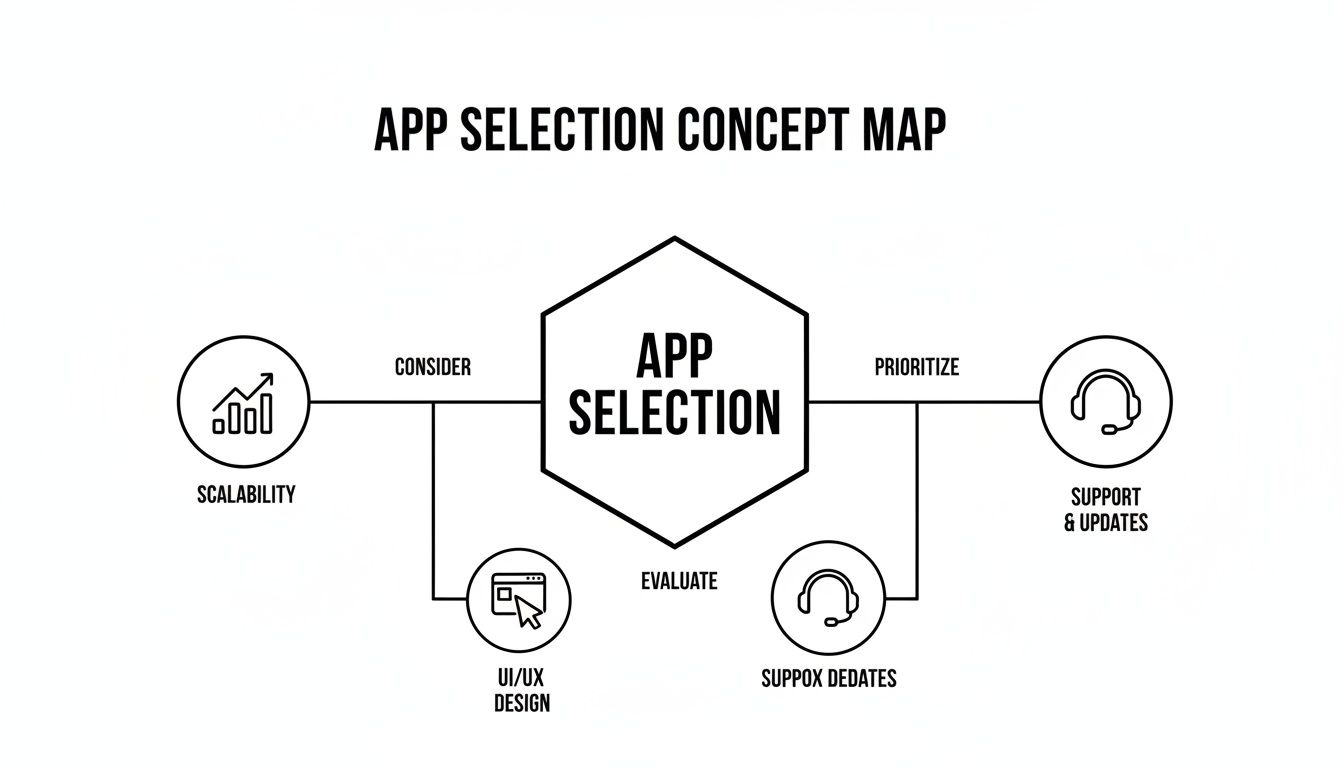
As this shows, the best tools balance powerful features with a great user experience and reliable help when you need it.
AI also excels at assortment optimization. It gives you clear, data-backed advice on which products are your true heroes and which ones are just collecting dust and tying up your cash.
For example, it might highlight a slow-moving SKU that's dragging down your bottom line. Or it could suggest bundling a popular item with a lesser-known one to boost its visibility and sales velocity. To get this right, you need to understand your product lifecycle by classifying stock by its value and sales frequency, a technique known as ABC analysis inventory.
An AI-first solution like Tociny.ai is built specifically to deliver these kinds of insights. It translates mountains of complex data into simple, actionable recommendations. Instead of you digging through reports, the system surfaces opportunities directly, empowering you to refine your product mix, run smarter promotions, and ultimately build a more profitable brand.
For a deeper dive into this, check out our guide on AI demand forecasting.
Choosing the right app for inventory tracking is a huge step, but let's be real: a new tool is only as good as its setup. A smooth implementation is what turns that potential into actual profit. Think of it like assembling a high-performance engine; every single part has to be clean and slotted in perfectly for the thing to roar to life.
I've put together a checklist to walk you through the big stages and make sure your new app delivers value from day one. Trust me, skipping these steps leads to maddening data errors and a messy rollout that completely defeats the purpose of getting a new system in the first place. Let's make sure that doesn't happen.
Before you even think about connecting the app, your existing data needs to be spotless. If you start with garbage numbers, you'll only get garbage insights. This initial cleanup is, without a doubt, the most important part of the entire process.
With your clean data locked and loaded, it’s time to connect the app and do a physical count. This is non-negotiable. You have to ensure what the app thinks you have matches what's actually sitting on your shelves.
A physical stocktake is your moment of truth. It syncs your digital records with physical reality, creating a reliable baseline for all future tracking and forecasting.
Next up is team training. Walk everyone through the daily tasks: how to receive stock, how to fulfill orders using the new system, and how to pull basic reports. A tool is completely useless if the team doesn't understand how or why to use it correctly.
Give them clear documentation and some hands-on practice to build their confidence. That initial time you invest in training will pay off tenfold by preventing simple user errors and getting everyone excited about the new, more efficient workflow.
Here's the rewritten section, designed to match the expert, human-written style of the provided examples:
Moving past spreadsheets isn't just about saving time; it’s about a fundamental shift in how you run your business. The right app for inventory tracking changes your entire strategy from reactive to proactive. It’s the difference between constantly stamping out fires—like surprise stockouts or last-minute clearance sales—and having a solid, data-backed plan for profitable growth.
This is a journey from operational chaos to strategic clarity. You graduate from the headaches of manual counts and pure guesswork to the confidence of AI-powered insights. Instead of losing sales because an item sold out faster than you expected, you start anticipating demand. Instead of letting cash get tied up in dust-collecting dead stock, you invest it in products you know your customers want.
This shift isn't just a "nice-to-have" anymore; it's becoming essential. The global market for inventory management software is on track to hit USD 3.64 billion by 2029, and that growth is almost entirely driven by the e-commerce boom and the non-negotiable need for real-time visibility. You can dig into the inventory management software market trends yourself to see how this is reshaping the entire industry.
An inventory app isn't just a tool; it's a strategic asset. It turns your stock into a dynamic, intelligent part of your business that actively drives growth instead of just sitting on a shelf.
Ultimately, this proactive approach lets you get back to what you love—building your brand, talking to your customers, and creating amazing products. You get out of the weeds of day-to-day firefighting and back into the driver's seat.
For Shopify merchants ready to make this leap, Tociny.ai offers a chance to get ahead of the curve. Join our private beta to help shape the future of intelligent inventory planning and turn your data into your most powerful growth engine.
Stepping into the world of dedicated inventory tracking can feel like a big move, and it's totally normal to have a few questions before you dive in. We hear a lot of the same queries from Shopify merchants who are right where you are now.
Let's clear up some of the most common ones so you can feel confident about what’s next for your brand.
You bet. In fact, this is one of the main reasons brands upgrade to a proper inventory app. The best tools are built from the ground up to pull all your stock data into one place, whether you're juggling multiple warehouses, brick-and-mortar stores, or even inventory held by a 3PL partner.
Instead of guessing, you get a single dashboard showing what you have and exactly where it is. This is a lifesaver for smart order routing—making sure an order ships from the closest, cheapest location. It also stops you from running out of stock in one warehouse while another is sitting on a mountain of the exact same product.
This is a big one, and the honest answer is: it varies. The price tag on an app for inventory tracking really depends on a few key things about your business:
Generally speaking, you’ll find simple apps starting around $30 per month, while more powerful platforms with multi-warehouse support and predictive analytics can run into the hundreds. My best advice? Always use the free trial. It’s the only way to know for sure if an app will deliver a real return on your investment.
Yes, and for any brand selling on more than just Shopify, this is an absolute game-changer. A good inventory app will sync your stock levels across every single one of your sales channels in near real-time.
Imagine this: a product sells on your Amazon store or at a weekend pop-up shop. The app instantly updates the stock count everywhere else, including your main Shopify site. This single feature is what stops you from overselling and having to send those awkward "sorry, we're out of stock" emails.
It automates the painful manual work of reconciling numbers from different platforms, which is where most costly inventory mistakes happen. The result is a single source of truth, ensuring every customer sees an accurate stock level, no matter where they found you.
Ready to stop reacting and start planning? Tociny.ai uses AI-powered analytics to give you the clarity and foresight needed to build a more profitable brand. Join our private beta to get ahead of the curve.
Tociny is in private beta — we’re onboarding a few select stores right now.
Book a short call to get early access and exclusive insights.