Picking the best inventory software for your ecommerce business can feel like a maze. But here’s the secret: the ‘best’ choice is all about your business model, how much you're selling, and where you're headed.
The perfect solution isn't one specific product. Instead, it falls into one of four distinct camps: native platform tools for startups just getting their feet wet, multi-channel POS systems for bridging the gap between online and in-store sales, beefy dedicated ERPs for complex operations, and advanced AI-driven platforms like Tociny.ai for brands laser-focused on scaling.
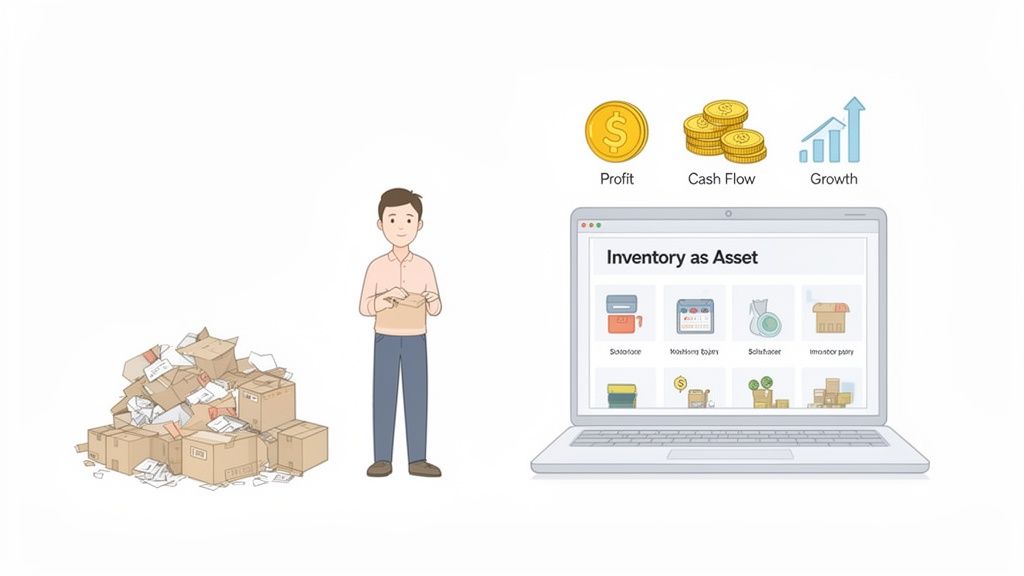
Choosing the right inventory software isn't just about solving a logistical headache; it's about turning your stock into a strategic asset that unlocks higher profits and frees up cash flow. The market is flooded with options, and it’s easy to make a costly mistake—either by paying for a complex system you don't need or by picking a basic tool you’ll outgrow in six months.
This guide gives you a clear framework for making a confident, informed decision. We’ll break down how the right software not only puts out today's fires but also paves the way for tomorrow's growth.
At its heart, all inventory software is trying to create a single source of truth for your stock. The difference is in how they do it and how deep they go. Many businesses take their first step away from spreadsheets by using barcode inventory management systems, which are a great starting point for understanding how to track stock efficiently.
No matter the system, there are a few key features you should always look for:
To cut through the noise, let's group the software out there into four main categories. Each one is built for a different type of merchant. Figuring out which group you belong to is the first step to finding the right fit.
| Software Tier | Core Functionality | Ideal User Profile | Key Limitation |
|---|---|---|---|
| Native Platform Tools | Basic stock counting inside a single ecommerce platform. | Startups running entirely on Shopify, BigCommerce, etc. | Can't handle multiple channels or locations. |
| Multi-Channel/POS Systems | Syncing inventory between online stores and retail locations. | Omnichannel retailers with both online and brick-and-mortar stores. | Usually weak on forecasting and deep analytics. |
| Dedicated ERP Systems | A central hub for the entire business—inventory, finance, and HR. | Large, complex businesses with multiple departments. | Expensive and takes a long time to set up. |
| AI Analytics Platforms | Predictive forecasting and demand planning to optimize stock. | Data-driven D2C brands focused on profitable growth. | Meant to enhance, not replace, your core inventory system. |
The key takeaway: The "best" inventory software for ecommerce isn't a one-size-fits-all product. It's the one that matches your current operational needs while giving you room to grow. This guide is here to help you navigate these tiers and find the right tool for you.
Choosing the best inventory software for your ecommerce brand has become less about ticking an operational box and more about crafting a sharp competitive edge. It goes way beyond just preventing stockouts. The right tool directly shapes your financial health and customer loyalty in ways a spreadsheet or manual tracking never could.
Frankly, it’s about turning your stock from a passive asset sitting on a shelf into an active driver of growth.
This all starts with cash flow. When your inventory is dialed in, capital isn’t just trapped in slow-moving products. That cash is freed up for things that actually grow the business—marketing, new product development, or expanding your team. In a D2C world where agility is everything, that kind of efficiency is a game-changer.
Good inventory control has a straight-line impact on your bottom line. By minimizing overstock, you’re actively slashing carrying costs—all those pesky expenses for storage, insurance, and the risk of products becoming obsolete. Those savings go directly to your profit margins.
At the same time, a well-managed inventory ensures your most popular products are always available, which is the bedrock of customer satisfaction. A single stockout can send a loyal customer straight to your biggest competitor. But consistent availability? That builds trust and massively increases customer lifetime value (LTV). It creates that reliable, "they always have it" shopping experience that fuels repeat business and glowing reviews.
Choosing the right software is no longer just about operational efficiency; it’s a strategic decision that directly impacts profitability, cash flow, and brand reputation in a crowded market.
The market data backs this up. The global e-commerce inventory management software market, currently valued at $14.88 billion, is expected to skyrocket to $36.67 billion by 2035. This explosive growth, highlighted by firms like MarketResearchFuture.com, shows just how seriously D2C brands and retailers now view these tools as essential for survival and scale.
In today's retail environment, where brands are juggling a Shopify store, an Amazon presence, and maybe even a physical pop-up, the need for smart inventory control is more urgent than ever. Trying to manage that complexity with a spreadsheet is a recipe for disaster. This is where modern software becomes a non-negotiable. For a closer look at the different options, check out our guide on different types of inventory systems.
Ultimately, you have to stop seeing inventory software as a cost center. It’s a strategic investment that delivers a clear, measurable return by tightening up your operations, strengthening customer relationships, and building a more resilient, scalable business. Getting these tools in place early is quickly becoming the key differentiator between brands that just get by and those that truly thrive.
To find the right inventory software, you first need to know where you stand. The market isn't just a random collection of tools; it’s more like a tiered system, with each level built for a specific stage of business growth. Picking the right software really comes down to accurately identifying which tier your business is in right now.
Think of this as a roadmap. We'll break down the four distinct categories of inventory solutions. For each one, we'll look at its core job, who it’s perfect for, and where it falls short. This will help you narrow down your search before you even start looking at specific features.
For anyone just getting started, the most straightforward and accessible tools are the ones already built into your ecommerce platform. We're talking about things like Shopify Inventory or BigCommerce's native product management. This is the ground floor of inventory control.
Their main function is simple: track stock levels for products you sell on one website. They’re designed to be dead simple, with no complex integrations or long setup times. If you're a solo founder launching your first store, this is exactly what you need. It stops you from overselling and gives you a basic count of what's on hand without adding another subscription to your monthly bills.
But that simplicity is also their biggest weakness. These tools are fundamentally built for a single channel and a single location. The moment you want to sell at a weekend market, list products on Amazon, or add a second warehouse, they simply can't keep up. They lack the horsepower for things like purchase orders, demand forecasting, or handling product bundles, which makes them a poor fit for any brand that's moved beyond the launch phase.
The next step up is for brands that have outgrown their single online store. This tier is all about syncing inventory between your digital and physical worlds. The solutions here usually combine Point of Sale (POS) functionality with multi-channel inventory management.
Picture a D2C brand opening its first brick-and-mortar shop. When a customer buys a t-shirt in person, the stock level needs to update on their Shopify site immediately to prevent an online customer from buying that same item. That’s the core problem Tier 2 systems solve. They act as a central hub, making sure stock counts are right everywhere—whether it's online, in-store, or on a marketplace.
These systems are perfect for omnichannel retailers managing just a handful of locations. They offer more robust features than the native tools, like creating basic purchase orders and transferring stock between locations.
The real game-changer with Tier 2 systems is their focus on channel synchronization. They are built from the ground up to ensure a sale on any channel is reflected everywhere else, giving you one unified view of your stock.
Despite being great at channel management, these solutions often lack depth in operational analytics. Their forecasting tools are typically basic, relying on simple historical data without really accounting for seasonality or market trends. As a business's supply chain gets more complex, the need for smarter planning becomes obvious.
When an ecommerce business really starts to scale, its needs go way beyond simple channel syncing. Managing multiple warehouses, juggling complex supplier relationships, and dealing with intricate product assemblies requires a much more powerful, centralized system. This is where dedicated Enterprise Resource Planning (ERP) or advanced inventory management platforms come in.
These systems are the central nervous system for the whole operation. They don’t just track inventory; they connect it to your financials, procurement, and even customer relationship management. For a brand with thousands of SKUs spread across three 3PLs and a B2B wholesale channel, an ERP provides the control and visibility you absolutely need.
The functionality in this tier is a major leap forward:
The main drawback? These platforms are complex and expensive. Implementation can be a months-long project that requires a significant investment, making them completely impractical for smaller businesses.
The final tier marks a strategic shift from just managing operations to proactively optimizing them. AI-powered analytics and forecasting platforms, like Tociny.ai, aren't meant to replace your core inventory system. Instead, they’re designed to make it smarter. They sit on top of your existing data, using machine learning to uncover insights that traditional systems can't see.
These tools are built for data-driven brands obsessed with maximizing profitability and cash flow. Instead of just telling you what you have in stock, they tell you what you should have. By analyzing historical sales, market trends, seasonality, and your promotional calendar, they generate incredibly accurate demand forecasts and replenishment recommendations.
This tier is for merchants who are asking the bigger, strategic questions: Which products should we cut? How much stock do we really need for Black Friday? Where is our cash getting tied up in slow-moving inventory? An AI platform gives you clear, actionable answers, helping you prevent stockouts and overstocking before they ever become a problem. For brands ready to use data as a competitive weapon, this is the future of inventory management.
Picking the right inventory software isn't about finding some magical "best" tool—it's about finding the right fit for your business right now. A feature that's a lifesaver for a growing omnichannel retailer can be a costly, over-engineered headache for a new D2C brand just finding its footing.
So, instead of just rattling off a generic feature list, let's look at how each type of software serves three very different merchant profiles. By understanding their unique growing pains, you can see which solution truly lines up with where you are and where you're headed.
This decision tree gives you a quick visual guide to see which path makes the most sense for your current setup.
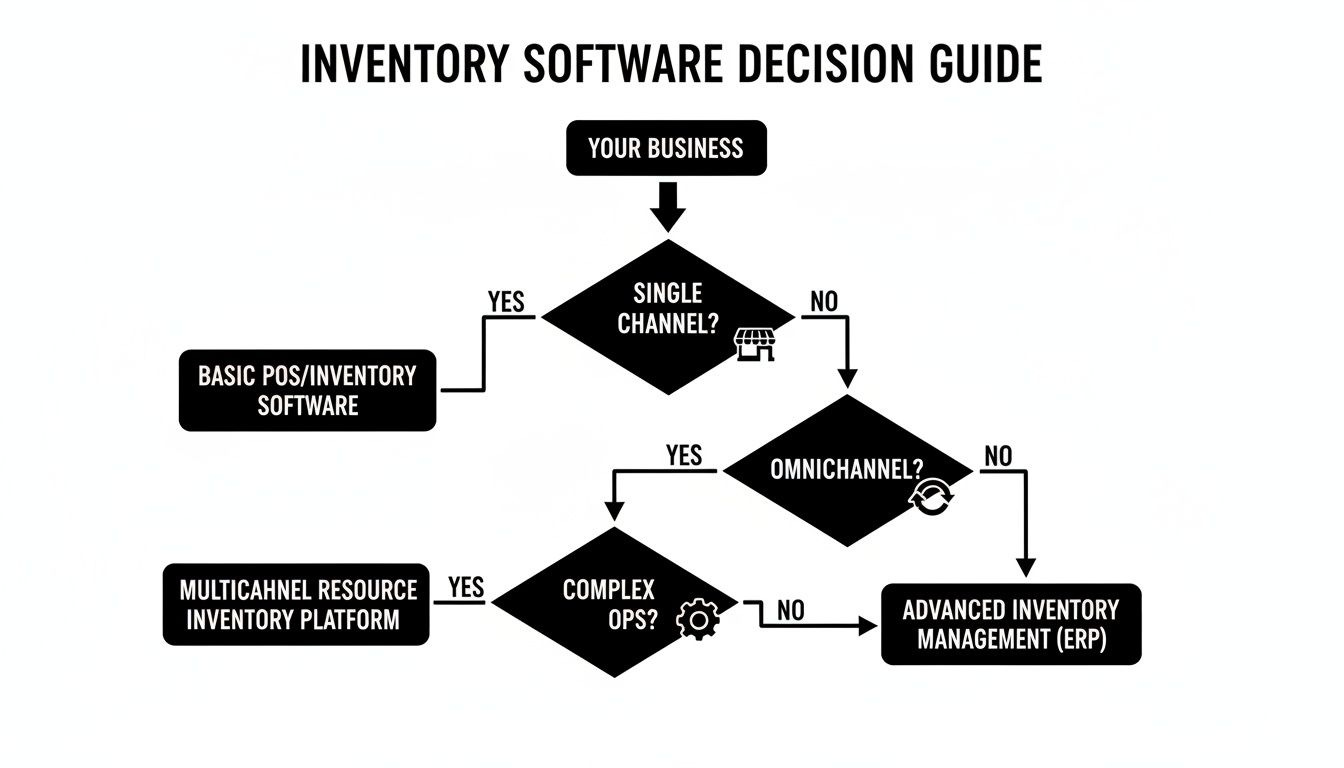
As you can see, the complexity of your sales channels—whether you’re running a single Shopify store or juggling a dozen different sales streams—is the biggest factor in pointing you toward the right tool.
This merchant is all about growth. They're likely running their entire operation through a single Shopify or BigCommerce store, and their needs are pretty straightforward. Their main goals? Avoid overselling, get orders out the door, and maybe manage a few simple product bundles without getting lost in complicated software.
For this kind of brand, Native Platform Tools are the obvious starting point. They're already built-in, they don't cost extra, and they do the one thing you absolutely need: basic stock counting. It's all about preventing that painful "sorry, we're sold out" email after a customer has already paid.
But the minute this brand adds a second sales channel—say, an Amazon storefront or a weekend pop-up shop—the native tools start to fall apart. They just can't sync inventory levels across different platforms, which leads to a constant risk of overselling and hours spent on manual reconciliation.
That’s when a simple Multi-Channel POS System becomes the next logical step. It solves the immediate problem of syncing inventory without the massive cost or learning curve of a full-blown ERP. It's the perfect bridge for an ambitious brand on the rise.
This business is more established. They've got a successful online store humming along, plus one or more brick-and-mortar locations. Their biggest challenge is creating a seamless experience for customers, which means they need a single, unified view of their inventory no matter where it's sold.
A customer needs to be able to buy online and pick up in-store without a hitch. An in-store purchase has to update the website's stock levels in real time. For this to work, Multi-Channel POS & Inventory Systems are non-negotiable. They are designed for this exact scenario, acting as the central nervous system that keeps online and offline operations in sync.
The problem is, these systems can start to buckle under more advanced operational weight. As the retailer adds more warehouses or needs to automate purchase orders to manage a growing list of suppliers, the limits of a POS-first solution become clear.
This is the point where a Dedicated ERP/Inventory Management Platform enters the conversation. An ERP gives you the deep operational control needed for multi-location fulfillment, complex stock transfers between stores, and precise COGS tracking—all things that are absolutely critical for scaling an omnichannel business. To dig deeper into finding the right tool for this stage, our overview of different inventory planner software offers some great context.
A Multi-Channel POS is fantastic at syncing sales channels. A Dedicated ERP excels at managing the complex operational backend that supports those channels as you scale. The right choice depends on where your biggest headaches are today.
This is the advanced operator. They're not just managing inventory; they're obsessed with optimizing it. They know inventory is a huge capital investment, and every purchasing decision directly hits the bottom line and impacts cash flow. Their challenges are more predictive than operational.
They need to accurately forecast demand for new product launches, spot slow-moving stock before it becomes dead weight, and fine-tune their product mix to get the best possible return on investment. This is where traditional inventory systems hit a wall. They're great at tracking what has happened, but they can't tell you what's going to happen.
This is exactly where AI-Powered Analytics & Forecasting Platforms like Tociny.ai provide a massive competitive edge. These tools sit on top of your existing ERP or multi-channel system, using machine learning to analyze sales data, seasonality, and market trends. The result? Incredibly accurate demand forecasts and smart replenishment recommendations.
An ERP gives you rock-solid operational control, but it doesn't have the predictive intelligence to stop you from making costly buying mistakes. An AI platform closes that gap. It turns inventory planning from a manual, gut-feel process into a data-driven strategy, giving you the clear insights you need to put your money into the right products at the right time.
To really nail down the differences, this table shows how each software category tackles key inventory functions, tailored to the merchants who use them.
| Key Function | Native Platform Tools (e.g., Shopify) | Multi-Channel POS Systems | Dedicated ERP/Inventory Platforms | AI Analytics & Forecasting (e.g., Tociny.ai) |
|---|---|---|---|---|
| Ideal User Profile | Emerging D2C Brand | Omnichannel Retailer | Large, Complex Operator | Data-Driven Merchandiser |
| Multi-Location Support | None. Limited to a single ecommerce storefront. | Good. Designed to sync online stores with a few physical locations. | Excellent. Built to manage complex multi-warehouse and 3PL networks. | N/A. Enhances an existing system's multi-location data with predictive insights. |
| Purchase Order Automation | Minimal. Manual creation is standard. | Basic. Can generate POs based on simple reorder points. | Advanced. Automates POs based on lead times, sales velocity, and supplier rules. | Prescriptive. Recommends precise PO quantities and timing based on demand forecasts. |
| Forecasting Accuracy | None. Relies entirely on manual analysis. | Low. Uses simple historical sales averages. | Moderate. Employs more advanced algorithms but is often not its core strength. | High. Leverages AI to analyze complex variables for superior accuracy. |
| Product Bundles/Kitting | Limited. Basic functionality, if any. | Moderate. Can typically manage simple bundles and kits. | Strong. Handles complex bills of materials for manufacturing and assembly. | N/A. Focuses on forecasting demand for the final sellable product. |
| Core Value Proposition | Simplicity and no extra cost for new stores. | Unified stock visibility across online and offline channels. | Centralized operational control over the entire supply chain. | Proactive inventory optimization to maximize profit and cash flow. |
Ultimately, the best choice comes down to being honest about your current operational needs and your strategic goals. Use these profiles as a map to figure out where you are today—and which software will help you get where you want to go tomorrow.
The whole game in ecommerce inventory management is shifting. For years, it's been about tracking what you have. Now, it's about predicting what you'll need.
Traditional systems are great at giving you a snapshot of today, but they fall flat when you ask forward-looking questions—the kind of questions that actually drive profit. This is where artificial intelligence comes in, turning inventory planning from a reactive chore into a serious strategic advantage.
AI-powered platforms don't just count your stock; they learn from your data. They dig into historical sales, seasonality, promo calendars, and even external market trends to generate scarily accurate demand forecasts. This helps brands finally kill the expensive guesswork that leads to stockouts on best-sellers or, just as bad, warehouses bloated with slow-moving products.

This evolution is plain to see in the market growth. Retail inventory management software is blowing up, expanding from $9.37 billion to $10.54 billion and rocketing toward a projected $16.78 billion. The complementary e-commerce analytics software market is growing even faster, with a projected size of $23.681 billion by 2030. That's a massive signal of how much value brands are placing on getting actionable insights. You can read the full research on retail software growth to see the numbers for yourself.
One of the biggest practical changes AI brings is the escape from spreadsheet hell. Forget wrestling with complex, multi-tabbed reports. Platforms like Tociny.ai boil down mountains of data into intuitive, actionable dashboards. Instead of manually crunching numbers to find a trend, your merchandising team gets a clear, visual overview of inventory health at a glance.
This streamlined view lets your team make faster, more confident decisions. The system automatically flags the stuff that matters—both problems and opportunities.
Think of AI as a strategic partner for your merchandising team. It does the heavy lifting on data analysis, freeing up your people to focus on creative strategy, supplier relationships, and actually growing the brand.
Here's the bottom line: implementing an AI-driven forecasting platform delivers a clear, measurable return. The best inventory software for ecommerce isn't about making your operations look neat; it’s about direct financial impact. When you connect predictive features to bottom-line results, the improvements are impossible to ignore.
For example, preventing stockouts on your top sellers during peak season means you capture sales you would have flat-out lost. On the flip side, by not overstocking on seasonal goods, you avoid the margin-crushing discounts you're forced to offer at the end of the season. Both lead directly to healthier cash flow and higher profits.
The real benefit is moving your inventory strategy from defense to offense. You’re no longer just reacting to sales data as it trickles in. You're making proactive purchasing decisions based on what the data says will happen next. You can learn more about how the tech works in our complete guide to demand forecasting software. For any brand looking to scale, this predictive power is the key to unlocking sustainable, profitable growth.
Knowing what to look for is one thing; actually choosing and switching to a new system is another. Let's be honest, it can feel overwhelming. To make it manageable, I break the process down into three distinct phases. This isn't just theory—it's a practical framework to get you from evaluation to seeing a real return on your investment without pulling your hair out.
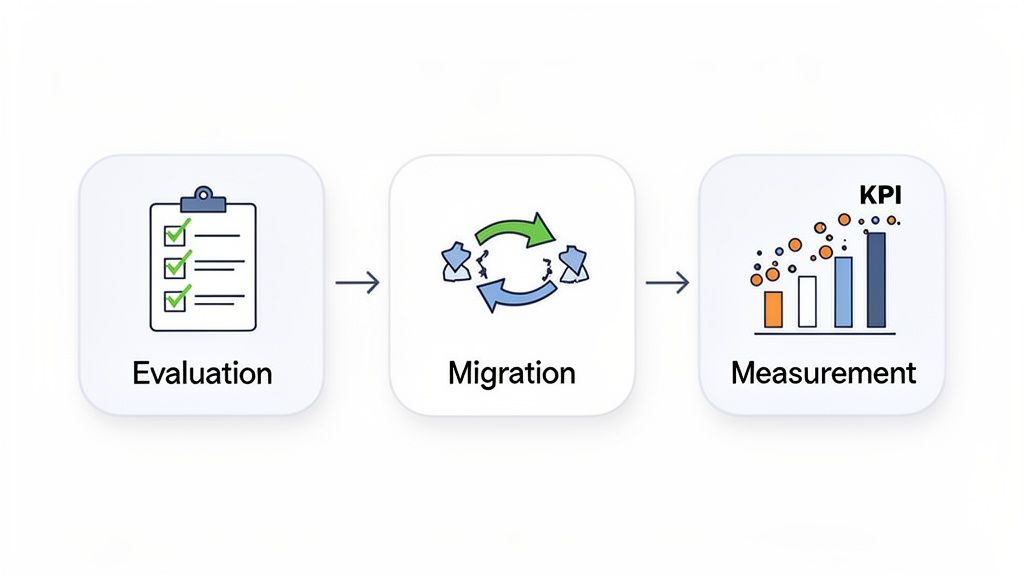
This step-by-step approach keeps you focused and moving forward, turning a massive project into a series of achievable goals.
The demo is your proving ground. Don't let vendors run their standard, polished pitch. You need to come prepared to grill them with a checklist of questions based on your specific, real-world operational headaches. Make them show you, not just tell you.
Here's what your checklist should force them to prove: * Real Integration Depth: Ask to see a live integration with your ecommerce platform. How does it actually handle product bundles, variants, and those messy mid-stream order edits? * Onboarding and Human Support: What does the setup process truly involve? Will you get a dedicated person to guide you, or are you just getting a link to a knowledge base? Pin them down on support team response times. * Scaling Costs: How does the pricing change when you add more SKUs, users, or another sales channel? You need to sniff out any hidden fees or surprise price hikes before you sign.
A smooth migration is all about the prep work. Seriously, don't even think about flipping the switch until you've cleaned up your data. A shiny new system running on garbage data just creates bigger, faster problems.
Start with a full-blown audit of your product catalog and historical sales data. Clean it up. Standardize it. This is also the perfect time for a parallel run. For a week or two, operate both your old and new systems at the same time. This lets you confirm the new software is tracking inventory, processing orders, and generating reports correctly—without risking your live operations. It's your safety net.
The single biggest migration mistake is rushing the data cleanup. A few days spent standardizing SKUs and verifying counts will save you months of headaches and costly errors after you go live.
Once you're live, the job isn't done. You need to prove this was all worth it. The goal is to track a few key performance indicators (KPIs) that directly tie back to inventory efficiency and, ultimately, your bottom line.
Establish a baseline for these metrics before you migrate, then track them every month.
By following these three phases, you’re creating a data-driven process that ensures your investment in the best inventory software for your ecommerce brand actually pays for itself.
Navigating the world of ecommerce inventory software always kicks up a few common questions. Let's tackle some of the ones we hear most often from merchants trying to make the right call.
You’ll know it’s time to upgrade from Shopify’s built-in inventory tools when complexity starts to crush simplicity. We see a few key triggers all the time.
Are you managing more than 100-150 SKUs? Processing over 500 orders a month? Or maybe you've just expanded to a second sales channel, like a pop-up shop or an Amazon storefront. These are the classic signs.
Once you’re trying to juggle stock across multiple locations or need real forecasting to stay ahead of demand, the native tools stop being a help and start becoming a serious operational bottleneck.
The difference really comes down to scope. A dedicated inventory management system is laser-focused on your products—it tracks stock levels, helps manage purchase orders, and keeps your channels in sync. Its entire purpose is to help you sell your products more efficiently.
An Enterprise Resource Planning (ERP) system, on the other hand, is a whole different beast. It’s built to be the central nervous system for your entire business, pulling inventory, finance, HR, and even customer management under one massive roof. ERPs are incredibly powerful, but they’re also far more complex, expensive, and take a whole lot longer to get up and running.
Think of it this way: an inventory system solves product-level problems. An ERP is designed to solve company-wide operational ones. Which one you need depends entirely on the scale of the problem you're actually trying to fix.
You can absolutely measure the ROI of the best inventory software for ecommerce by focusing on a few tangible metrics. The key is to get a clear picture of your performance before you make the switch.
Once your new system is live, start tracking improvements in these areas: * Reduced Carrying Costs: Calculate exactly how much less you’re spending to store inventory that isn't selling. * Higher Inventory Turnover: Measure how much faster your stock is flying off the shelves. * Fewer Lost Sales: Put a number on the reduction in stockouts for your best-selling products.
This kind of hard data doesn't just feel good—it gives you a rock-solid financial justification for your investment.
Ready to stop guessing and start planning with precision? Tociny.ai uses AI-driven insights to give you a clear view of your inventory, helping you make smarter, more profitable decisions. Join the private beta to see how it works.
Tociny is in private beta — we’re onboarding a few select stores right now.
Book a short call to get early access and exclusive insights.